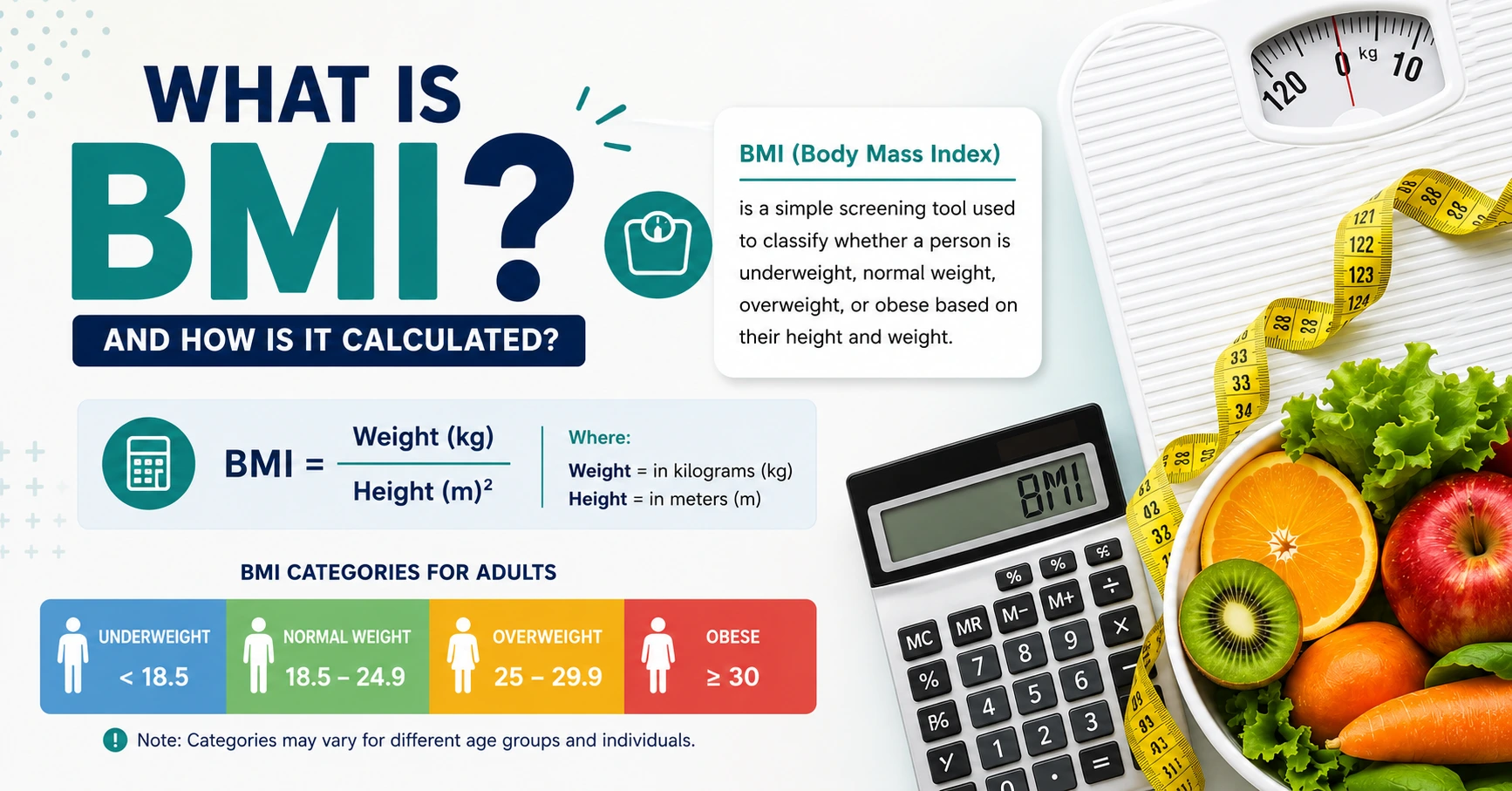
What is BMI and How is it Calculated?
You are sitting in a doctor’s clinic for a routine checkup. The nurse calls your name, you step onto the cold metal scale, and they measure your height. A few minutes later, you are handed a printed summary of your visit. Right there at the top, next to your blood pressure, is a mysterious little number labeled “BMI” followed by a bold categorization like underweight, normal, overweight, or obese.
If you have ever felt a sudden drop in your stomach seeing the word “overweight” printed next to your name, especially when you feel perfectly healthy and active, you are definitely not alone.
BMI is a term that gets thrown around constantly in doctor clinics, fitness apps, and health blogs. Yet, for most people, it remains a slightly confusing metric that a computer calculates for them. What actually is it? Where did it come from? Is it actually a reliable way to judge your health? And more practically, how do you calculate it yourself without relying on a digital app every single time?
Let us strip away the heavy medical jargon. We will look at what BMI actually is, why it is deeply flawed, why the medical world refuses to let it go, and how you can figure out your own number in less than sixty seconds.
What Does BMI Actually Mean?
BMI stands for Body Mass Index. When you strip away all the clinical intimidation, it is nothing more than a highly simplified mathematical formula. It compares your total body weight to your height.
The core idea behind it makes logical sense on the surface. A person who is six feet tall is naturally going to weigh more than a person who is five feet tall, even if both of them are perfectly healthy. You cannot simply look at a raw number on a scale to determine health. A weight of 180 pounds means something entirely different on a towering basketball player than it does on a petite gymnast.
BMI attempts to solve this problem by putting your weight into context. It takes your weight, factors in your height, and spits out a single two-digit number. That number is then supposed to give you a rough idea of whether your overall mass falls into a statistically healthy range for someone of your exact stature.
Here is the most important thing you need to know, which doctors often forget to mention. BMI does not measure your body fat.
It does not know how much muscle you have. It does not know how dense your bones are. It cannot tell if your weight is carrying around your waistline or distributed evenly across your frame. It is purely a mathematical shortcut. Think of BMI like the check engine light on your car dashboard. It is a screening tool designed to flag potential concerns so that you can have a real conversation with a professional. It is absolutely not a final medical diagnosis.
If you want to understand this crucial difference in depth, check out our guide on Body Fat Percentage vs BMI.
The Surprisingly Weird History of BMI
If you assume that BMI was created by a team of elite medical doctors and modern health scientists, you are in for a surprise.
BMI was invented in the 1830s by a Belgian astronomer, sociologist, and mathematician named Adolphe Quetelet. Quetelet had absolutely no interest in individual human health or medicine. He was obsessed with finding the mathematical formula for the average man. He wanted to understand the statistical distribution of physical characteristics across entire populations to help governments allocate resources.
Quetelet explicitly warned that his formula should never be used to judge the health or fatness of a single individual. It was strictly meant for studying thousands of people at once.
It was not until over a century later, in 1972, that a physiologist named Ancel Keys revived the formula. He was conducting a massive study and needed a fast and cheap way to estimate body fat across huge populations. He renamed it the Body Mass Index. Like Quetelet, Keys also warned that it was only appropriate for population studies and wildly inaccurate for individual diagnoses.
Despite those warnings, insurance companies and healthcare systems loved it. It was incredibly cheap, required zero medical equipment beyond a standard scale and a tape measure, and took ten seconds to calculate. By the 1990s, BMI became the undisputed global standard for defining obesity.
The BMI Formula: How to Do the Math Yourself
So how does this nearly two-hundred-year-old math equation actually work? There are two common versions of the formula. Your choice depends on whether you use the metric system like kilograms and meters or the imperial system like pounds and inches.
Here are the formulas:
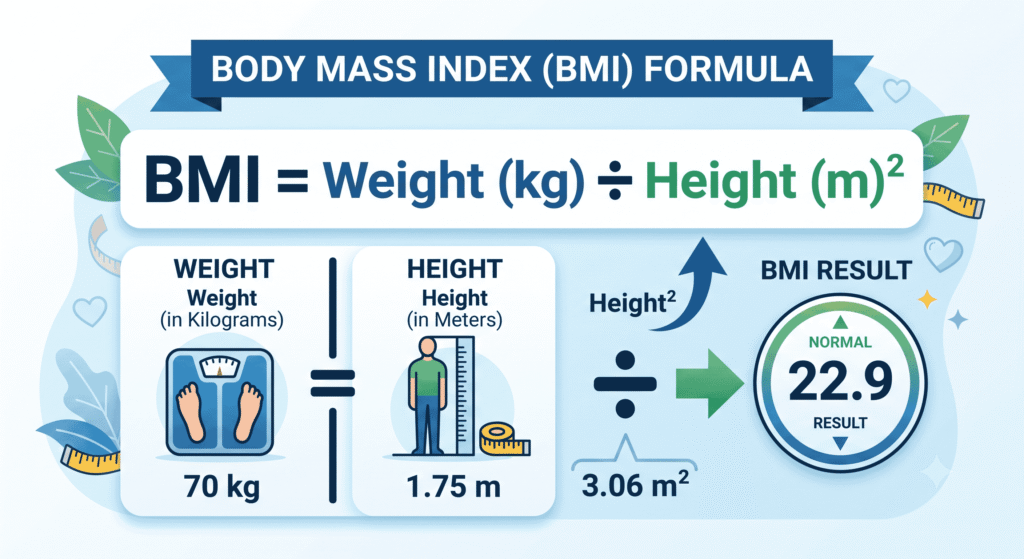
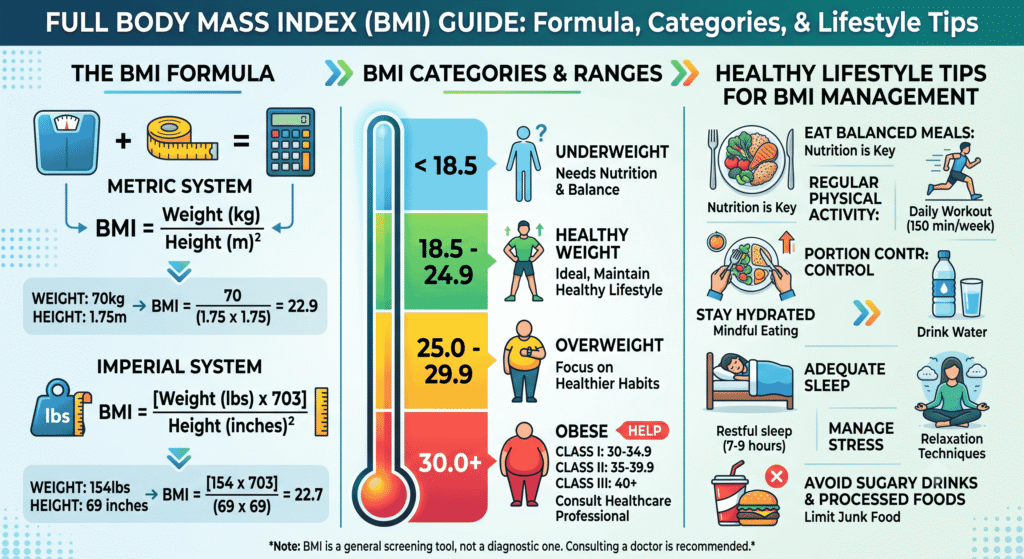
The Metric Formula: BMI = Weight in kilograms divided by your Height in meters squared.
The Imperial Formula: BMI = Weight in pounds divided by your Height in inches squared, and then multiplied by 703.
That is the whole thing. There are no complicated variables for your age, your gender, or your body frame size. It is just your weight divided by your height squared. The multiplier of 703 is tacked onto the end of the imperial formula simply so the math lines up perfectly with the metric system.
Let Us Look at a Metric Example
Let us say we have a woman who weighs 70 kilograms and is exactly 1.75 meters tall. First, we square her height. We multiply 1.75 by 1.75, which gives us 3.0625. Next, we divide her weight by that number. We divide 70 by 3.0625, which gives us 22.86. Her final BMI is approximately 22.9.
Let Us Look at an Imperial Example
Now let us calculate the BMI for a man who weighs 154 pounds and is 5 feet 8 inches tall. Since 5 feet 8 inches equals 68 inches, we will use that number. First, we square his height in inches. We multiply 68 by 68, giving us 4,624. We divide his weight by that number. We divide 154 by 4,624, which gives us 0.0333. Finally, we multiply by the magic 703 factor. Multiplying 0.0333 by 703 gives us 23.4. His final BMI is roughly 23.4.
If you do not want to do the manual math every time your weight fluctuates, you can always use our free BMI Calculator at InnovaiTools to get your exact number instantly.
How to Read Your Final BMI Number
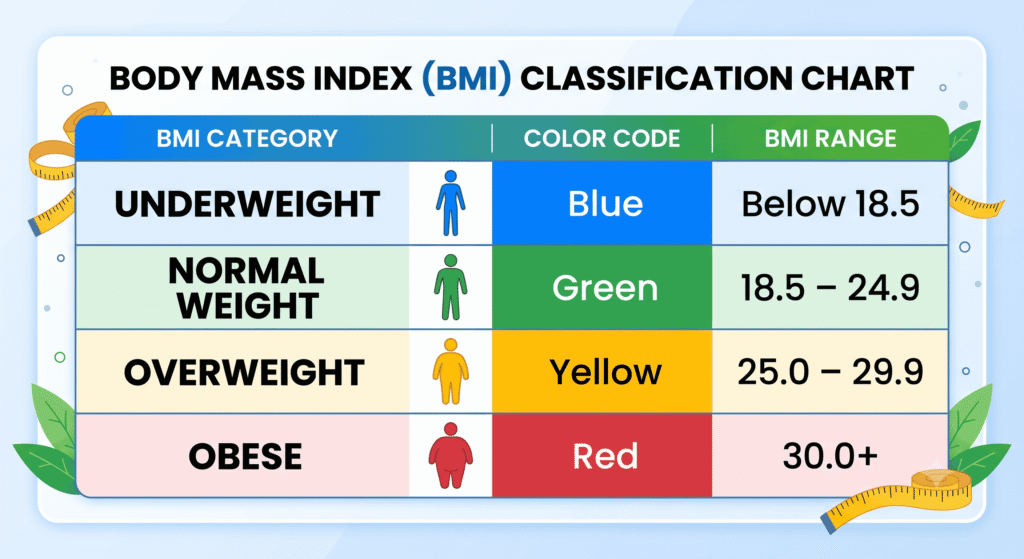
Once you have done the math, you are left with a two-digit number. For most adults, this number sits somewhere between 15 and 40. Health organizations, including the World Health Organization, sort these numbers into strict categories:
- Below 18.5: Underweight
- 18.5 to 24.9: Normal or Healthy Weight
- 25.0 to 29.9: Overweight
- 30.0 and above: Obese
These ranges look incredibly official, but remember their origins. They were built from population-level statistics. They describe broad trends across millions of people, not the undeniable health status of the person staring back at you in the mirror.
The Massive Flaws: Why BMI Isn’t the Full Picture
Here is where things get genuinely interesting, and where the heavy criticism of BMI comes from. Because the formula is so utterly simple, it has several massive blind spots.
1. It Cannot Tell Muscle From Fat
Muscle tissue is significantly denser and heavier than fat tissue. If you take a professional rugby player or a dedicated weightlifter and check their BMI, the formula will almost certainly label them as overweight or obese. Their scale weight is very high, but that weight is pure healthy muscle, not excess fat. Because BMI is blind to body composition, it accidentally penalizes highly fit and athletic people.
2. The Skinny Fat Dilemma
The opposite problem is arguably more dangerous. A person can have a perfectly normal BMI of 22 while carrying a dangerously high percentage of body fat and almost zero muscle mass. In the medical world, this is known as Normal Weight Obesity. People colloquially call it being skinny fat. Their BMI looks perfectly healthy on a doctor clipboard, but their actual internal body composition carries all the metabolic risks of obesity. BMI completely misses this hidden danger.
3. Location Matters: Visceral vs Subcutaneous Fat
Two people can have the exact same BMI, but they might store their fat completely differently. One might carry their weight in their hips and thighs, which is called subcutaneous fat. The other might carry a hard round belly full of fat packed around their internal organs, which is called visceral fat. Decades of medical research have proven that visceral belly fat carries a drastically higher risk of heart disease and diabetes. BMI cannot tell the difference between the two because it just sees total mass.
4. It Ignores Age and Biology
Women naturally carry a higher percentage of essential body fat than men due to reproductive biology, yet they share the exact same BMI chart. Furthermore, as humans age, we naturally lose muscle mass and replace it with fat. An 80-year-old and a 20-year-old might share an identical BMI of 24, but the actual composition and health of their bodies will be wildly different.
5. It Has a Massive Ethnic Blind Spot
The original BMI formula was based entirely on 19th-century white European men. Modern research shows that people of different ethnic backgrounds carry and distribute fat differently. Extensive data shows that people of South Asian descent tend to develop metabolic issues and diabetes at much lower body weights than people of European descent. A BMI of 24 might be perfectly safe for a Caucasian man but could represent a significant health risk for an Indian or Pakistani man. Using one rigid numerical scale for the entire global population is scientifically flawed.
If It Is So Flawed, Why Do Doctors Refuse to Drop It?
If you lay out all of these flaws, it seems completely absurd that BMI is still the global standard for health screening. So why hasn’t the medical community replaced it?
The honest answer is pure economics and practicality. Measuring true body fat percentage requires time, money, and advanced technology. You need clinical DEXA scans, underwater weighing tanks, or bioelectrical impedance devices. These are not tools you can easily keep in a standard examination room.
BMI costs absolutely nothing. Every single clinic in the world has a scale and a height ruler. The calculation takes ten seconds and gives the doctor a fast, standardized number to put into your digital health record. For researchers studying the health of an entire country over fifty years, BMI is a beautifully simple tool that correlates reasonably well with overall public health outcomes.
It is a fantastic tool for tracking the health of a million people. It is simply a terrible tool for judging the health of one person.
What Should You Actually Do With Your BMI Number?
If you calculate your BMI today and find that you fall into the overweight category, take a deep breath. Panic is not the correct response. Context is the correct response.
A single isolated number from an old math formula does not dictate your destiny. Instead of hyper-focusing on your BMI, you should look at it alongside a holistic set of real health markers. Grab a tape measure and check your waistline. This gives you a far better indication of dangerous visceral organ fat than BMI ever could. Look at your blood work. Your cholesterol and fasting blood sugar levels are direct and undeniable indicators of your metabolic health.
You also need to evaluate your lifestyle. A slightly overweight person who runs three miles a day and eats whole foods is generally much healthier than a normal weight person who sits on a couch twelve hours a day eating junk food. If your BMI is high and you are feeling sluggish, treat it as a conversation starter with a registered dietitian who can look at your entire life picture.

A Quick Word on BMI for Children and Teens
It is also worth noting that BMI rules change completely when you are dealing with kids and teenagers. Children are constantly growing, and the relationship between their height, weight, and body fat fluctuates wildly during puberty. Applying the rigid adult BMI scale to a 12-year-old would be medically irresponsible.
Pediatricians calculate a child’s BMI using the exact same math, but then they compare that number against age and gender specific growth charts. Because tracking exact age is so critical for these charts, parents often use an Age Calculator to get their child’s exact chronological age down to the month.
This produces a BMI percentile. It shows how that specific child compares to thousands of other children of the exact same age and sex. A child in the 60th percentile has a higher BMI than 60 percent of their peers. It is a shifting scale that respects the reality of human growth.
Frequently Asked Questions About BMI
What is the best way to lower my BMI? The only way to lower your BMI is to reduce your overall body weight, as you cannot change your height. Focusing on a balanced diet rich in whole foods, maintaining a caloric deficit, and engaging in regular physical activity are the most sustainable ways to achieve this.
Can I have a high BMI and still be completely healthy? Yes, absolutely. Bodybuilders, professional athletes, and people who lift weights regularly often have a high BMI because muscle is very dense and heavy. Their high weight comes from healthy muscle tissue, not excess fat.
Is BMI the same for men and women? The mathematical formula and the standard categories are exactly the same for both men and women. However, women biologically carry more essential body fat than men. This means a man and a woman with the exact same BMI will usually have very different actual body compositions.
Why does my BMI change slightly depending on the calculator I use? Most online calculators are highly accurate, but minor differences usually come down to rounding. Some calculators round your height and weight before doing the math, while others calculate the exact decimals before rounding the final result.
At what BMI should I be concerned about my health? Medical professionals generally start looking for related health risks when your BMI crosses into the obese category, which is 30.0 and above. However, if you have a family history of heart disease or diabetes, a doctor might want to monitor your health even if your BMI is in the overweight category between 25.0 and 29.9.
The Bottom Line
Ultimately, BMI is exactly what it was always intended to be. It is a simple and lightning fast mathematical shortcut to estimate if a person’s mass falls into a range that is statistically associated with good health.
It is not a crystal ball. It is not a precise measurement of your body composition. It should never be the final judge of your self-worth or your overall health profile.
Calculating it takes less than a minute. If you want a fast baseline, skip the manual math and use our completely free BMI Calculator at InnovaiTools. But remember that the real value comes from what you do next. Look past the number. Use it as just one tiny piece of a much larger puzzle that includes your energy levels, your daily habits, your strength, and your mental well-being.

Arid is a web developer and computer expert who specializes in building practical utility web applications. With a strong focus on technical problem-solving and user experience, he develops efficient online calculators and writing tools designed to help students, bloggers, and professionals streamline their daily tasks.