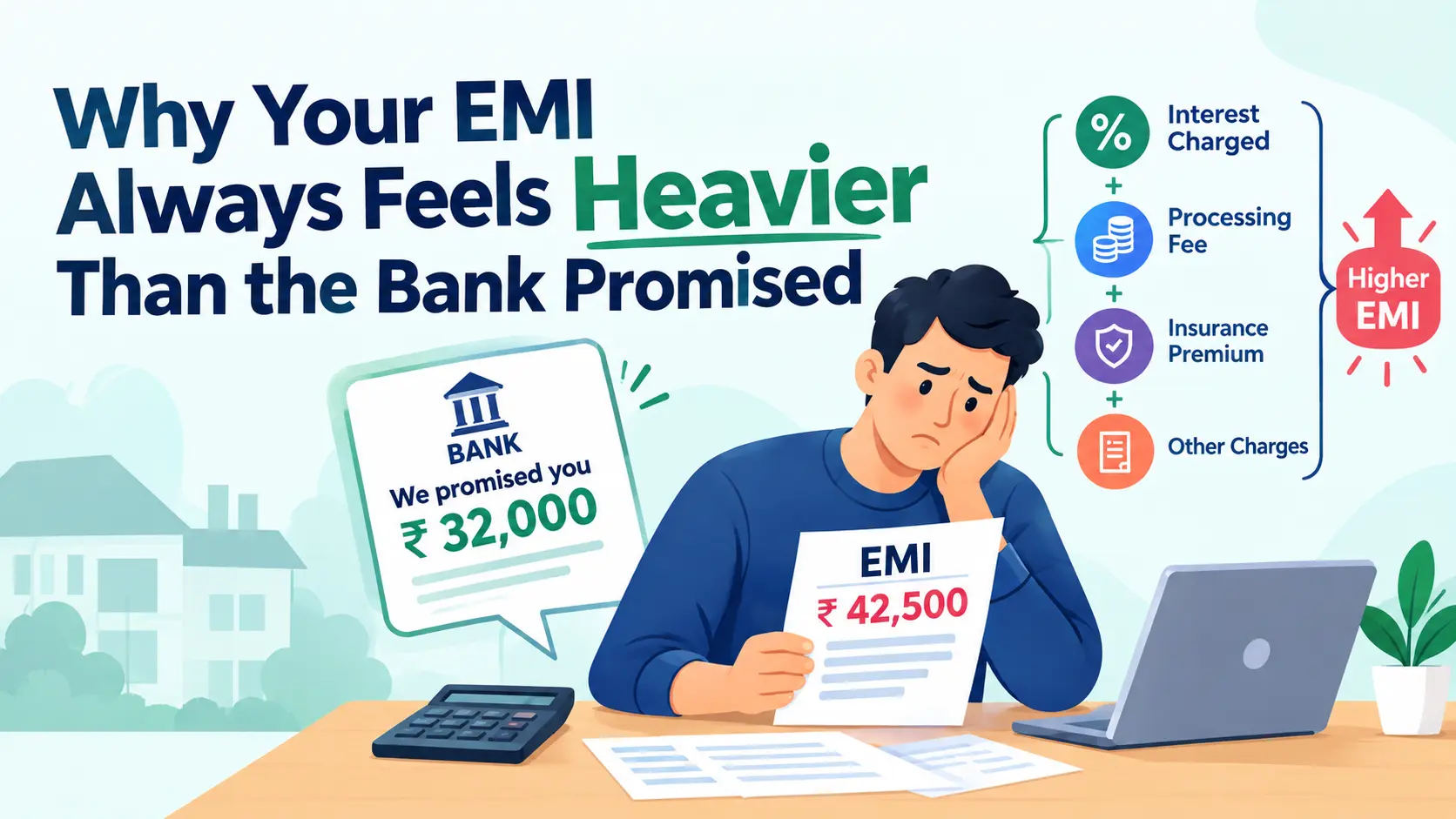
Why Your EMI Always Feels Heavier Than the Bank Promised
You are six months into a brand-new loan. You’ve been responsible. You set up the auto-debit, you haven’t missed a single payment, and you’ve mentally patted yourself on the back for being a functioning financial adult. One afternoon, out of sheer curiosity, you log into your banking app to see how much of that debt you’ve conquered.
You pull up the loan statement, expecting to see a satisfying, straight downward slope. You figure that if you took out a five-year loan and have paid for a tenth of that time, you should owe roughly a tenth less.
Instead, you stare at the screen. The principal balance has barely budged.
You’ve paid thousands of dollars (or rupees, or euros), yet the outstanding amount looks terrifyingly identical to the day you borrowed it. It feels like a glitch. It feels like you are pouring water into a bucket with a hole in it. Most of all, it feels like the bank has pulled a fast one on you.
Nothing is technically wrong. You have just collided with the reality of loan mathematics a system that banks disclose entirely in the fine print but rarely explain in plain, spoken language during the glossy sales pitch.
This isn’t about banks operating illegally. The numbers are all there on the paperwork you signed. But there is a massive canyon between “technically disclosed in a forty-page contract” and “actually understood by the human being borrowing the money.” That specific gap in understanding costs regular people vast amounts of wealth every single year. Let’s close that gap, tear apart the math, and look at exactly why your EMI feels so much higher than you expected.
The Illusion of the Fixed Payment: Your EMI Stays the Same, But the Inside Shifts
Here is the mechanism that trips up almost every first-time borrower: your Equated Monthly Installment (EMI) stays completely rigid for the entire life of the loan. You pay the exact same amount in month one as you do in month sixty. But the ingredients inside that fixed number change drastically every thirty days.
In the early stages of your loan, a massive chunk of your monthly payment is purely interest. In the final months of your loan, almost the entire payment goes toward wiping out the principal balance.
This is known as the reducing balance method. It is the standard operating procedure for the overwhelming majority of global debt, including mortgages, auto loans, student loans, and personal loans.
To understand why it feels so punishing early on, you have to look at how interest is generated. Interest for any given month is calculated exclusively on whatever principal is still outstanding at the dawn of that specific month.
Monthly Interest = Outstanding Principal × (Annual Interest Rate ÷ 12)
At the very beginning of your loan journey, your outstanding principal is at its absolute maximum. It is the full, unvarnished loan amount. Because the principal is at its peak, the interest generated on that principal is also at its peak.
Therefore, when you hand over your fixed EMI to the bank in month one, the bank takes its massive interest cut first. Whatever tiny sliver of money is left over is then applied to your actual debt.
As you grind through the months, the outstanding principal slowly, agonizingly shrinks. Because the principal is slightly smaller next month, the interest charged is slightly smaller too. This means a fractionally larger share of your fixed EMI is finally freed up to attack the principal. It is a slow-motion seesaw. It is steepest exactly when you are most anxious about your debt right at the start, when the balance looks impossibly large.
Putting Real Numbers on the Frustration
Let’s step out of the theory and look at cold, hard numbers. Assume you take out a loan of 1,000,000 (pick your currency; the mathematical mechanics remain identical) at a 12% annual interest rate over a 5-year (60-month) timeline.
The standard EMI formula the banking system uses looks like this:
EMI = [P × r × (1+r)^n] ÷ [(1+r)^n − 1]
- P is your principal (1,000,000).
- r is your monthly interest rate (12% annual ÷ 12 months = 1%, or 0.01).
- n is the number of total months (60).
When you plug those numbers into the machine, the EMI spits out at approximately 22,244.
You will pay 22,244 every month for 60 months. That equals a total lifetime repayment of roughly 1,334,640. This means you are paying 334,640 purely in interest for the privilege of borrowing that initial million.
Already, that total interest figure is a number most people actively avoid calculating before they sign the paperwork. But the total cost isn’t what causes the mid-loan panic. The panic comes from looking under the hood of that 22,244 payment at different checkpoints in your life.
| Checkpoint | Interest Portion | Principal Portion | Remaining Balance |
| Month 1 | 10,000 | 12,244 | 987,756 |
| Month 12 | 8,884 | 13,360 | 878,443 |
| Month 24 | 7,506 | 14,738 | 738,882 |
| Month 36 | 5,935 | 16,309 | 579,871 |
| Month 48 | 4,145 | 18,099 | 397,946 |
| Month 60 | 220 | 22,024 | 0 |
Look closely at the leap between Month 1 and Month 60.
In Month 1, almost 45% of your hard-earned payment is evaporating into pure interest. That 10,000 does not reduce your actual debt by a single cent. It just pays the bank for renting their money for thirty days. By Month 60, the interest has plummeted to a mere 1% of the payment, and almost the entire 22,244 is an aggressive strike against the remaining balance.
Here is the exact statistic that breaks people’s intuition: By the halfway mark of your loan (Month 30), you still owe roughly 66% of the original loan.
You have diligently made half of your payments. You have crossed the halfway point of your timeline. And yet, you are still carrying two-thirds of your debt. This is not a clerical error. The bank hasn’t stolen from you. The reducing balance method is doing exactly what the math dictates. It just violates human intuition, which naturally assumes that debt should shrink like a melting block of ice—evenly, steadily, and predictably.
The Flat Rate Trap: Where the Real Danger Lies
If the reducing balance method is frustrating, the flat rate is where actual financial damage occurs. This is the marketing trick that actively weaponizes your desire for a lower interest rate against you.
You will often see flat rates advertised for car loans, personal loans, furniture financing, and “easy installment” retail schemes. A lender will boldly advertise a “7% flat rate” right across the street from a traditional bank offering a “13% reducing rate.”
To a normal human brain, 7% is vastly superior to 13%. You sign the 7% contract, feeling like a savvy negotiator. You just fell into the trap.
A flat rate calculates your total interest based on the original principal for the entire tenure of the loan. It entirely ignores the fact that you are paying the balance down every month.
If you borrow 1,000,000 at a 7% flat rate for 5 years:
Total Interest = 1,000,000 × 0.07 × 5 = 350,000.
That looks suspiciously close to the 334,640 we calculated earlier for the 12% reducing loan. But watch how the trap snaps shut when this is converted into your monthly EMI. A flat-rate loan takes your total payable amount (principal + interest) and simply divides it equally by the number of months.
Total Payable = 1,350,000.
Flat EMI = 1,350,000 ÷ 60 = 22,500.
Your EMI on this “cheap” 7% flat rate is actually higher (22,500) than the EMI on the “expensive” 12% reducing rate (22,244).
A 7% flat rate is never actually 7%. Because you are paying interest on the full million even in month 59—when you effectively owe the bank almost nothing a 7% flat rate is mathematically equivalent to a 12% to 13% standard reducing rate.
Financial analysts use a simple rule of thumb: multiply a flat rate by 1.8 or 1.9 to find its true cost. The next time a salesperson offers you a “6% flat rate” on a car, you need to automatically translate that in your head to an 11.5% actual burden. It isn’t explicitly a scam; it is legally documented. But it is fundamentally designed to be misread by consumers who don’t have a background in financial mathematics.
The Invisible Line Items: Why the Headline EMI is a Lie
The interest rate structure is only the foundation of the confusion. Your EMI feels heavier because the headline number you are quoted at the sales desk almost never reflects the true friction of borrowing the money. Lenders layer in hidden costs that subtly inflate your actual borrowing rate without ever changing the advertised EMI.
1. The Silent Drain of Processing Fees
Almost all lenders charge an upfront processing fee, usually between 1% and 3% of the total loan amount. If you borrow 1,000,000 with a 2% processing fee, the bank hands you 980,000.
However, your EMI is calculated on the full 1,000,000. You are paying interest on money you never actually got to use. Your effective interest rate just spiked, but your EMI number looks identical to what was promised.
2. Mandatory (and Financed) Loan Insurance
Many lenders quietly bundle a credit life insurance or asset insurance policy into your loan agreement. They will often finance this premium directly into the loan itself. If the insurance costs 20,000, your loan principal is suddenly 1,020,000. You aren’t just paying for the insurance; you are paying compounded interest on the insurance premium for the next five to thirty years.
3. Floating Rate Resets (The Silent Creep)
If you sign up for a variable or floating rate loan (common in mortgages), your interest rate is tied to a central economic benchmark. When central banks raise rates to fight inflation, your rate goes up.
When this happens, banks usually don’t increase your monthly EMI, because that causes customer service nightmares. Instead, they quietly extend the tenure of your loan. You keep paying your expected 22,244 a month, but instead of finishing in 60 months, you are now on the hook for 68 months. You barely notice it until years later when you realize your finish line has been moved.
4. The Prepayment Penalty
Banks make their money off the interest you pay over time. If you get a bonus at work and try to pay off a huge chunk of your loan early, you are actively cutting into the bank’s projected profits. To stop you from doing this, many lenders charge a 2% to 5% foreclosure or prepayment penalty on the outstanding balance. They penalize you for being financially responsible.
The Antidote: Weaponizing the Math in Your Favor
Once you truly internalize that interest is calculated strictly on the outstanding balance each month, a massive loophole opens up. The math practically begs you to exploit it: Extra payments made early in the life of a loan are exponentially more powerful than extra payments made later.
Let’s go back to our 1,000,000 loan at 12% for 60 months.
Imagine you scrape together a spare 50,000 in Month 3 and dump it into your loan as an extra payment toward the principal. You just obliterated 50,000 of debt that still had 57 months left to generate interest. By removing that principal now, you essentially dodge years of compounded interest. That single early payment can shave several months off your total loan time and save you tens of thousands in interest.
Now imagine you make that exact same 50,000 extra payment in Month 55. It barely makes a dent. There are only five months of interest left to save on anyway.
The mathematical truth of the reducing balance method rewards early, front-loaded aggression. Unfortunately, human reality works the exact opposite way. Most people only find themselves with spare, disposable cash much later in the loan tenure, once their salaries have grown and their initial expenses have settled. If you can force yourself to overpay in the first year even slightly—you will drastically alter the gravity of your debt.
Why It Actually Feels So High
When you put all of this together, the feeling of betrayal isn’t imaginary. The EMI number the bank quoted you is factually accurate, but the mental model you brought to the table was incomplete.
You assumed debt shrinks in a straight line. You assumed halfway through the timeline meant halfway through the balance. You assumed a smaller advertised interest rate always meant a cheaper loan.
None of those assumptions survive contact with a real amortization schedule. The moment you strip away the single, simplified EMI number and look at the month-by-month breakdown, the mystery vanishes. The shock of “why is this so expensive?” resolves into the colder, sharper reality of “this is just how compounding interest operates.”
10 Frequently Asked Questions About Loan Math
1. Why hasn’t my principal gone down after a full year of paying my EMI?
Because in the first year of a reducing-balance loan, your outstanding principal is at its highest point. Therefore, the interest generated on that principal is also at its highest. A massive percentage of your monthly EMI is swallowed by this interest charge, leaving only a tiny fraction to actually pay down the principal. You are primarily paying the cost of borrowing, not returning the borrowed money yet.
2. Is a “flat interest rate” a scam?
It is not a legal scam, but it is a highly deceptive marketing practice. A flat rate calculates interest on your original borrowing amount for the entire life of the loan, ignoring the fact that you are steadily paying the balance down. A 7% flat rate will cost you almost the exact same amount of money as a 12% to 13% standard reducing rate. Always demand the bank convert a flat rate into an “Effective Annual Rate” (EAR) or Annual Percentage Rate (APR) before signing.
3. Does adding just an extra $50 or $100 a month to my payment actually make a difference?
Yes, and the impact is massive if you do it early. When you pay your regular EMI, a huge portion goes to interest. But any extra money you throw at the loan bypasses the interest entirely and strikes the principal directly. Shrinking the principal faster means next month’s interest calculation will be lower, creating a snowball effect that shortens your loan tenure and saves you significant money over time.
4. Why do banks charge me a penalty for paying off my loan early?
Banks are businesses that sell money, and their profit margin is the interest you pay over the tenure of the loan. When you pay off a loan three years early, the bank loses three years of projected profit. Prepayment and foreclosure penalties are designed to recoup some of that lost profit and discourage you from paying them back too quickly.
5. Should I choose a shorter loan tenure with a higher EMI, or a longer tenure with a lower EMI?
Financially speaking, the shorter tenure is always cheaper because you pay interest for less time. However, life isn’t just a spreadsheet. If a high EMI stretches your monthly budget so thin that you have no emergency fund, a longer tenure provides safety. The ultimate “hack” is to take a longer tenure (for a lower mandatory payment) but voluntarily pay extra every month as if it were a shorter tenure. (Just ensure your loan doesn’t have prepayment penalties before doing this).
6. What happens to my EMI if I have a floating rate and the central interest rates go up?
Usually, your monthly EMI amount will not change. Banks prefer to keep your monthly payment identical to avoid mass defaults and customer panic. Instead, they will quietly extend the length of your loan. If you originally had a 20-year mortgage, a rate hike might turn it into a 22-year mortgage. You will pay the same amount each month, but for much longer.
7. Can I change my EMI amount midway through the loan?
This depends entirely on your lender, but generally, yes. Many banks allow you to “step up” your EMI if your income increases, which helps you pay off the loan faster. Conversely, if you are struggling, you can sometimes request to restructure the loan to a longer tenure, which will drop your EMI but increase your total lifetime interest paid.
8. How can I find out the real interest rate I am paying?
You need to ask your lender for the Annual Percentage Rate (APR). The APR is a broader measure of the cost of borrowing than the standard interest rate. It factors in the interest rate plus any mandatory fees, processing charges, and insurance costs required to get the loan. The APR tells you the actual, bottom-line cost of the money.
9. Why did the bank deduct money from my loan before depositing it into my account?
This is the processing fee, sometimes called an origination fee. It covers the administrative cost of underwriting your loan, running your credit, and processing the paperwork. The trap is that even though the bank withheld this money from your payout, your interest and EMI are still calculated as if you received the full amount.
10. How does mandatory loan insurance actually work, and do I need it?
Loan protection insurance pays off your outstanding debt if you die, become severely disabled, or sometimes if you lose your job. Lenders love it because it guarantees they get paid. While protecting your family from inheriting your debt is smart, buying the policy directly from the lender is usually a terrible deal. They often finance the premium into the loan, meaning you pay interest on your insurance. You are usually much better off buying a separate, standard term-life insurance policy on the open market.

Arid is a web developer and computer expert who specializes in building practical utility web applications. With a strong focus on technical problem-solving and user experience, he develops efficient online calculators and writing tools designed to help students, bloggers, and professionals streamline their daily tasks.