How Time Zones Affect Age and Date Calculations
Have you ever called a friend on the other side of the world to wish them a happy birthday, only to be met with a confused laugh because you are twelve hours too early? Or maybe you have read one of those viral news stories about twins born just a few minutes apart but because one was born on December 31st at 11:58 PM and the other on January 1st at 12:02 AM, they technically have entirely different birth years.
Most of us never really think about how time zones affect our birth dates or our age. We just look at the calendar on our wall and assume that “today” is the same “today” everywhere. But until a specific edge case makes it suddenly relevant, we don’t realize that “what date is it?” does not actually have a single, universal answer. It depends entirely on where you are standing on the planet.
This guide explores the fascinating reality of how time zones affect date calculations. We will look at what UTC actually is, the mind-bending reality of the International Date Line, what happens when a baby is born on an international flight, and why online calculators sometimes show you a date you weren’t expecting.
Why Time Zones Exist and How They Dictate “Today”
To understand why date calculations can get so messy, we have to look at why time zones exist in the first place.
Before the 1800s, every town basically kept its own local time based on the sun. When the sun was directly overhead, it was noon. But when trains were invented and people started traveling fast, this caused absolute chaos for train schedules. Earth was eventually divided into roughly two dozen time zones so that clock time loosely corresponds to the sun’s position overhead, no matter where you are.
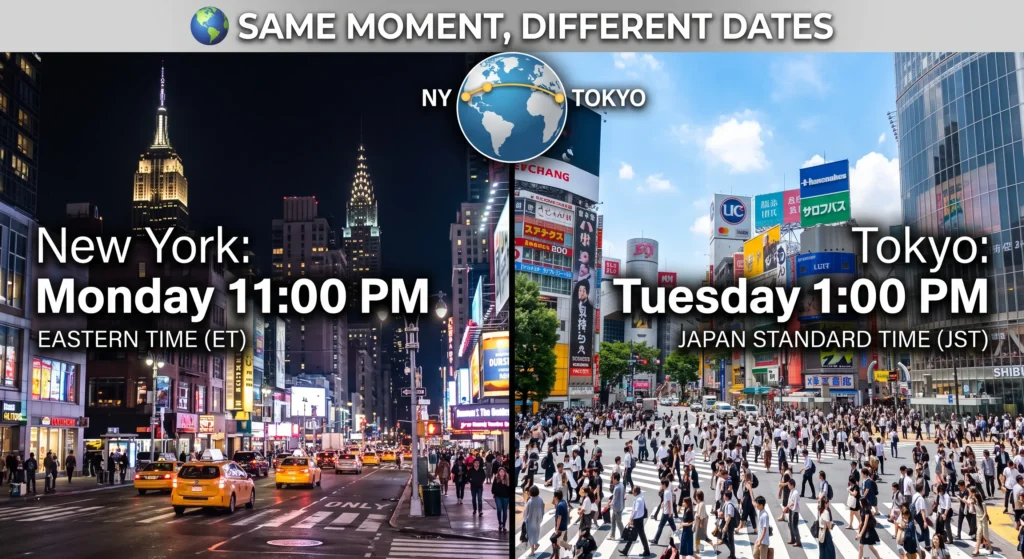
Because of this system, the concept of “midnight” happens at a genuinely different real-world moment depending on your location. Right now, at the exact moment you are reading this sentence, it is simultaneously one calendar date in some countries and a completely different calendar date in others. This is not a rare glitch in the matrix; it is a literal reality every single second of every day. You cannot definitively answer “what date is it?” without also asking “where?”
What is UTC and Why Does Your Computer Care?
If you have ever tried to book an international flight or set up a global calendar invite, you have probably seen the letters “UTC” followed by a plus or minus sign (like UTC+5 or UTC-8).
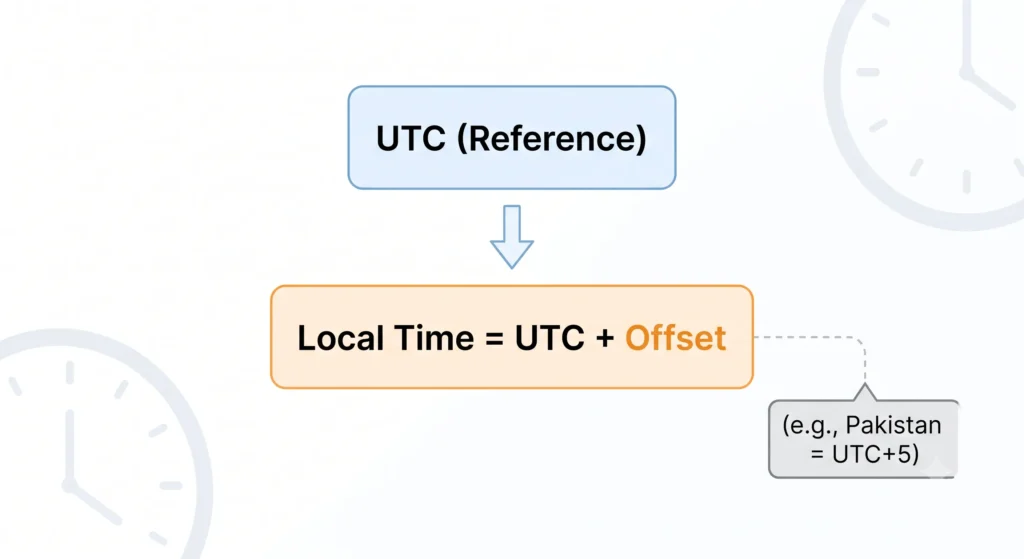
UTC stands for Coordinated Universal Time. Think of it as the ultimate anchor for the world’s clocks. Instead of trying to figure out what time it is in every individual country, computers, international databases, and global servers just use UTC as their single point of truth.
This matters heavily for date calculations. When a software system needs to calculate “today’s date,” it needs a perspective. If a website runs its calculations purely in UTC, without properly adjusting for your specific local time zone, the website might tell you that “today” is Tuesday when it is still very clearly Monday outside your window. This is exactly why some poorly coded online calculators or forms will mysteriously shift your birth date by one day when you try to submit them.
The International Date Line: Time Travel in Real Life
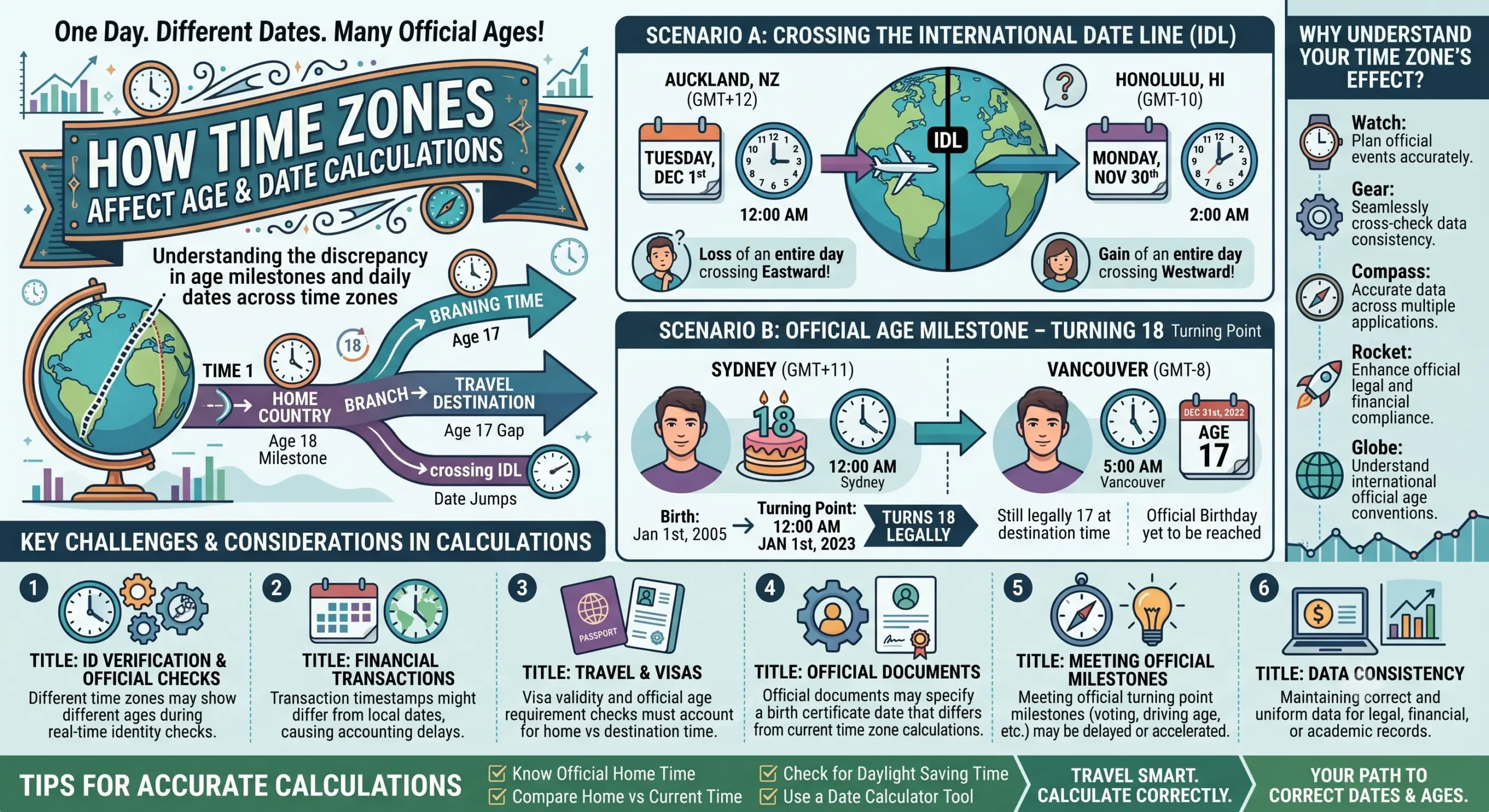
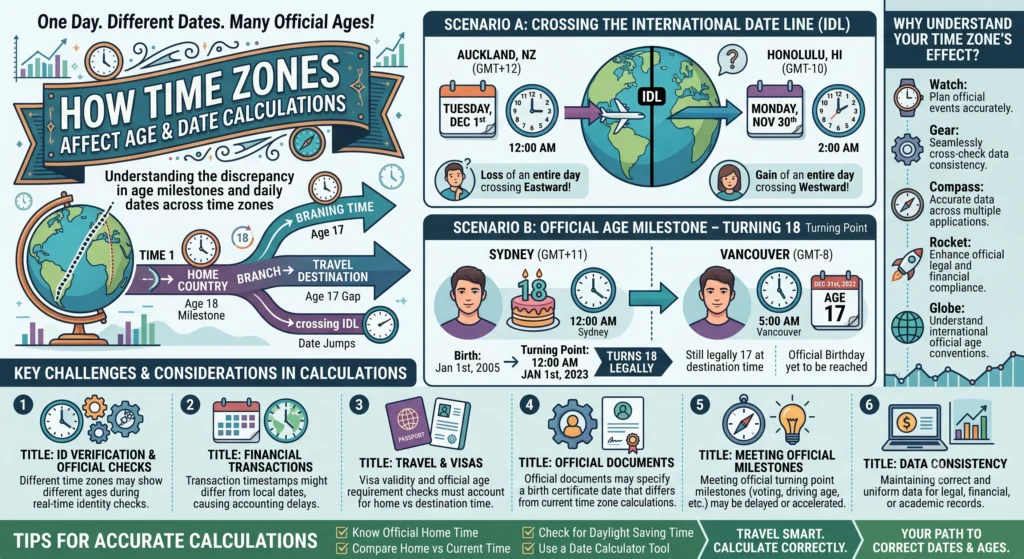
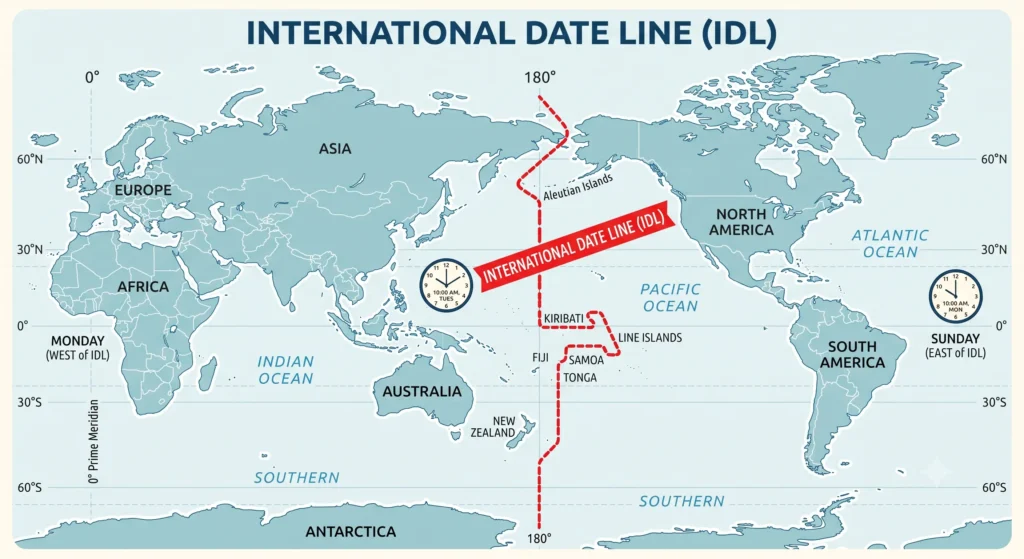
If you want to see where date calculations get truly wild, look at the International Date Line. This is an imaginary boundary that runs roughly down the middle of the Pacific Ocean.
When you cross this line, you don’t just change your clock by an hour you jump forward or backward an entire calendar day. You could be on a boat crossing this line and literally sail from Wednesday into Thursday in the blink of an eye, even though the sun hasn’t moved.
This creates some genuinely striking scenarios. For instance, you could celebrate New Year’s Eve in Sydney, Australia, hop on a fast flight to Honolulu, Hawaii, cross the International Date Line, and celebrate New Year’s Eve all over again the next day.
The line isn’t perfectly straight, either. It zigzags aggressively around the ocean specifically to keep certain island nations on a single, consistent date. In 2011, the country of Samoa actually redrew the line around their islands so they could be on the same calendar day as their main trading partners, Australia and New Zealand. To do this, Samoa simply erased December 30, 2011, from their history. They went to sleep on the 29th and woke up on the 31st!
Real-World Chaos: Midnight Births and Airborne Babies
So, how does all this global geography affect a normal person’s recorded age? It usually comes down to birth certificates and extremely close timing.
The Midnight Boundary
The most common real-world scenario involves babies born right around midnight. Imagine a baby born at 11:58 PM on February 28th. Now imagine another baby born just four minutes later, at 12:02 AM. That second baby’s birthday is legally March 1st. Those four minutes separate their legal birth dates by a full calendar day, which can later affect everything from school enrollment cutoffs to when they can legally drive or vote.
Born on an International Flight
A much rarer, but highly complicated scenario involves babies born in the sky. If a woman goes into labor on a flight from London to Los Angeles, what time zone do they use for the birth certificate? The time in London? The time in LA? The time of the country they happen to be flying over at that exact moment?
In practice, this bureaucratic puzzle is usually resolved by established airline and hospital protocols. Generally, the date and time are credited to the location where the airplane first lands and the birth is officially registered with local authorities, rather than trying to map the exact GPS coordinates and time zone of the aircraft at the moment of birth.
Daylight Saving Time: The “Twin Time” Paradox
While we are talking about time zones, we have to mention Daylight Saving Time (DST). In regions that observe DST, clocks either spring forward an hour or fall back an hour depending on the season.
While DST doesn’t usually change your calendar date, it creates absolute chaos for measuring age differences. Here is a famous, real-world scenario: A mother is giving birth to twins in November, right when the clocks are scheduled to “fall back.”
Twin A is born at 1:55 AM. Five minutes later, at 2:00 AM, Daylight Saving Time ends, and the hospital clocks automatically roll back to 1:00 AM. Thirty minutes later, Twin B is born at 1:30 AM.
Technically, and legally on paper, Twin B (the younger twin) has a recorded birth time that is 25 minutes before Twin A! This is a perfect example of why calculating exact elapsed time requires a deep understanding of local clock rules.
How the Law and Software Handle Your Age
With all this complexity, you might be wondering how your official age is determined. While computers love to convert everything to UTC for a global standard, legal systems do not care about UTC.
Legal and official birth records strictly use the local time and date at the actual physical location of your birth. This is the established standard because it avoids massive confusion. It is exactly why your birth certificate reflects the date as it was experienced by the doctors in the room with you, rather than a globally standardized computer time.
If there is ever a discrepancy between a digitized medical record and your physical documents, your official civil birth certificate is the absolute, authoritative truth. You should never try to recalculate or adjust your own birth date based on time zone assumptions.
Using the InnovaiTools Age Calculator
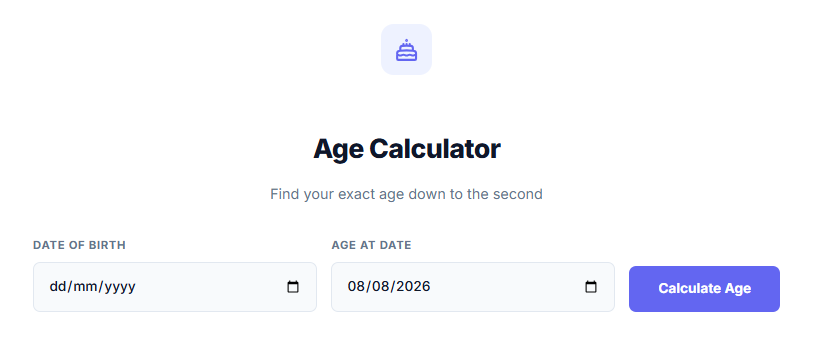
Because the legal system relies on your local date of birth, our free Age Calculator at InnovaiTools is built to respect exactly that.
Our tool calculates your exact age based on the date of birth exactly as you type it in. It does not attempt to independently “guess” your time zone, apply a UTC offset, or adjust your data behind the scenes. This guarantees that as long as you input the correct local date printed on your official passport or birth certificate, the calculator will give you a flawless, highly accurate result in years, months, and days.
If you want to understand all the other ways age is calculated across different cultures (like traditional East Asian age reckoning), you can check out our complete guide on how to calculate your exact age online.
Common Mistakes When Dealing With Time Zones and Dates
- Mistake 1: Assuming your birth date is tied to a global standard like UTC. It isn’t. Your official records strictly use the local time on the clock at the physical hospital where you were born.
- Mistake 2: Using online calculators that auto-detect your current timezone and accidentally shift your birth date forward or backward by a day without you noticing.
- Mistake 3: Confusing time zone boundaries with Daylight Saving Time. Crossing a time zone can literally change the calendar date. Daylight Saving Time only shifts the clock by an hour to chase daylight.
- Mistake 4: Trying to “correct” your official birth date because you later moved to a country 14 hours ahead. Your legal birth date remains anchored to the location where it happened.
Key Terms You Should Know
- UTC (Coordinated Universal Time): The ultimate global reference time standard. All time zones on Earth are defined as an offset from UTC (for example, UTC+5).
- International Date Line: An imaginary, zigzagging boundary in the Pacific Ocean. Crossing it means jumping forward or backward an entire calendar day.
- Local Time: The actual time experienced by people in a specific region, which is calculated by taking UTC and applying the local time zone offset.
- Daylight Saving Time (DST): A seasonal clock adjustment practiced by certain countries that creates a skipped hour in the spring and a repeated hour in the autumn.
Frequently Asked Questions
Q1: Can time zones actually change what date someone was born on? Yes, absolutely. If a birth occurs very close to midnight, a difference of just a couple of minutes can place the recorded date on either side of the midnight boundary, legally giving the child a different birthday.
Q2: What happens if a baby is born during an international flight? It creates a massive bureaucratic headache! However, it is generally resolved based on hospital and airline protocol. The birth date and time are usually credited to the local time of the city where the plane first lands and the birth is officially registered.
Q3: What is UTC and why do websites use it? UTC is the global baseline for time. Websites and computer databases use it to keep their internal records clean and organized, so they don’t get confused when users from fifty different countries all log in at the same time.
Q4: Why do some online date calculators show my birthday as one day off? This happens when a poorly programmed calculator runs its math in UTC, but fails to adjust for your local computer’s time zone. It creates a glitch where the system thinks it is already “tomorrow” or still “yesterday.”
Q5: Does Daylight Saving Time affect age calculations? It doesn’t usually change your calendar date, but it deeply affects exact time-of-day math. As mentioned in the twin example, the falling-back of clocks can legally make the second-born twin appear to have an older birth time.
Q6: What exactly is the International Date Line? It is an invisible line running roughly down the middle of the Pacific Ocean. Because the Earth is a globe spinning in space, there has to be a designated “starting point” for a new day, and this line serves that purpose.
Q7: Which time zone does my birth certificate use? Your birth certificate uses the local time and local date of the physical city where you were born. It does not matter what time it was in the rest of the world.
Q8: How do computer systems handle dates across time zones? The smartest systems save everything in UTC behind the scenes. When you open the app on your phone, the app translates that UTC timestamp into whatever local time zone your phone is currently sitting in.
Q9: Can two people born five minutes apart have different recorded birth dates? Yes! If Person A is born at 11:57 PM on Tuesday, and Person B is born at 12:02 AM on Wednesday, they have different legal birthdays despite only a five-minute age gap.
Q10: Does the InnovaiTools Age Calculator account for time zones? Our calculator respects the date exactly as you enter it. As long as you type in the local date written on your official documents, it will give you a perfectly accurate result without any complicated time zone glitches.
Final Thoughts
“What date is it?” feels like it should be the simplest question in the world to answer. But as time zones, UTC server logs, and the International Date Line clearly show us, the answer genuinely depends on where you are standing when you ask the question.
For the vast majority of us, time zones are just a minor annoyance when scheduling a Zoom meeting or recovering from jet lag. But for the small handful of people born exactly at the stroke of midnight, or thousands of miles in the air over the Pacific Ocean, it is the reason for a lifelong puzzle of “which date is really my true birthday?”
Whenever you need an instant, totally accurate calculation based on your official local birth date, use our free Age Calculator at InnovaiTools. It is completely private, requires no sign-up, and won’t get confused by the clock on the wall.

Arid is a web developer and computer expert who specializes in building practical utility web applications. With a strong focus on technical problem-solving and user experience, he develops efficient online calculators and writing tools designed to help students, bloggers, and professionals streamline their daily tasks.