Reading Time Calculator: How It Works and Why It Matters
You’ve almost certainly seen it at the top of an article: “8 min read.” It’s such a familiar little label that most readers barely register it consciously, yet it quietly influences a decision every single time whether to commit to reading or scroll past. That small number is the output of a reading time calculation, and there’s genuinely more going on behind it than a simple word-count-divided-by-speed formula suggests.
This guide covers where the now-ubiquitous “X min read” label actually came from, why a single average reading speed doesn’t tell the whole story, some surprising places reading-time math shows up outside of blogging entirely, and how to put a reading time calculator to practical use on your own content.
What Is a Reading Time Calculation, and Where Did “X Min Read” Come From?
A reading time calculation estimates how long it will take an average reader to get through a piece of text, based on its word count and a typical reading speed. The label itself that small “X min read” tag now standard across blogs, news sites, and publishing platforms was popularized by Medium starting around 2012, when the platform began displaying estimated reading time on every article as a deliberate design choice rather than a technical afterthought.
The idea behind it was straightforward but effective: giving readers a sense of the time commitment upfront helps them make a faster, more confident decision about whether to start reading. Once Medium demonstrated the pattern at scale, it spread rapidly across the wider publishing and blogging world, to the point that its absence on a long-form article can now feel slightly unusual.

The Reading Time Formula
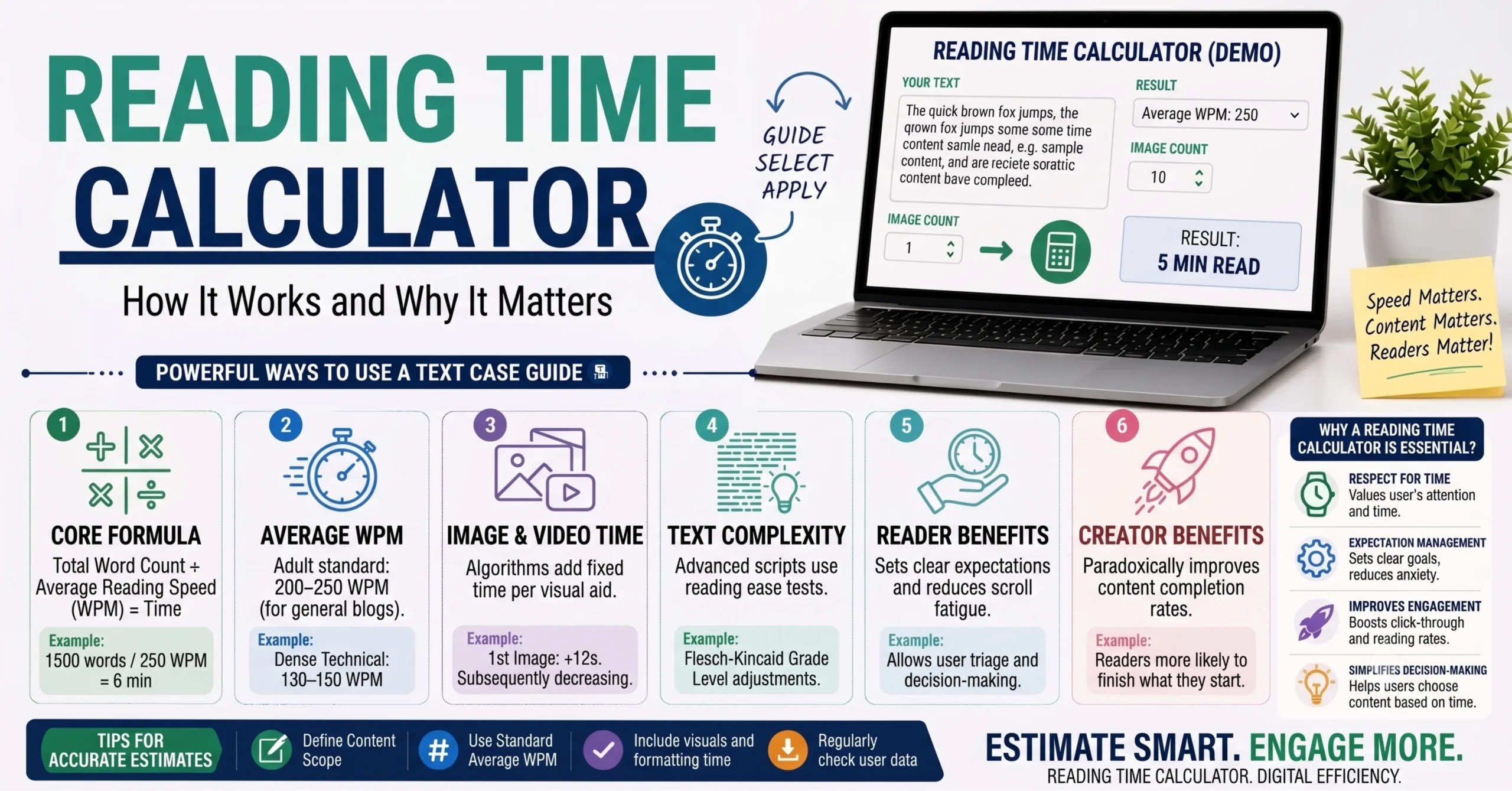
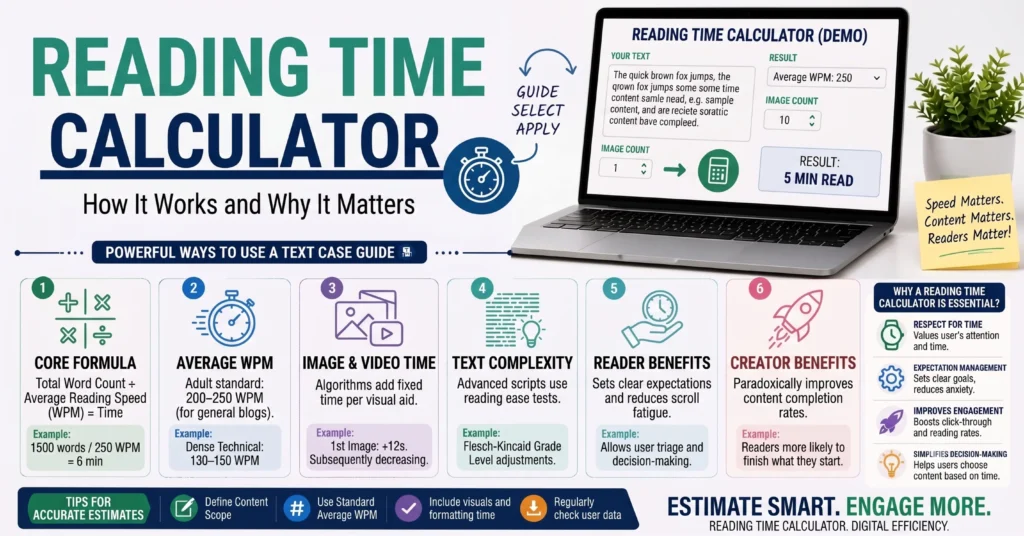
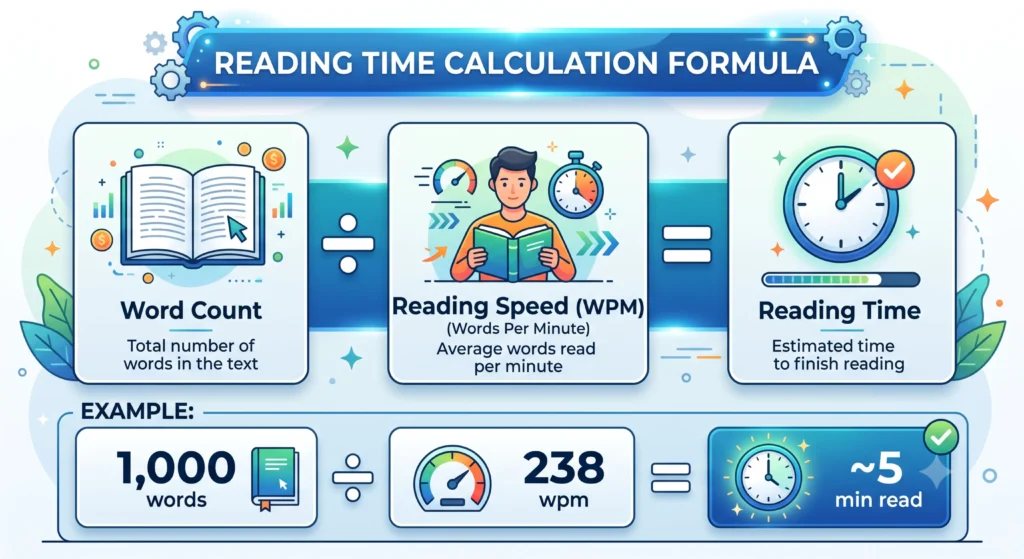
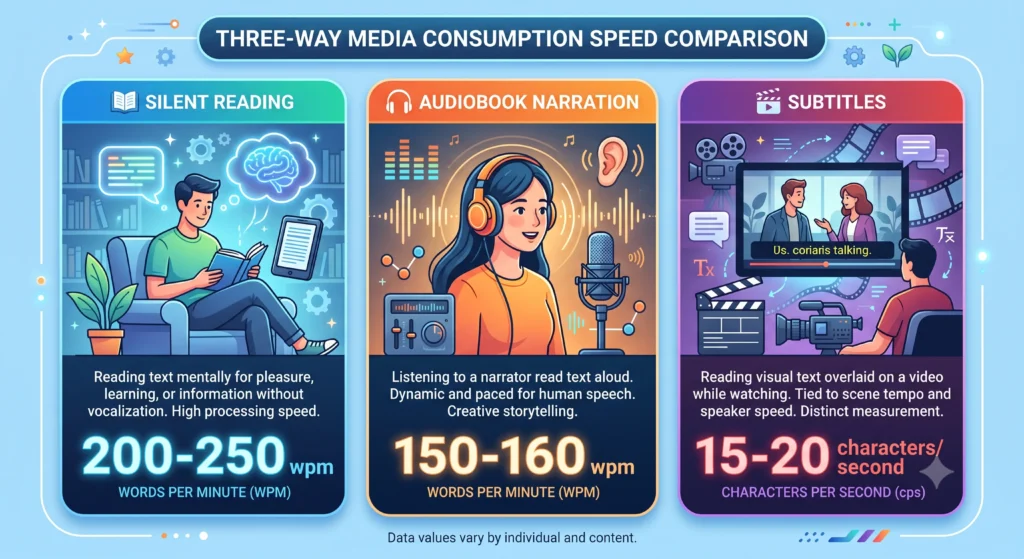
The underlying math is simple: divide the total word count by an average reading speed, typically somewhere between 200 and 250 words per minute for adult readers of non-fiction text.
- Reading Time (minutes) = Word Count ÷ Reading Speed (words per minute)
Why Reading Speed Isn’t One-Size-Fits-All
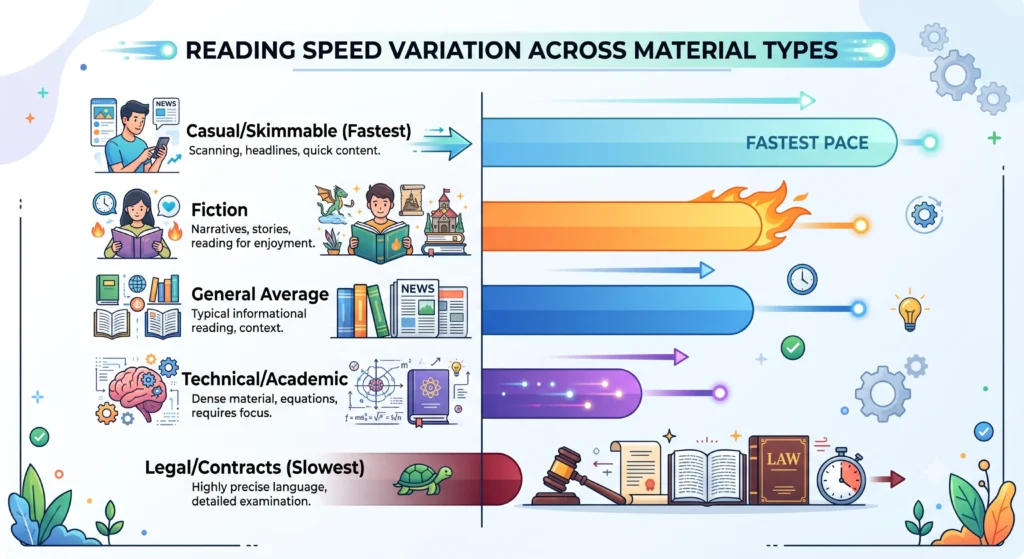
The 200–250 word-per-minute range is a genuinely useful average, but treating it as a universal constant misses an important nuance: reading speed shifts significantly depending on what’s actually being read. Casual, skimmable content short social posts, simple listicles, familiar topics trends to be read faster than the average, since readers can skim and still absorb the gist without processing every word closely. Fiction is often read at a comfortable, flowing narrative pace close to the general average, since it’s typically written to be consumed in a smooth, continuous way.
Technical, academic, or unfamiliar material sits at the other end of the spectrum entirely. Dense writing full of new concepts, statistics, or specialized vocabulary forces readers to slow down, sometimes re-reading a sentence before moving forward, which can drop effective reading speed well below the general average. Legal and contractual text is often the slowest of all, since readers frequently cross-reference clauses and read with a level of precision that casual content never demands. This is exactly why a single fixed reading speed, applied uniformly across every kind of writing, will always be an approximation rather than a precise prediction for any specific piece of content.
Does Displaying Reading Time Actually Help Engagement?
There’s a genuine practical reason publishers adopted this label so widely beyond simple curiosity: displaying reading time appears to function as a kind of commitment device. Knowing upfront that an article will take roughly five minutes, rather than an unknown and potentially open-ended amount of time, seems to make readers more willing to start the uncertainty itself is part of what causes hesitation before clicking into a longer piece.
That said, the effect isn’t uniformly positive at every length. For very long reading times pieces in the fifteen-minutes-or-more range displaying the number can work against engagement, since it signals a substantial time investment upfront that some readers will simply decide not to make. Content in the roughly three-to-ten-minute range, which happens to align closely with typical high-performing blog post lengths, tends to be where a visible reading time label does the most good, reassuring readers that the commitment is manageable without triggering the hesitation a much larger number might cause.
Reading Time in Other Contexts You Might Not Expect
Reading-speed calculations show up in a few places well outside of blogging, and the differences between them are genuinely interesting.
The film and television industry relies on its own version of this math for subtitle and caption timing. Subtitles need to stay on screen long enough for an average viewer to read them completely before the next line appears, and industry practice generally works from a readable pace of somewhere around fifteen to twenty characters per second a figure calibrated specifically for on-screen reading under time pressure, which is notably different from the leisurely pace assumed for an untimed blog post.
Audiobooks offer another interesting comparison point. Professional audiobook narration is typically recorded at a natural speaking pace of around 150 to 160 words per minute noticeably slower than the 200-to-250 word-per-minute range assumed for silent reading. This is part of why listening to the audiobook version of a book often takes measurably longer than reading the same text yourself would, even though the total word count is identical in both cases.
There’s also an ongoing body of research comparing screen reading to paper reading, with somewhat mixed findings depending on the specific study and content type some research points to marginally slower reading or slightly lower comprehension on screens for certain kinds of dense material, though the gap has narrowed considerably as screen reading has become the default for most people. It’s a genuinely unsettled area rather than a clear-cut rule, but worth knowing if you’re wondering whether your blog’s on-screen reading time estimate might undersell the actual time a reader spends with it.
How Reading Speed Varies Across Languages
Average reading speed isn’t a fixed human constant it varies meaningfully across languages, largely because different writing systems pack different amounts of information into each character or word. Logographic writing systems, where a single character can represent an entire word or concept, generally use different words-per-minute or characters-per-minute benchmarks than alphabetic languages, where multiple characters combine to form each word. This is worth keeping in mind if you’re calculating reading time for multilingual content a reading speed benchmark calibrated for English text won’t translate directly to every other language without adjustment.
How to Use the InnovaiTools Reading Time Calculator
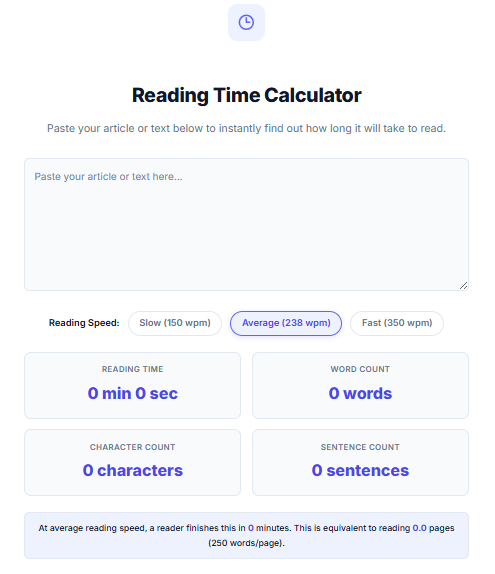
- Step 1: Open the Reading Time Calculator on InnovaiTools.
- Step 2: Paste or type your text directly into the input box.
- Step 3: Choose your reading speed slow, average, or fast depending on your audience and content type, based on the variation covered earlier in this guide.
- Step 4: View your results instantly: reading time, word count, character count, and sentence count, all updating live as you type or edit. If you want a more detailed word and character breakdown, our Word & Character Counter offers additional stats like reading time alongside a deeper text analysis.
How to Add a Reading Time Label to Your Own Blog
If you’re a blogger or content creator looking to add this label to your own posts, the practical approach is straightforward: calculate the reading time for your finished draft using a tool like ours, then include it near your title or byline in a simple, familiar format “X min read” is instantly recognizable to readers and requires no explanation. It’s worth recalculating the estimate after any significant editing pass, since even moderate cuts or additions can shift a piece from, say, a 4-minute read to a 6-minute one, and an inaccurate label undermines the trust the feature is meant to build in the first place. For content that leans technical or dense, consider using the “slow” reading speed setting rather than the general average, since it will produce a more honest estimate for that specific audience.
Common Mistakes When Estimating Reading Time
- Mistake 1: Using the general 200–250 word-per-minute average for highly technical or dense content, which produces an estimate that understates the actual time most readers will need.
- Mistake 2: Forgetting to recalculate the reading time after substantial edits, leaving a stale, inaccurate label on a piece that’s grown or shrunk significantly since it was first calculated.
- Mistake 3: Not accounting for non-text elements like embedded code blocks or data tables, which readers typically spend more time parsing than an equivalent word count of normal prose.
- Mistake 4: Applying an English-calibrated reading speed benchmark directly to content in a different language without adjustment.
Key Terms Related to Reading Time
- Words Per Minute (WPM): The standard unit for measuring reading speed, representing how many words an average reader processes in sixty seconds.
- Skimming: A faster style of reading in which the reader scans for key information rather than processing every word, typically used for familiar or low-stakes content.
- Dwell Time: A related web analytics metric measuring how long a visitor actually spends on a page, which can be compared against the estimated reading time to gauge engagement.
- Characters Per Second (CPS): The unit commonly used in subtitle and captioning work to determine how long text should remain visible on screen.
Frequently Asked Questions About Reading Time Calculators
Q1: How is reading time calculated? Reading time is calculated by dividing total word count by an assumed reading speed, typically 200–250 words per minute for general non-fiction content, then usually rounding up to the nearest minute.
Q2: Where did the “X min read” label come from? Medium popularized the label starting around 2012, displaying estimated reading time on articles as a way to help readers quickly gauge the time commitment before starting to read.
Q3: Does reading speed differ by type of content? Yes significantly casual, skimmable content is typically read faster than average, while technical, academic, or unfamiliar material is often read considerably slower.
Q4: Does showing reading time actually increase clicks? Evidence suggests it can function as a helpful commitment device for moderate-length content, roughly three to ten minutes, though very long reading times can sometimes discourage clicks by signaling a large time investment upfront.
Q5: How fast are audiobooks compared to reading? Audiobooks are typically narrated at around 150–160 words per minute, noticeably slower than the 200–250 word-per-minute range typical of silent reading, which is why audiobooks often take longer to finish than reading the same text.
Q6: How is subtitle timing calculated for movies and TV? The industry generally works from a readable pace of roughly fifteen to twenty characters per second, ensuring captions remain on screen long enough for an average viewer to read them before the next line appears.
Q7: Does reading speed vary by language? Yes different writing systems carry different amounts of information per character or word, so reading speed benchmarks calibrated for one language don’t transfer directly to another without adjustment.
Q8: Should I recalculate reading time after editing my content? Yes, even moderate edits can meaningfully shift the estimate, and an outdated reading time label undermines the trust the feature is designed to build with readers.
Q9: Is screen reading slower than reading on paper? Research findings are mixed and vary by study and content type, though the gap appears to have narrowed considerably as screen reading has become the default experience for most readers.
Q10: Is the InnovaiTools Reading Time Calculator free? Yes, completely free with no sign-up required, offering slow, average, and fast reading speed options alongside live word and character counts.
Final Thoughts
That small “X min read” label carries more genuine calculation and design thinking behind it than its simplicity suggests from Medium’s original decision to display it, to the real variation in reading speed across content types, languages, and even mediums like subtitles and audiobooks. Understanding what actually goes into that number makes it easier to use thoughtfully, whether you’re deciding how long to make your next blog post or simply curious what’s behind a label you’ve scrolled past a thousand times.
For an instant, accurate reading time estimate on any piece of text, use our free Reading Time Calculator at InnovaiTools no sign-up required, with results that update live as you type.

Arid is a web developer and computer expert who specializes in building practical utility web applications. With a strong focus on technical problem-solving and user experience, he develops efficient online calculators and writing tools designed to help students, bloggers, and professionals streamline their daily tasks.