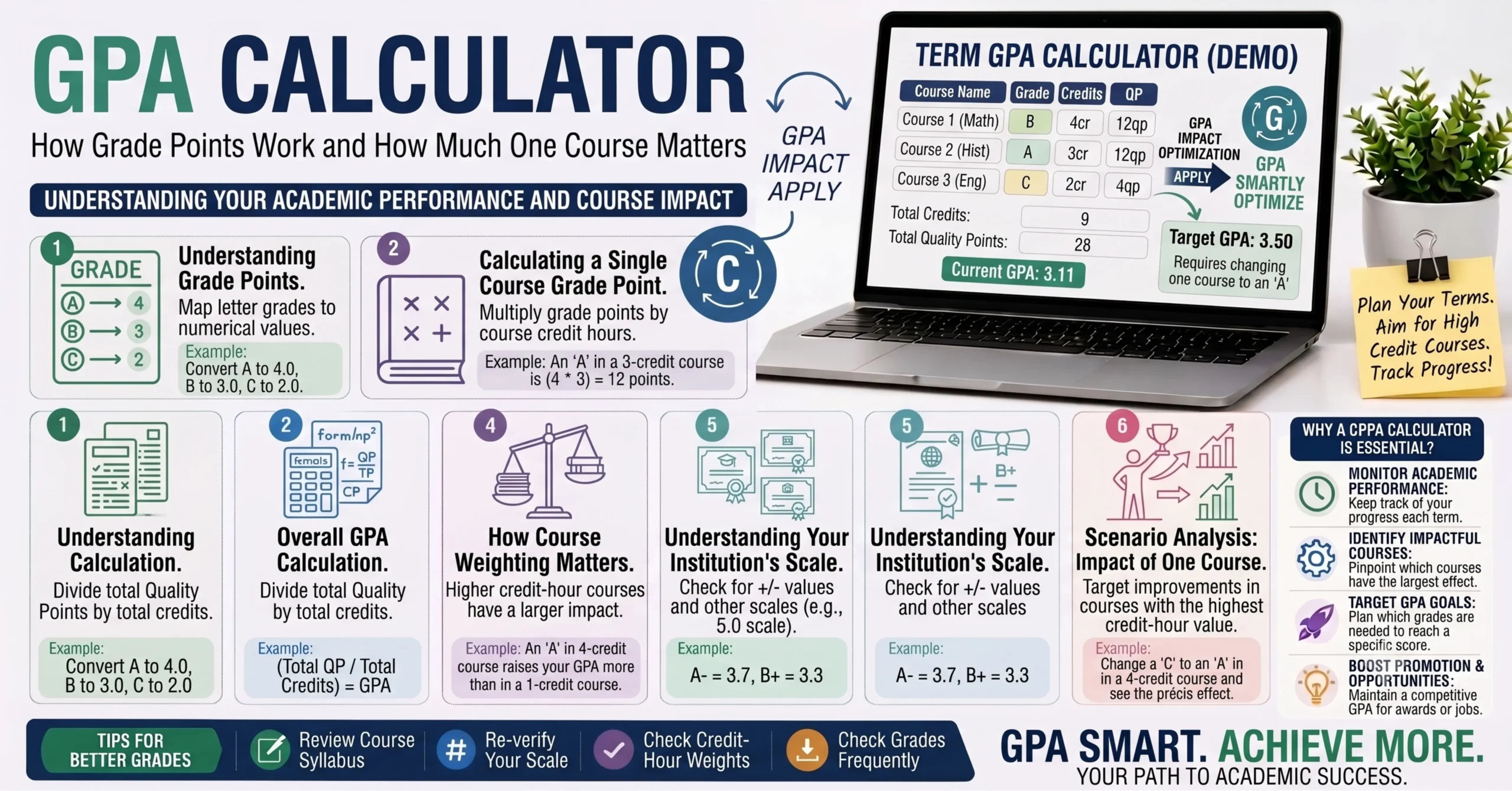
GPA Calculator: How Grade Points Work
Every letter grade on your transcript is quietly doing double duty it communicates your performance to a human reader, and simultaneously represents a specific number that your GPA calculation actually runs on behind the scenes. Most students know their GPA as a single number without ever seeing the numeric translation happening underneath it, which is exactly why concepts like weighted GPA or “how much will this one course actually move my average” tend to feel more mysterious than they need to.
This guide breaks down exactly how letter grades convert into the grade points your GPA is built from, the real difference between weighted and unweighted scales, and genuinely one of the most useful calculations a student can run precisely how much a single course will move your GPA before you’ve even finished taking it.
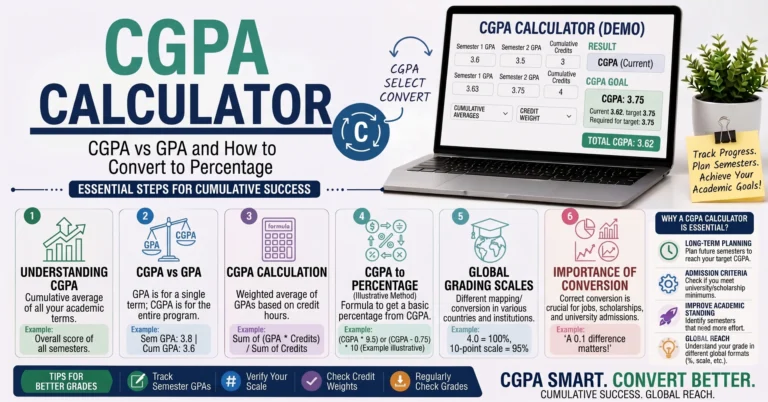
If you’re looking specifically for how GPA differs from its cumulative counterpart across multiple semesters, that distinction is covered in detail in our CGPA guide this post focuses specifically on the single-semester GPA calculation itself.
Understanding Grade Points The Numbers Behind Your Letters
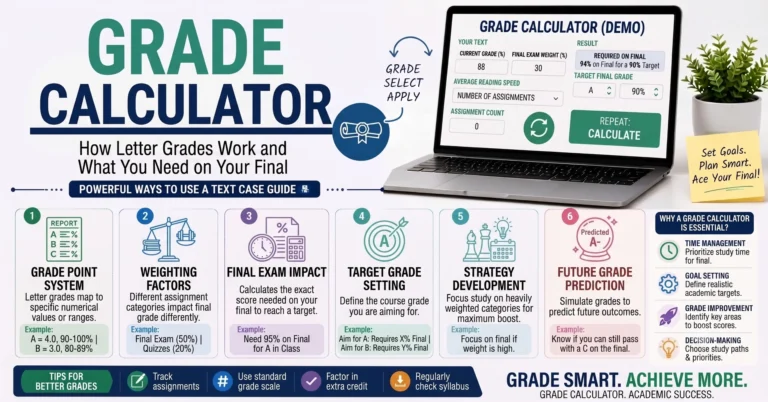
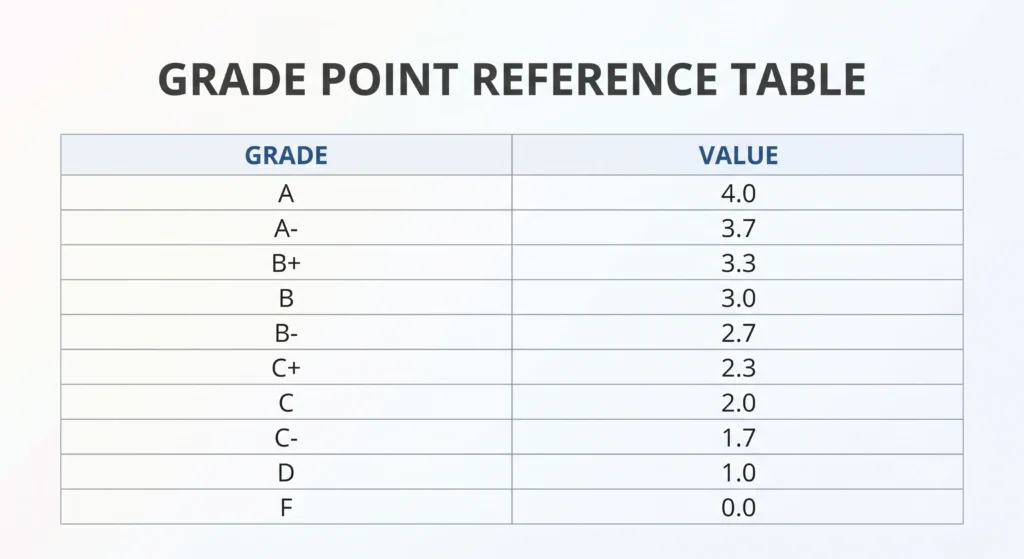
Every letter grade corresponds to a specific numeric value called a grade point, and it’s this numeric value not the letter itself that actually drives your GPA calculation. A commonly used standard scale looks like this:
- A = 4.0
- A- = 3.7
- B+ = 3.3
- B = 3.0
- B- = 2.7
- C+ = 2.3
- C = 2.0
- C- = 1.7
- D+ = 1.3
- D = 1.0
- F = 0.0
The letter grade exists for quick, human-readable communication it’s what appears on a report card or transcript summary. But underneath it, your actual GPA math always runs on these numeric grade point equivalents, which is why understanding this translation table matters even if you never manually calculate a GPA by hand.
The GPA Formula Explained
The mathematical formula for your semester GPA is straightforward once you know your grade points:
GPA = Sum of (Grade Point × Course Credit Hours) ÷ Total Credit Hours for the Semester
Here’s a worked example across four courses in a single semester:
- Course 1: Grade A (4.0), 3 credits → 4.0 × 3 = 12.0 grade points
- Course 2: Grade B+ (3.3), 4 credits → 3.3 × 4 = 13.2 grade points
- Course 3: Grade A- (3.7), 3 credits → 3.7 × 3 = 11.1 grade points
- Course 4: Grade B (3.0), 3 credits → 3.0 × 3 = 9.0 grade points
Total Credits: 13 | Total Grade Points: 45.3
GPA = 45.3 ÷ 13 = 3.48
Notice that this is a weighted calculation, not a simple average of the four grade points a 4-credit course pulls the semester GPA more strongly toward its own grade than a 3-credit course does, since it contributes proportionally more grade points to the total.
4.0 Scale vs 5.0 Scale vs Weighted GPA
This is where a lot of genuine confusion creeps in, particularly for students comparing their own GPA against a stated requirement from another school or scholarship.
An unweighted 4.0 scale treats every course identically regardless of difficulty an A is worth 4.0 whether it came from an introductory elective or the hardest course in the catalog. A weighted GPA, common in many US high schools, deliberately assigns extra grade points to more rigorous coursework an A in an Honors, AP, or IB-level course might be worth 5.0 instead of the standard 4.0, allowing a student’s weighted GPA to exceed the traditional 4.0 ceiling entirely. The reasoning behind this is straightforward: without weighting, a student who takes on genuinely harder coursework and earns a B could end up with a lower GPA than a student who took easier courses and earned straight A’s, even though the first student arguably did more academically demanding work.
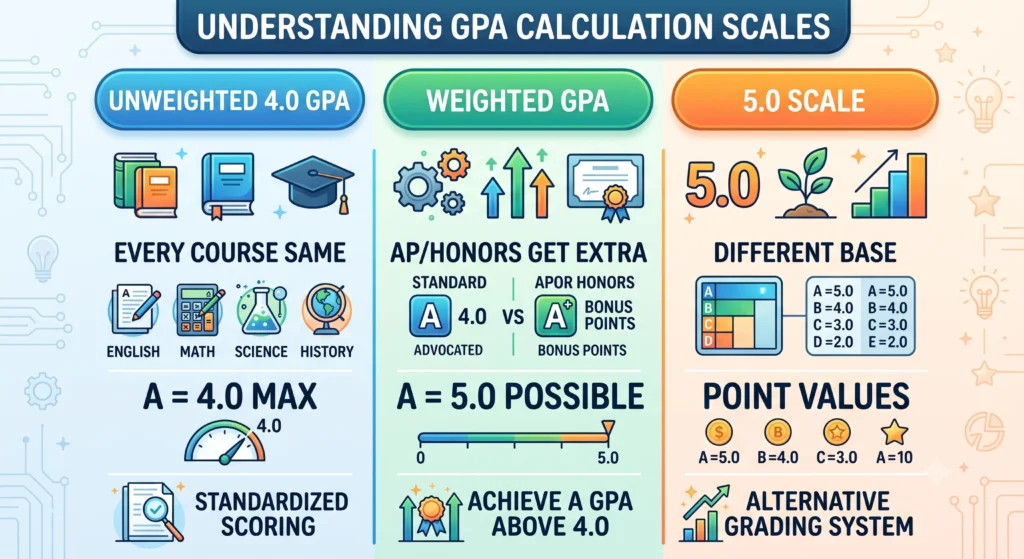
Separately, some institutions use an entirely different 5.0 unweighted scale, where the base point values themselves are simply different from the standard 4.0 system this is a distinct situation from weighted honors/AP scoring, even though both can produce a GPA figure above 4.0. Because of this, a 3.8 GPA on one scale and a 3.8 GPA on another can represent meaningfully different actual academic performance, which is exactly why it’s worth confirming which specific scale applies before comparing your own GPA against any external benchmark or requirement.
How Much Does One Course Actually Affect Your GPA?
This is a genuinely practical question worth being able to answer before you’re deep into a difficult course, and the underlying math is a direct extension of the weighted formula covered earlier.
New GPA = (Current GPA × Current Total Credits + New Course Grade Points × New Course Credits) ÷ (Current Total Credits + New Course Credits)
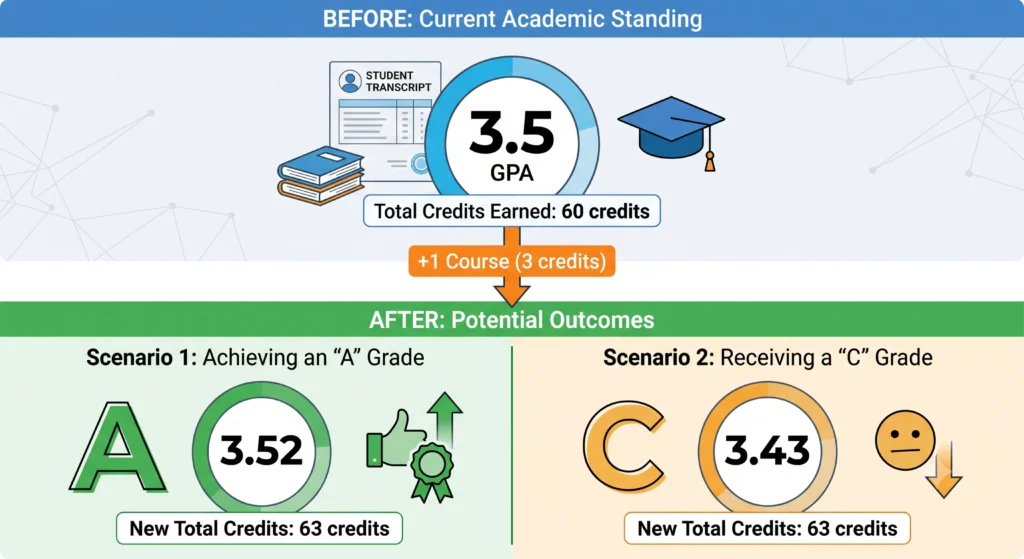
Here’s a worked example: suppose your current GPA is 3.5 after completing 60 credit hours, and you’re taking one additional 3-credit course this term.
If you earn an A (4.0) in that course:
New GPA = (3.5 × 60 + 4.0 × 3) ÷ (60 + 3)= (210 + 12) ÷ 63= 222 ÷ 63 ≈ 3.52
If you earn a C (2.0) in that course instead:
New GPA = (3.5 × 60 + 2.0 × 3) ÷ (60 + 3)= (210 + 6) ÷ 63= 216 ÷ 63 ≈ 3.43
Even the difference between an A and a C in a single 3-credit course only moves the overall GPA by roughly a tenth of a point once 60 credits have already accumulated a concrete illustration of exactly why any single course matters progressively less as your total credit history grows, and why panicking over one difficult class is rarely proportional to its actual mathematical impact.
How to Use the InnovaiTools GPA Calculator
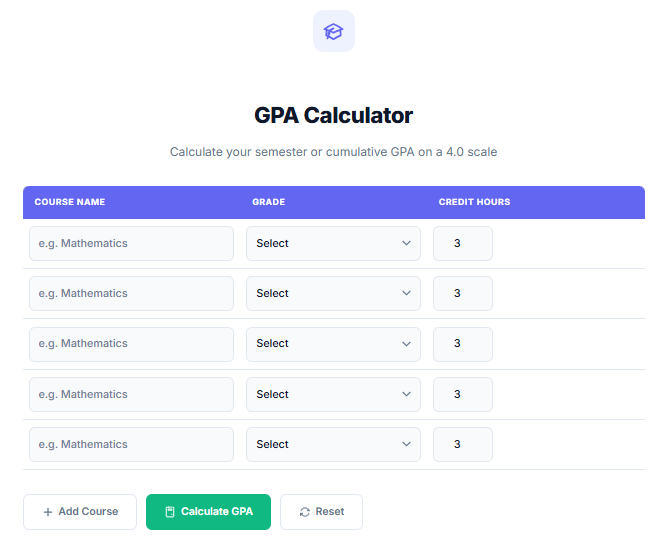
- Step 1: Open the GPA Calculator on InnovaiTools.
- Step 2: Add each course you’re taking this semester, along with its letter grade and credit hours.
- Step 3: View your calculated semester GPA instantly as you add or adjust courses.
- Step 4: If you need your cumulative average across multiple completed semesters rather than a single term, our CGPA Calculator handles that calculation separately, and our Grade Calculator converts individual assignment marks into their corresponding letter grade.
Practical Tips for Managing Your GPA Each Semester
Balancing difficulty across a single semester tends to protect your GPA more reliably than either stacking every hard course together or avoiding challenging courses altogether spreading demanding coursework across multiple terms gives you more capacity to perform well in each one individually. It’s also worth knowing your institution’s specific withdrawal deadline and policy, since a course withdrawal, typically recorded as a “W,” generally doesn’t factor into GPA the same way a completed low grade would, making it a genuinely useful safety valve when a course is clearly going poorly and recovery looks unlikely. Before setting a specific numeric GPA target for yourself, confirming exactly which scale your institution uses weighted, unweighted, 4.0, or 5.0 matters more than it might seem, since a target based on the wrong scale can be either unrealistically difficult or meaninglessly easy. Finally, remember that credit-heavy semesters and credit-heavy individual courses carry more mathematical weight in your GPA than lighter ones, so a particularly strong or weak performance in a high-credit course has a proportionally larger effect than the same performance in a lighter one.
Common Mistakes When Calculating GPA
- Mistake 1: Confusing GPA with CGPA and reporting a single semester’s figure when a cumulative figure was actually requested, or vice versa.
- Mistake 2: Assuming an A+ always earns extra grade points beyond a standard A, when many institutions cap both at the same 4.0 value with no numeric distinction between them.
- Mistake 3: Comparing a weighted GPA figure directly against an unweighted requirement without adjusting for the different scales, which can make a genuinely qualifying GPA look like it falls short, or vice versa.
- Mistake 4: Assuming a course withdrawal affects GPA the same way a completed low grade would, without checking the institution’s specific withdrawal policy.
Key Terms Related to GPA
- Grade Point: The specific numeric value assigned to a letter grade, which is what a GPA calculation actually runs on rather than the letter itself.
- Weighted GPA: A GPA calculation that assigns extra grade points to more rigorous coursework, such as Honors, AP, or IB courses, allowing the resulting average to exceed a standard 4.0 ceiling.
- Unweighted GPA: A GPA calculation that treats every course identically regardless of difficulty, using the same standard grade point scale across all courses.
- Withdrawal (W): A transcript notation indicating a student dropped a course after a certain deadline, generally treated differently from a completed grade and typically excluded from GPA calculations.
Frequently Asked Questions About GPA
Q1: What is a 4.0 GPA? A 4.0 GPA on a standard unweighted scale represents straight A’s across every course, since A is typically assigned the maximum grade point value of 4.0.
Q2: What is the difference between weighted and unweighted GPA? Unweighted GPA treats every course identically. Weighted GPA assigns extra grade points to more rigorous courses like Honors, AP, or IB classes, allowing the resulting average to exceed 4.0.
Q3: How many grade points is an A-? On a commonly used standard scale, an A- is typically worth 3.7 grade points, though exact values can vary slightly by institution.
Q4: How much does one course affect my GPA? The impact depends on the course’s credit hours relative to your total accumulated credits the more credits you’ve already completed, the smaller the proportional impact of any single additional course.
Q5: Does a course withdrawal affect my GPA? Generally no, a withdrawal is typically excluded from GPA calculations entirely, though this depends on your specific institution’s policy and the deadline by which the withdrawal was filed.
Q6: What is the difference between GPA and CGPA? GPA measures performance within a single semester. CGPA measures cumulative performance across every completed semester. OurCGPA guidecovers this distinction in full detail.
Q7: Can my GPA be higher than 4.0? Yes, on a weighted scale that assigns extra grade points to advanced coursework like AP or IB classes, or on institutions using an entirely different 5.0 base scale.
Q8: How is GPA calculated for a semester? Each course’s grade point is multiplied by its credit hours, these results are summed across all courses in the semester, and the total is divided by the total credit hours for that semester.
Q9: What GPA is considered good? This varies by context and scale, but a GPA above 3.5 on a standard 4.0 unweighted scale is commonly viewed as strong, while specific requirements for scholarships or programs vary considerably.
Q10: Is the InnovaiTools GPA Calculator free? Yes, completely free with no sign-up required, and it supports adding multiple courses with different credit hours to calculate your full semester GPA instantly.
Final Thoughts
Behind every letter grade on a transcript sits a specific number doing the actual mathematical work, and understanding that translation along with the real difference between weighted and unweighted scales turns GPA from an opaque single figure into something you can genuinely reason about and plan around. Knowing roughly how much a single course will move your average, before you’ve even finished taking it, replaces a lot of unnecessary end-of-semester anxiety with a much clearer sense of what’s actually at stake.
For an instant, accurate semester GPA calculation any time you need one, use our free GPA Calculator at InnovaiTools and when you’re ready to look across your full academic record, our CGPA Calculator picks up exactly where this one leaves off.

Arid is a web developer and computer expert who specializes in building practical utility web applications. With a strong focus on technical problem-solving and user experience, he develops efficient online calculators and writing tools designed to help students, bloggers, and professionals streamline their daily tasks.