CGPA Calculator: CGPA vs GPA and How to Convert to Percentage
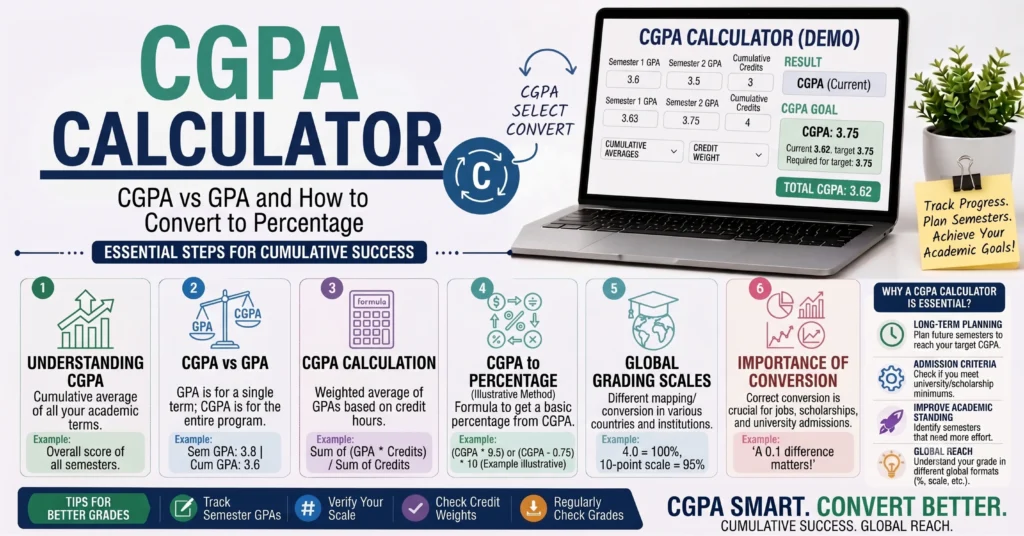
If you’ve ever stared at your transcript wondering why a genuinely great semester barely moved your overall average, you’ve already run into the core idea behind CGPA, even if nobody explained it to you directly. GPA and CGPA get used almost interchangeably in casual conversation, but they measure fundamentally different things, and understanding that difference explains a lot about how your academic record actually behaves over time.
This guide covers exactly what separates CGPA from GPA, how the cumulative calculation actually works, one of the most commonly searched practical questions. how to convert CGPA into a percentage and what really happens to your average when you retake a course you didn’t do well in the first time.
What Is CGPA, and How Is It Different From GPA?
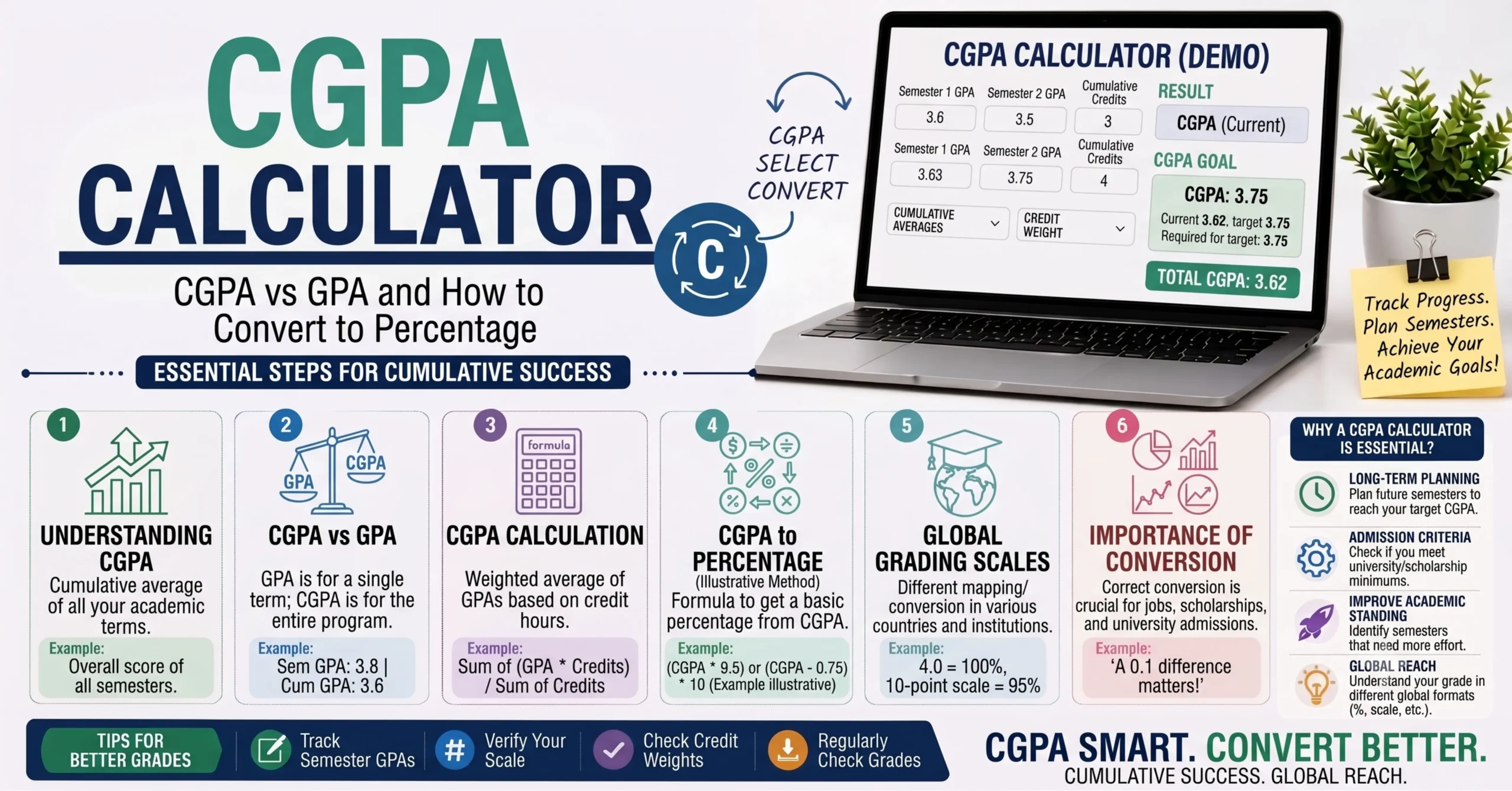
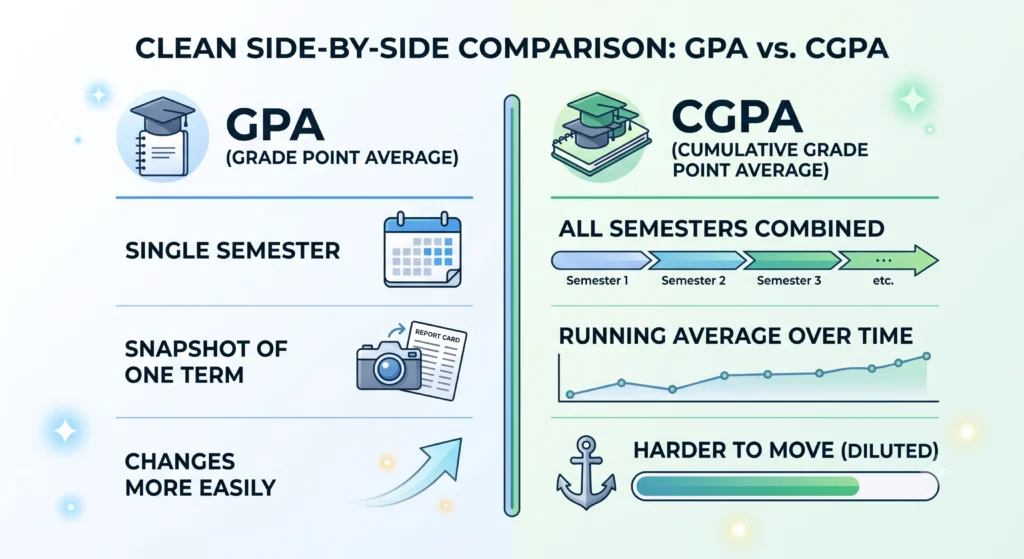
GPA, or Grade Point Average, measures your academic performance within a single semester or term it’s a snapshot of how you did during that specific stretch of time, based on the courses and credit hours you completed in it. CGPA, or Cumulative Grade Point Average, measures your performance across every semester you’ve completed so far, weighted by the credit hours of each one, giving you a running average of your entire academic record to date.
This distinction explains something that confuses a lot of students: why one excellent semester doesn’t move your overall average nearly as much as you’d expect. Once you’ve accumulated several semesters’ worth of credit hours, a single new semester represents a proportionally smaller slice of your total academic record, so its impact on CGPA gets diluted by everything that came before it even if that semester itself was genuinely your best one yet. GPA reflects the moment; CGPA reflects the trajectory, and the two frequently tell noticeably different stories about the exact same student.
The CGPA Formula Explained
The mathematical relationship between your semester performance and your overall average follows a precise weighted formula:
$$\text{CGPA} = \frac{\sum (\text{Semester GPA} \times \text{Semester Credit Hours})}{\text{Total Credit Hours Across All Semesters}}$$
Here’s a worked example across three semesters:
- Semester 1: GPA 3.4, Credits 15 → $3.4 \times 15 = 51.0$ grade points
- Semester 2: GPA 3.7, Credits 16 → $3.7 \times 16 = 59.2$ grade points
- Semester 3: GPA 3.2, Credits 15 → $3.2 \times 15 = 48.0$ grade points
Total Credits: 46 | Total Grade Points: 158.2
$$\text{CGPA} = \frac{158.2}{46} = 3.44$$
Notice how the calculation weights each semester by its credit load rather than simply averaging the three GPA values together a semester with a heavier credit load pulls the cumulative average more strongly toward its own result than a lighter semester does.
How to Convert CGPA to Percentage
This is one of the most commonly searched practical questions around CGPA, particularly for students applying to institutions or jobs abroad that expect a percentage figure rather than a grade point average. It’s worth being upfront about something important here: there is no single universal formula for this conversion, and treating any one formula as officially authoritative can cause real problems on an application.
Some Indian universities and technical boards commonly cite a conversion of CGPA multiplied by 9.5 to approximate an equivalent percentage on a 10-point CGPA scale, though this specific multiplier is tied to particular institutional conventions rather than being a universal international standard. On a 4.0 scale, common in the US and increasingly used by universities across Pakistan, a rough approximation sometimes used is dividing CGPA by 4 and multiplying by 100 but again, this is an approximation, not an officially certified conversion in most cases.
The genuinely important guidance here is this: for anything that actually matters a job application, a visa document, a graduate school submission always request an official conversion certificate or formula directly from your own institution’s registrar or examination department, rather than relying on a generic online formula. Institutions frequently have their own certified conversion method, and using the wrong one on an official document can create unnecessary complications.
What Happens to Your CGPA When You Retake a Course?
This question matters enormously for any student considering retaking a course they didn’t perform well in, and the honest answer depends entirely on your specific institution’s policy, since there isn’t one universal approach.
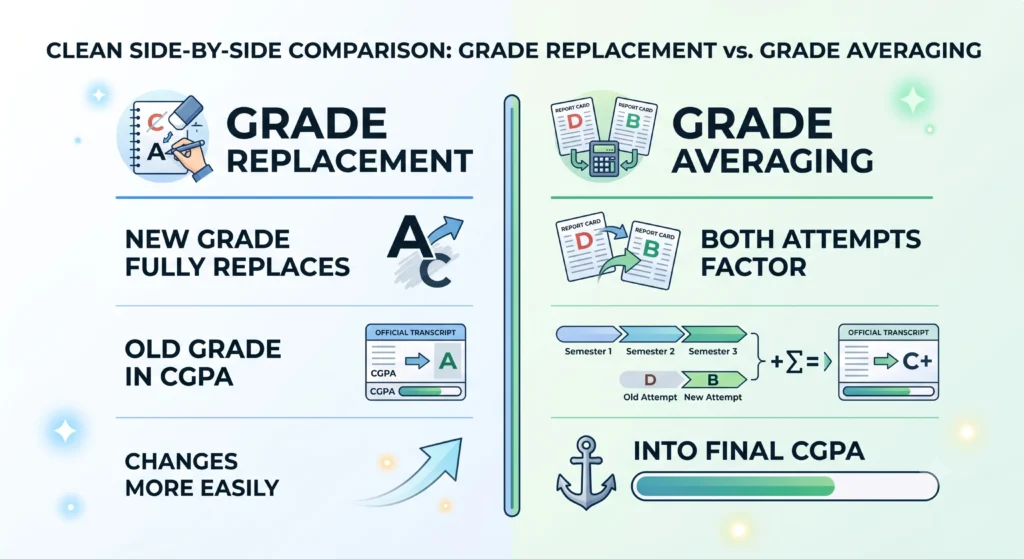
Under a grade replacement policy, your new grade completely replaces the old one in your CGPA calculation, as though the original attempt’s grade points no longer count toward your cumulative average though the original attempt often still appears on your transcript as a matter of record, even if it no longer affects your CGPA. Under a grade averaging policy, both attempts factor into your CGPA in some way, meaning even a significantly improved second attempt won’t fully erase the drag of the original lower grade.
The practical impact of these two policies can be dramatically different for the same student with the same improved retake score, which is exactly why it’s worth checking your institution’s specific policy before assuming a retake will “fix” your CGPA the way you might expect.
Common CGPA Requirements You’ll Encounter
CGPA thresholds show up constantly throughout an academic career in ways that are worth being aware of ahead of time. Scholarships very commonly set a minimum CGPA often somewhere around 3.5 on a 4.0 scale, though this varies significantly by program as an ongoing eligibility requirement, not just an initial qualifying bar. Graduate school admissions frequently reference a CGPA cutoff for consideration, though the specific threshold varies enormously by program and institution, and a lower CGPA can sometimes be offset by strong standardized test scores, research experience, or recommendation letters depending on the program. Many universities also award distinction-level honors at graduation designations roughly analogous to cum laude or magna cum laude in Western systems, or “First Class” and “Distinction” classifications common in South Asian institutions based on specific CGPA thresholds set by the institution. On the other end, academic probation policies typically trigger when CGPA falls below a defined threshold, making it worth knowing exactly where that line sits at your own institution well before you’re anywhere close to it.
How to Use the InnovaiTools CGPA Calculator
- Step 1: Open the CGPA Calculator on InnovaiTools.
- Step 2: Enter each completed semester’s GPA along with its corresponding credit hours.
- Step 3: Add additional semester rows as needed to cover your full academic record so far.
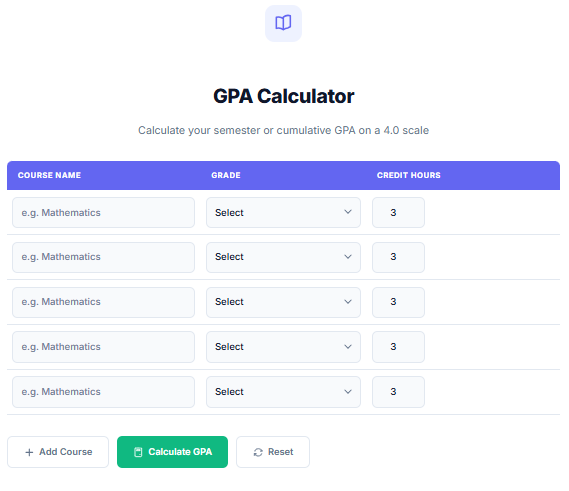
- Step 4: View your calculated CGPA instantly. If you need to convert a single assignment score into a letter grade rather than a cumulative average, our Grade Calculator handles that separately, and our GPA Calculator focuses specifically on a single semester’s grade point average.
Tips for Improving Your CGPA Over Time
Because CGPA is a weighted average across your entire academic record, the mathematical reality is that early semesters carry outsized long-term influence a strong start builds a cushion that later semesters can maintain more easily, while a rough first year creates a deficit that takes considerably more sustained effort to fully recover from later on, simply because each additional semester represents a smaller fraction of an increasingly large total. It’s also worth paying particular attention to semesters where you’re carrying a heavier credit load, since those semesters weight more heavily in the cumulative calculation than a lighter semester would, making strong performance in a demanding term especially valuable to your overall average. Before deciding whether a retake is worth pursuing for a weak grade, checking your institution’s specific replacement-versus-averaging policy covered earlier in this guide tells you exactly how much benefit that retake will realistically deliver, rather than assuming it will simply erase the original result. Finally, being realistic about course load and timing, rather than overloading a single difficult semester unnecessarily, tends to protect CGPA more reliably over time than attempting to recover a lot of ground all at once.
Common Mistakes When Calculating CGPA
- Mistake 1: Confusing CGPA with GPA and reporting or calculating a single semester’s figure when a cumulative figure was actually required.
- Mistake 2: Assuming one universal CGPA-to-percentage formula applies everywhere, when conversion conventions genuinely vary by institution and country.
- Mistake 3: Assuming a course retake automatically erases the original grade’s impact on CGPA without first confirming whether your institution uses grade replacement or grade averaging.
- Mistake 4: Calculating CGPA as a simple average of semester GPAs rather than properly weighting each semester by its credit hours.
Key Terms Related to CGPA
- CGPA: Cumulative Grade Point Average a weighted average of academic performance across every completed semester, weighted by each semester’s credit hours.
- GPA: Grade Point Average academic performance measured within a single semester or term, rather than cumulatively.
- Credit Hour: A unit representing the weight or workload of a specific course, used to weight that course’s contribution to both GPA and CGPA calculations.
- Grade Replacement: An institutional policy in which a retaken course’s new grade fully replaces the original grade in CGPA calculations, as opposed to averaging both attempts together.
Frequently Asked Questions About CGPA
Q1: What is the difference between GPA and CGPA?
GPA measures performance within a single semester. CGPA measures cumulative performance across every completed semester, weighted by credit hours, giving a running average of your entire academic record.
Q2: How is CGPA calculated?
CGPA is calculated by multiplying each semester’s GPA by its credit hours, summing those results across all completed semesters, and dividing by the total credit hours.
Q3: How do I convert CGPA to percentage?
There is no single universal formula some institutions cite conversions like CGPA times 9.5 on a 10-point scale, but for anything official, always request the certified conversion method directly from your institution’s registrar.
Q4: Does retaking a course improve my CGPA?
It depends on your institution’s policy. Under grade replacement, the new grade fully replaces the old one. Under grade averaging, both attempts factor into your CGPA, softening but not eliminating the original grade’s impact.
Q5: What CGPA is required for scholarships?
Requirements vary significantly by program, though a minimum around 3.5 on a 4.0 scale is a commonly cited threshold, often required to be maintained continuously rather than just met initially.
Q6: Can one bad semester ruin my CGPA?
A single poor semester will lower your CGPA, but its overall impact shrinks as you accumulate more credit hours in later semesters, since each new semester represents a smaller share of your total academic record over time.
Q7: Is CGPA the same as cumulative GPA?
Yes, CGPA and cumulative GPA generally refer to the same concept your weighted average academic performance across all completed semesters.
Q8: What CGPA is considered good?
This varies by context, but a CGPA above 3.5 on a 4.0 scale is commonly viewed as strong, while requirements for specific scholarships, honors, or graduate programs vary considerably by institution.
Q9: Does CGPA include failed courses?
Generally yes, failed courses are typically included in the cumulative calculation unless your institution’s specific retake policy explicitly removes or replaces them, which varies by institution.
Q10: Is the InnovaiTools CGPA Calculator free?
Yes, completely free with no sign-up required, and it supports adding multiple semesters to calculate your full cumulative average instantly.
Final Thoughts
CGPA and GPA might get used interchangeably in casual conversation, but they answer genuinely different questions one about a single term, the other about your entire academic trajectory to date. Understanding how the cumulative weighting actually works, why percentage conversion isn’t a one-size-fits-all formula, and how your specific institution handles retakes puts you in a much stronger position to actually plan around your CGPA rather than just reacting to it each semester.
For an instant, accurate cumulative calculation across as many semesters as you need, use our free CGPA Calculator at InnovaiTools and pair it with our GPA Calculator whenever you need a single semester’s figure on its own.

Arid is a web developer and computer expert who specializes in building practical utility web applications. With a strong focus on technical problem-solving and user experience, he develops efficient online calculators and writing tools designed to help students, bloggers, and professionals streamline their daily tasks.