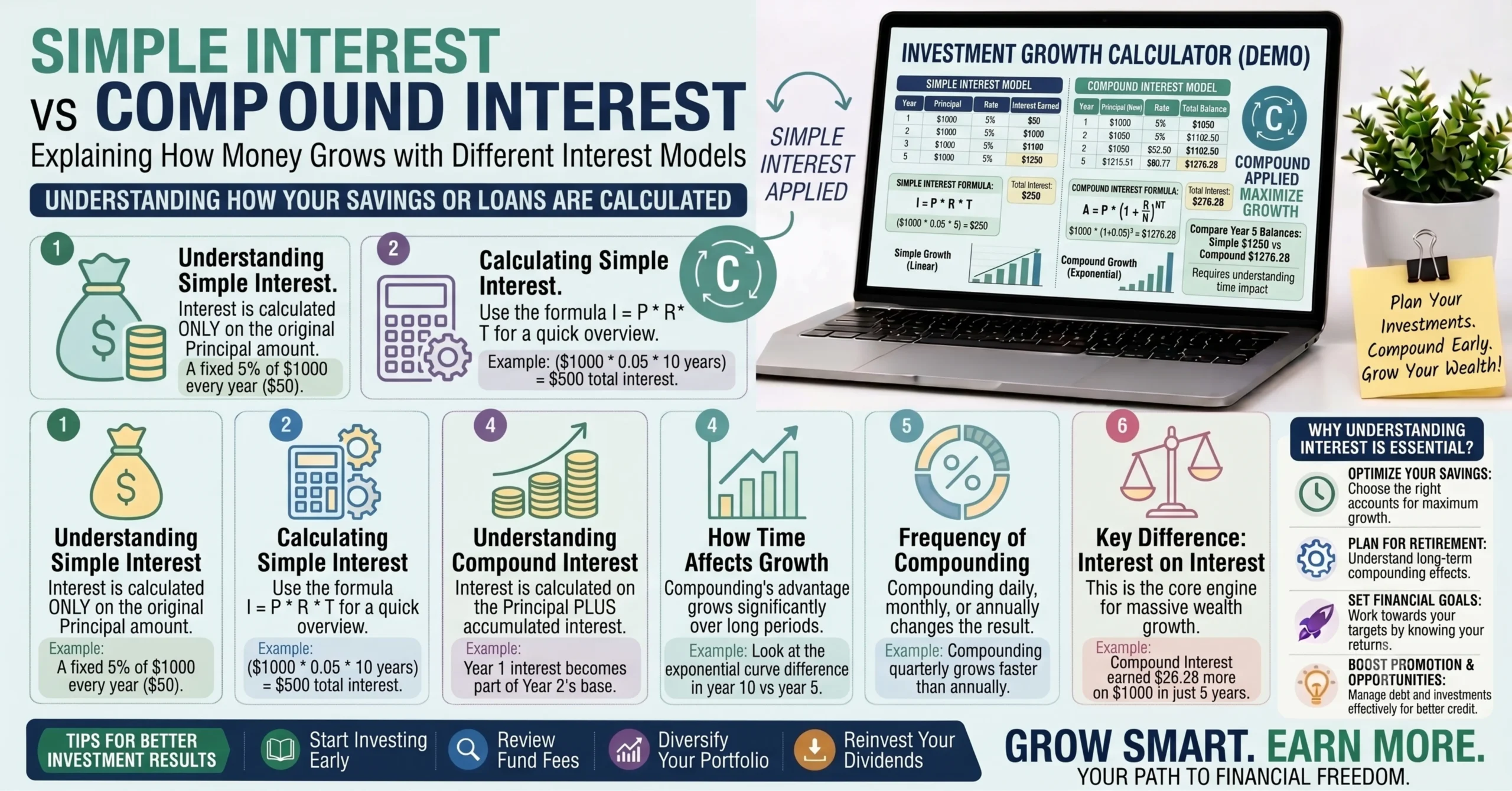
Simple Interest vs Compound Interest Explained
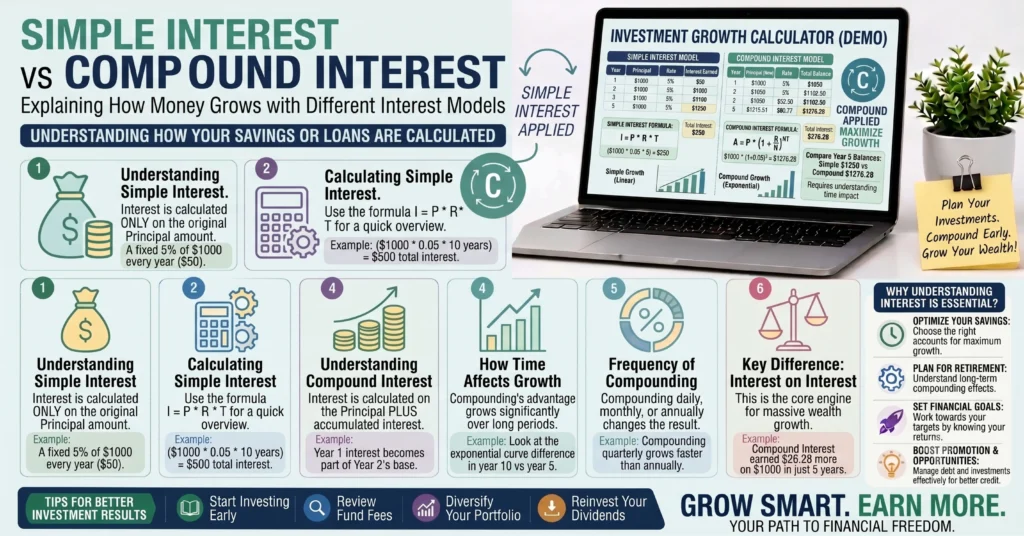
Two loans with the same principal and the same stated interest rate can end up costing wildly different amounts, depending on one detail most borrowers never think to ask about: whether the interest is simple or compound. The same is true in reverse for savings and investments the difference between these two calculation methods, especially over long time periods, is genuinely one of the most consequential concepts in personal finance, even though the underlying math is fairly approachable once it’s laid out clearly.
This guide breaks down exactly how each type of interest is calculated, shows a side-by-side example of how dramatically they diverge over time, covers a genuinely useful mental math shortcut for estimating compound growth, and explains where each type actually shows up in real financial products including a detail that surprises a lot of people about how most loans actually work.
What Is Simple Interest?
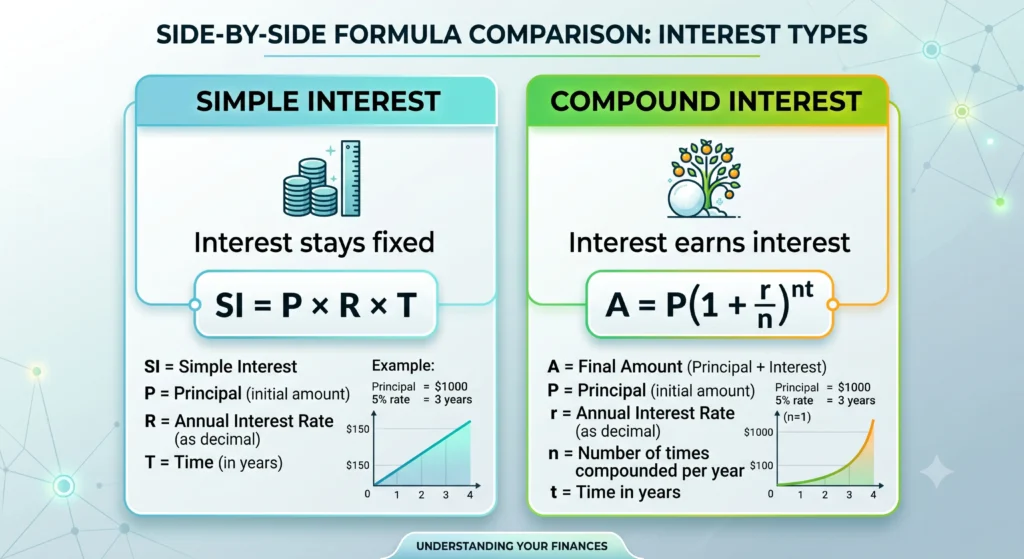
Simple interest is calculated only on the original principal amount, for the entire duration of a loan or investment. It never compounds interest earned or charged in one period doesn’t itself generate additional interest in later periods, no matter how long the money sits.
$$\text{Simple Interest} = \text{Principal} \times \text{Rate} \times \text{Time}$$
Here’s a worked example: PKR 100,000 at a 10% annual rate for 3 years.
Simple Interest = 100,000 × 0.10 × 3 = PKR 30,000
Total amount after 3 years = PKR 130,000. The interest amount stays fixed at PKR 10,000 per year for every year of the term, regardless of how much time has passed.
What Is Compound Interest?
Compound interest is calculated on the principal plus any interest that has already accumulated. Each period’s interest gets added to the running total, and subsequent interest is then calculated on that larger amount meaning the interest itself starts earning interest.
$$A = P\left(1 + \frac{r}{n}\right)^{nt}$$
Where $A$ is the final amount, $P$ is the principal, $r$ is the annual interest rate, $n$ is how many times per year the interest compounds, and $t$ is the time in years.
Using the same figures as before PKR 100,000 at 10% annually, compounded once per year, for 3 years:
$$A = 100,000 \times \left(1 + \frac{0.10}{1}\right)^{1 \times 3} = 100,000 \times (1.10)^3 = 100,000 \times 1.331 = \text{PKR } 133,100$$
That’s PKR 33,100 in interest, compared to PKR 30,000 under simple interest on the exact same principal, rate, and time period a modest difference over just 3 years, but one that grows dramatically as the time horizon extends, covered directly in the next section.
The Real Difference A Side-by-Side Example Over Time
The gap between simple and compound interest looks fairly small over a short period, which is exactly why its long-term impact catches so many people off guard. Extending the same PKR 100,000 principal at 10% annually out to 20 years illustrates this clearly.
- Under simple interest: Interest = 100,000 × 0.10 × 20 = PKR 200,000. Total amount = PKR 300,000.
- Under compound interest (compounded annually):$$A = 100,000 \times (1.10)^{20} = 100,000 \times 6.727 \approx \text{PKR } 672,700$$Total interest earned = approximately PKR 572,700.
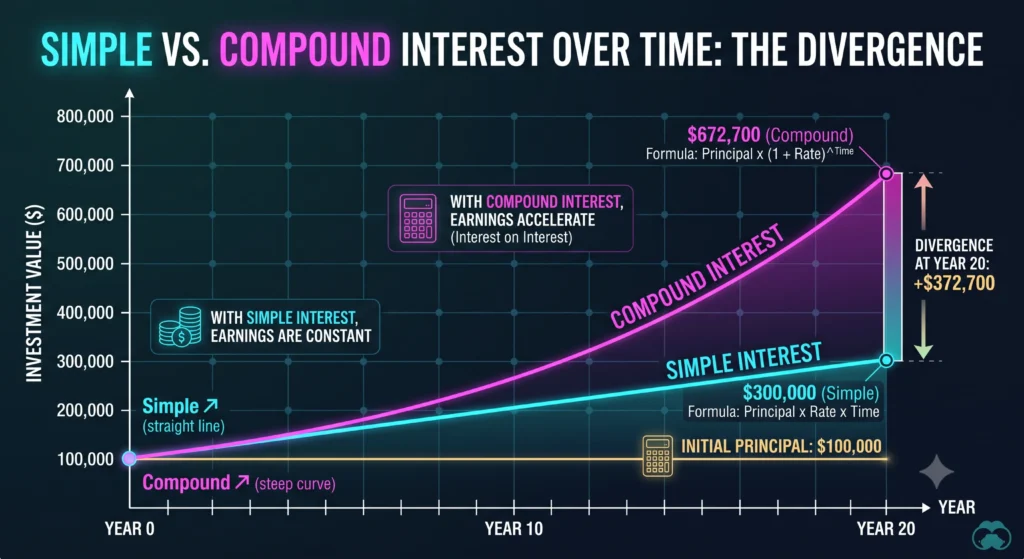
Over the same 20-year period, at the exact same rate, compound interest produces more than double the total amount that simple interest does. This is the core mechanic behind the well-known financial advice to start saving or investing as early as possible the advantage of compounding isn’t primarily about the rate itself, it’s about giving the compounding process as much time as possible to work.
Why Compounding Frequency Matters
Even at an identical stated annual rate, how often interest compounds within that year changes the actual return you earn. Comparing PKR 100,000 at a 10% annual rate over just one year, across different compounding frequencies, shows the effect clearly.
- Compounded annually ($n = 1$):$$100,000 \times (1.10)^1 = \text{PKR } 110,000$$
- Compounded monthly ($n = 12$):$$100,000 \times \left(1 + \frac{0.10}{12}\right)^{12} \approx \text{PKR } 110,471$$
- Compounded daily ($n = 365$):$$100,000 \times \left(1 + \frac{0.10}{365}\right)^{365} \approx \text{PKR } 110,516$$
More frequent compounding always produces a slightly higher effective return at the same nominal rate, since interest starts earning its own interest sooner within each year. This is exactly why financial products distinguish between a nominal rate the stated annual percentage and an effective annual rate, which reflects the true annual return once compounding frequency is factored in. Two products advertising the same nominal rate can genuinely deliver different real returns depending on how often they compound.
The Rule of 72 A Quick Mental Math Shortcut
Among the most genuinely useful tricks in personal finance, the Rule of 72 provides a fast way to estimate how long it takes an investment to double under compound interest, without needing to run the full exponential formula.
$$\text{Years to Double} \approx \frac{72}{\text{Annual Interest Rate}}$$
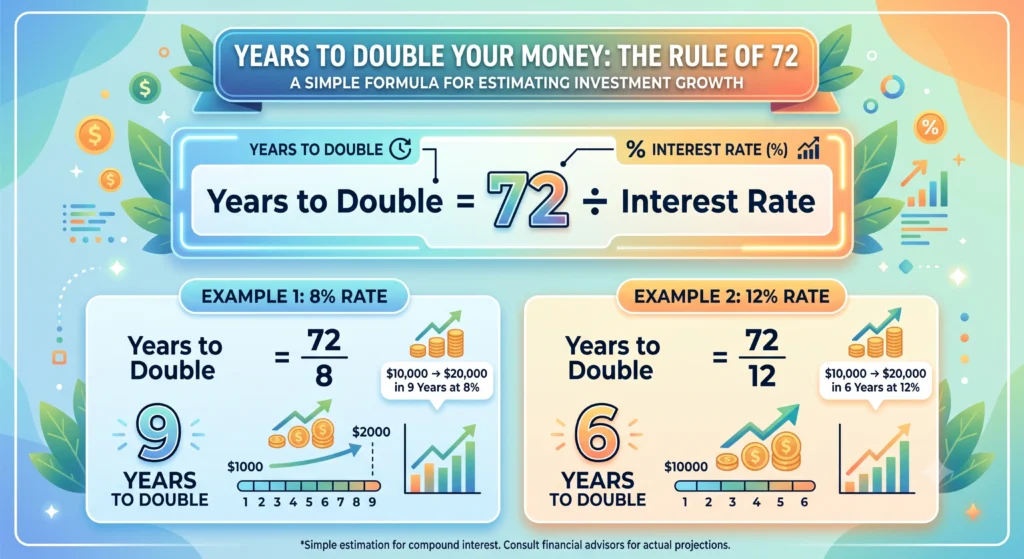
At an 8% annual return, money doubles in approximately 72 ÷ 8 = 9 years. At a 12% return, it takes roughly 72 ÷ 12 = 6 years. This shortcut is an approximation rather than an exact calculation, and it works best within a moderate interest rate range, roughly 6% to 10% its accuracy declines somewhat at very high or very low rates. Still, for a quick mental estimate while comparing investment options, it’s a remarkably handy tool that requires no calculator at all.
Where You’ll Actually Encounter Each Type
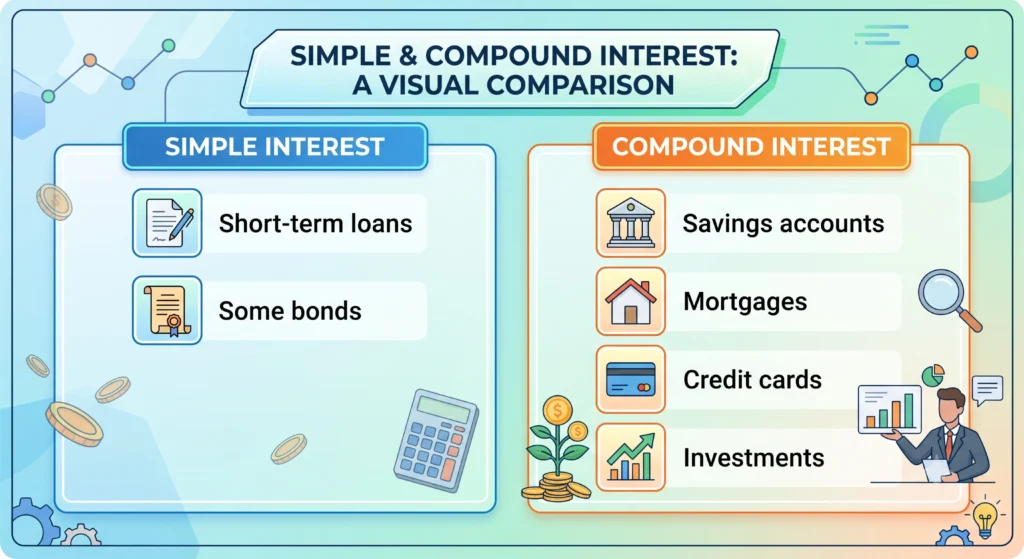
Simple interest shows up less often in real financial products than most people assume it appears mainly in certain short-term personal loans, some bonds, and in introductory finance education, where it’s a useful starting point precisely because the math is simpler to follow.
Compound interest, by contrast, is genuinely everywhere in modern finance. Virtually every standard savings account compounds, as do most investment vehicles, including mutual funds and reinvested dividends. Perhaps the most counterintuitive part is that most consumer loans mortgages, car loans, and especially credit cards also use compound interest, working against the borrower rather than for them. Many people assume a loan works on simple interest simply because it sounds more straightforward, but in practice, the reducing-balance method used by most lenders is fundamentally a compound interest mechanism.
Compound Interest and Loans Why Your EMI Isn’t Simple Interest
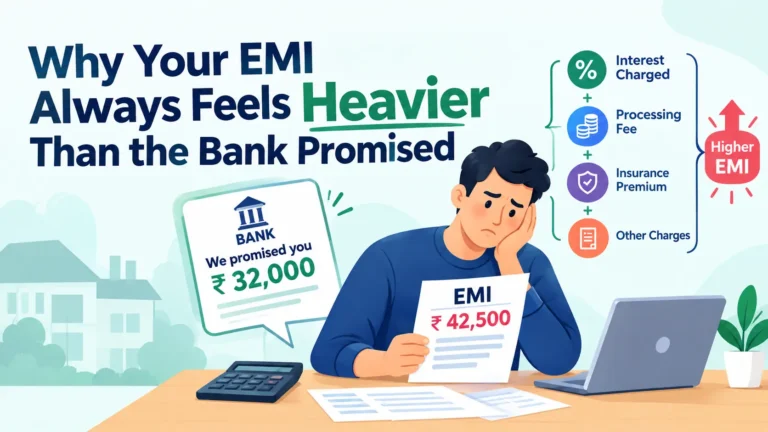
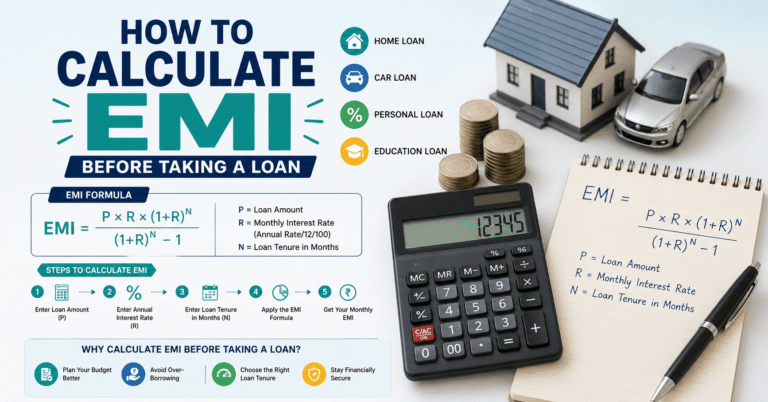
If you’ve calculated a loan EMI before covered in detail in our EMI Calculator guide you’ve already worked with compound interest without necessarily labeling it that way. The reducing-balance method used to calculate EMI charges interest each month on whatever principal balance remains outstanding, not on the original loan amount for the entire term. If a payment is missed or only partially made, the unpaid interest itself can become part of the balance that future interest is calculated on interest compounding on interest, exactly as described earlier in this guide.
This is precisely why carrying a balance on compound-interest debt, particularly something like a credit card, can spiral so quickly compared to what a simple interest assumption would predict. Understanding that most loans compound, rather than accruing simple interest, is genuinely useful context before signing any loan agreement or deciding how aggressively to pay down existing debt.
How to Use Our Calculators for Interest-Related Math
For loan-specific calculations that apply these compound interest principles directly, our EMI Loan Calculator breaks down your monthly installment, total interest, and total repayment amount using the reducing-balance method described above. For the underlying percentage math behind any interest rate calculation, our Percentage Calculator handles the basic rate-based arithmetic that both simple and compound interest formulas ultimately build on.
Common Mistakes When Thinking About Interest
- Mistake 1: Assuming a loan uses simple interest by default, when most consumer loans mortgages, car loans, and credit cards especially actually compound.
- Mistake 2: Comparing two interest rates without accounting for differing compounding frequencies, which can make a lower nominal rate on one product actually cost more than a seemingly higher rate on another, once effective annual rates are properly compared.
- Mistake 3: Underestimating how dramatically the gap between simple and compound interest widens over long time horizons, since the difference looks minor within the first year or two.
- Mistake 4: Applying the Rule of 72 at very high or very low interest rates, where its accuracy as an estimate declines noticeably.
Key Terms Related to Interest Calculations
- Principal: The original amount of money borrowed or invested, before any interest is applied.
- Compounding Frequency: How many times per year interest is calculated and added to the balance annually, monthly, or daily are common examples.
- Effective Annual Rate (EAR): The true annual return or cost once compounding frequency is factored in, which can differ from the stated nominal interest rate.
- Rule of 72: A mental math shortcut estimating the number of years needed for an investment to double under compound interest, calculated as 72 divided by the annual interest rate.
Frequently Asked Questions About Simple and Compound Interest
Q1: What is the difference between simple interest and compound interest?
Simple interest is calculated only on the original principal for the entire term. Compound interest is calculated on the principal plus any previously accumulated interest, meaning interest itself starts earning interest.
Q2: Which grows money faster, simple or compound interest?
Compound interest grows money faster over time, since accumulated interest itself begins earning additional interest a gap that widens significantly the longer the time period extends.
Q3: Do loans use simple or compound interest?
Most consumer loans, including mortgages, car loans, and credit cards, use compound interest through a reducing-balance method, despite many borrowers assuming otherwise.
Q4: What is the Rule of 72?
It’s a quick estimation method for how long an investment takes to double under compound interest, calculated by dividing 72 by the annual interest rate.
Q5: How does compounding frequency affect returns?
More frequent compounding monthly or daily versus annually produces a slightly higher effective return at the same stated nominal rate, since interest begins earning interest sooner.
Q6: What is the formula for compound interest?
The formula is $A = P\left(1 + \frac{r}{n}\right)^{nt}$, where $P$ is the principal, $r$ is the annual rate, $n$ is the compounding frequency per year, and $t$ is the time in years.
Q7: Why does compound interest matter more over long time periods?
The gap between simple and compound interest starts small but widens dramatically over time, since each period’s compound interest is calculated on an increasingly larger base amount.
Q8: What is the effective annual rate?
It’s the true annual return or cost once compounding frequency is accounted for, which can differ meaningfully from the stated nominal interest rate on the same product.
Q9: Is credit card interest simple or compound?
Credit card interest is compound interest, which is part of why carrying an unpaid balance can grow considerably faster than a simple interest assumption would suggest.
Q10: Can I calculate loan interest using InnovaiTools?
Yes, our freeEMI Loan Calculatorcalculates monthly installments, total interest, and total repayment using the compound, reducing-balance method most loans actually follow.
Final Thoughts
The difference between simple and compound interest isn’t just an academic distinction it’s the reason long-term saving and investing rewards patience so heavily, and the reason carrying debt on the wrong terms can spiral faster than expected. Understanding which type of interest actually applies to a given loan, savings account, or investment and how compounding frequency shifts the real return even at an identical stated rate puts you in a genuinely stronger position to evaluate any financial decision involving interest.
For loan-specific calculations built on these exact principles, use our free EMI Loan Calculator at InnovaiTools to see exactly how compound interest applies to your own numbers.

Arid is a web developer and computer expert who specializes in building practical utility web applications. With a strong focus on technical problem-solving and user experience, he develops efficient online calculators and writing tools designed to help students, bloggers, and professionals streamline their daily tasks.