How to Calculate EMI Before Taking a Loan
How to Calculate EMI Before Taking a Loan — Complete Guide
Taking a loan is one of the biggest financial decisions most people make in their lifetime. Whether you are buying a home, purchasing a car, funding your education, or covering an emergency expense — a loan can be a powerful financial tool when used wisely. But here is the problem: most people focus only on the loan amount they need and completely ignore one of the most important numbers — the EMI.
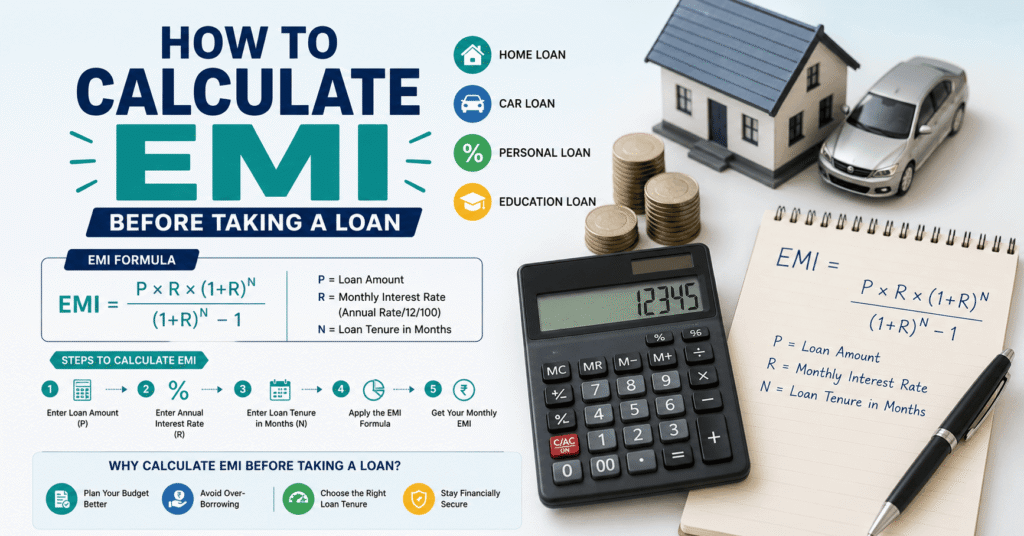
EMI, or Equated Monthly Installment, is the fixed amount you pay to your bank or lender every single month until the loan is fully repaid. It includes both the principal amount and the interest charged on it. If you do not calculate your EMI before taking a loan, you could end up committing to monthly payments that strain your budget, damage your savings, or worse — lead to a debt trap.
The good news? Calculating your EMI before signing any loan agreement is incredibly easy today. Our free EMI Loan Calculator at InnovaiTools gives you an instant, accurate breakdown of your monthly payment, total interest payable, and total repayment amount — in just a few seconds.
In this complete guide, we will walk you through everything you need to know about EMI — what it is, how it is calculated, what factors affect it, and how to use it to make smarter borrowing decisions.
What is EMI?
EMI stands for Equated Monthly Installment. It is the fixed monthly payment you make to a lender to repay a loan over a specified period of time. The word “equated” means that the amount stays the same every month throughout the loan tenure — making it easier to plan your monthly budget.
Every EMI payment you make has two components:
- Principal Component: This is the portion of your payment that goes toward repaying the actual loan amount you borrowed.
- Interest Component: This is the portion that goes toward paying the interest charged by the lender on the outstanding loan balance.
Important Note: In the early months of your loan, the majority of your EMI goes toward paying interest, with only a small portion reducing your principal. As the loan progresses, this ratio gradually shifts — more of your EMI goes toward the principal and less toward interest. This process is documented in an amortization schedule.
The EMI Formula — How is EMI Calculated?
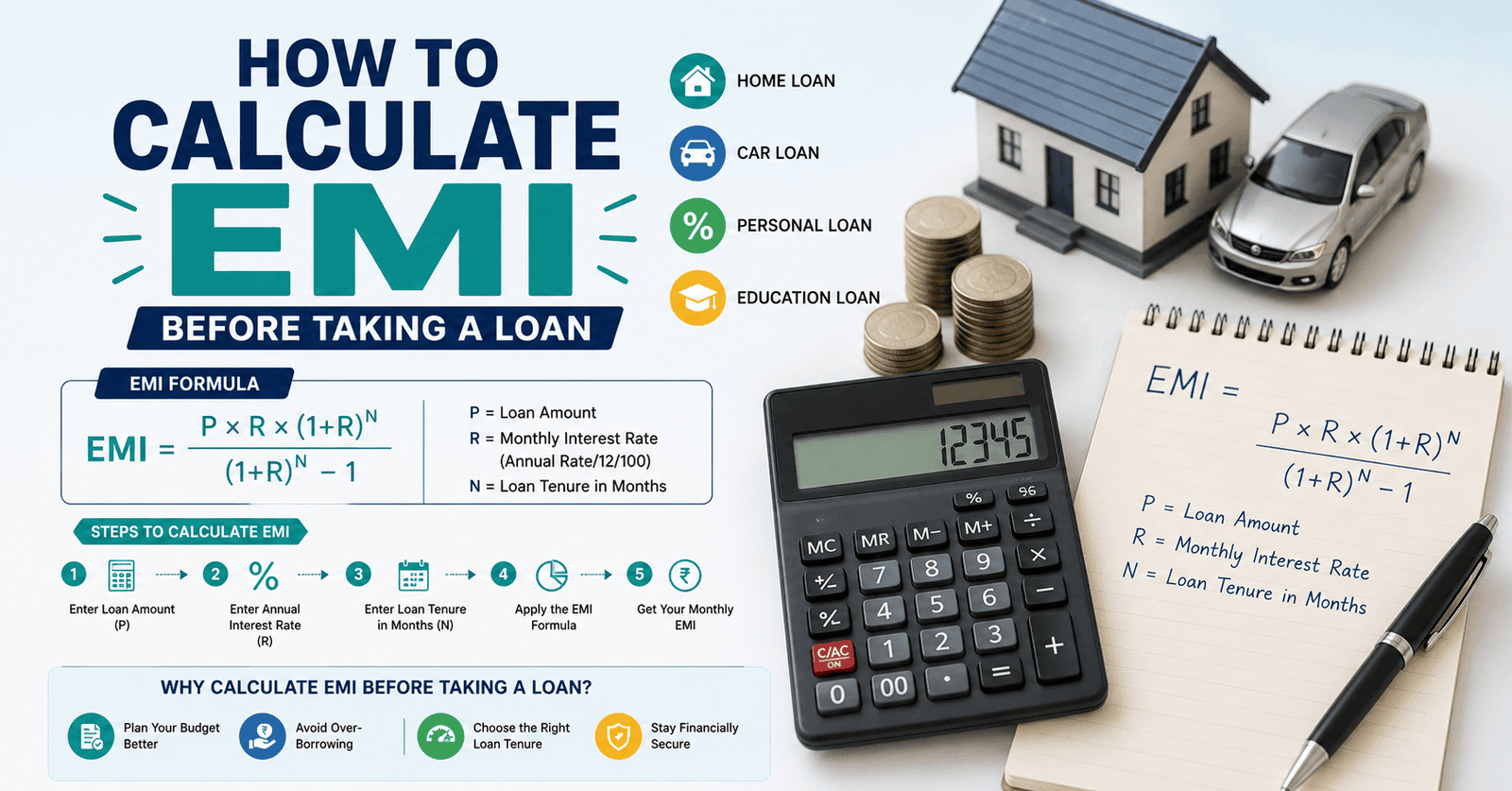
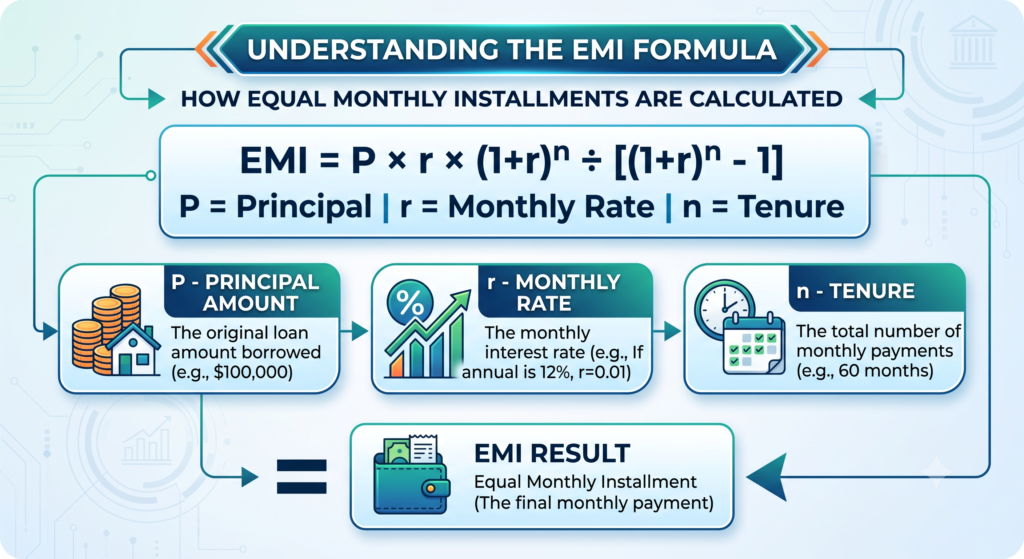
The standard EMI formula used by banks and financial institutions worldwide is:
$$\text{EMI} = \frac{P \times r \times (1 + r)^n}{(1 + r)^n – 1}$$
Where:
- P = Principal loan amount (the amount you borrow)
- r = Monthly interest rate (annual interest rate divided by 12, then divided by 100)
- n = Loan tenure in months (number of months to repay)
EMI Calculation Example
Let us say you want to take a personal loan of PKR 500,000 at an annual interest rate of 12% for a tenure of 3 years (36 months).
- Find the monthly interest rate (r):$$\text{Annual rate} = 12\% \rightarrow 12 \div 12 \div 100 = 0.01$$
- Find the tenure in months (n):$$3 \text{ years} = 36 \text{ months} \rightarrow (n = 36)$$
- Apply the formula:$$\text{EMI} = \frac{500,000 \times 0.01 \times (1 + 0.01)^{36}}{(1 + 0.01)^{36} – 1} \approx \textbf{PKR 16,607 per month}$$
- Total Amount Payable: $16,607 \times 36 =$ PKR 597,852
- Total Interest Paid: $597,852 – 500,000 =$ PKR 97,852
As you can see, on a PKR 500,000 loan at 12% for 3 years, you end up paying nearly PKR 98,000 extra in interest alone. This is exactly why calculating your EMI before taking a loan is so important.
Do not want to do this math manually? Use our free EMI Loan Calculator at InnovaiTools to get your result instantly — just enter your loan amount, interest rate, and tenure.
How to Use the InnovaiTools EMI Loan Calculator
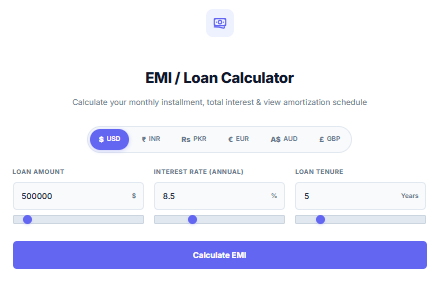
Our free EMI Loan Calculator makes it incredibly simple to calculate your monthly installment in seconds. Here is how to use it:
- Open the Calculator: Navigate to the EMI Loan Calculator on InnovaiTools.
- Enter Loan Amount: Input the total amount you want to borrow.
- Enter Interest Rate: Type in the annual interest rate offered by your bank or lender.
- Enter Loan Tenure: Input the time period in months or years depending on your preference.
- Click Calculate: Press the “Calculate EMI” button.
- Review Instant Results: Instantly view your:
- Monthly EMI amount
- Total interest payable over the entire loan period
- Total amount payable (principal + interest)
Our calculator is completely free, requires no sign-up, and works on all devices. Your financial data stays private — nothing is stored or shared.
What Factors Affect Your EMI?
Understanding what affects your EMI helps you make smarter decisions when choosing a loan. There are three primary factors:
1. Loan Amount (Principal)
The higher the loan amount, the higher your EMI will be. This seems obvious, but many people borrow more than they actually need — which unnecessarily increases their monthly burden. Always borrow only what you need and can comfortably repay.
2. Interest Rate
The interest rate is one of the biggest drivers of your EMI. Even a small difference in interest rate can significantly change your monthly payment and total interest paid over the life of the loan.
Impact of Interest Rates on a PKR 1,000,000 Loan (5-Year Tenure):
| Annual Interest Rate | Estimated Monthly EMI | Monthly Difference |
| 10% | PKR 21,247 | — |
| 14% | PKR 23,268 | + PKR 2,021 / mo |
| 18% | PKR 25,393 | + PKR 4,146 / mo |
That is a difference of over PKR 4,000 per month just from an 8% difference in interest rate. Always compare interest rates from multiple lenders before deciding.
3. Loan Tenure
The loan tenure — how long you take to repay — has a major impact on your EMI. A longer tenure means a lower monthly EMI but higher total interest paid. A shorter tenure means a higher monthly EMI but lower total interest paid.
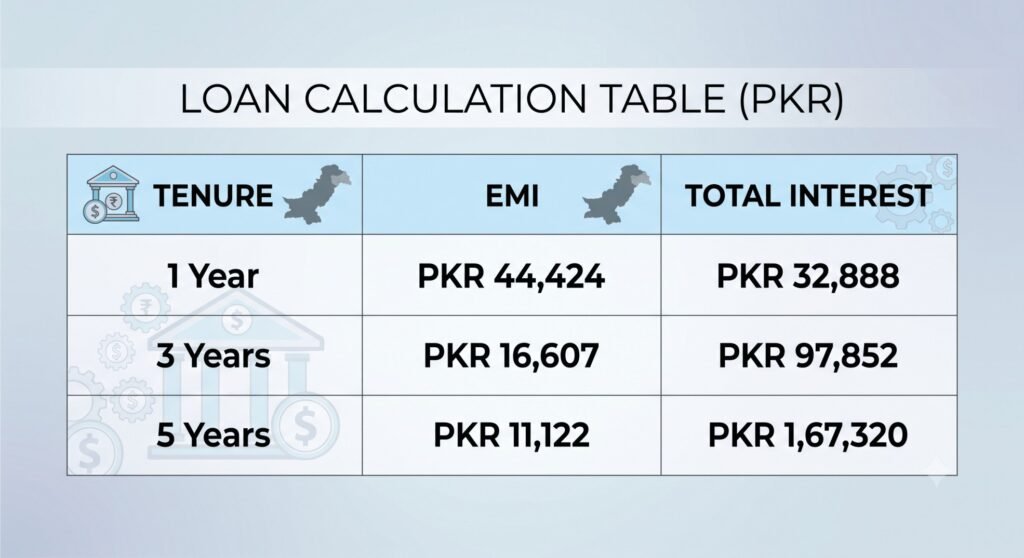
Impact of Tenure on a PKR 500,000 Loan (12% Annual Interest):
| Loan Tenure | Monthly EMI | Total Interest Paid |
| 1 Year (12 mos) | PKR 44,424 | PKR 32,888 |
| 3 Years (36 mos) | PKR 16,607 | PKR 97,852 |
| 5 Years (60 mos) | PKR 11,122 | PKR 167,320 |
Notice how stretching the loan from 1 year to 5 years reduces the monthly EMI significantly — but the total interest paid jumps from PKR 33,000 to PKR 167,000. This is the hidden cost of long loan tenures.
Types of Loans and Their Typical EMI Ranges
EMI applies to virtually every type of loan. Here is a quick overview of the most common loan types:
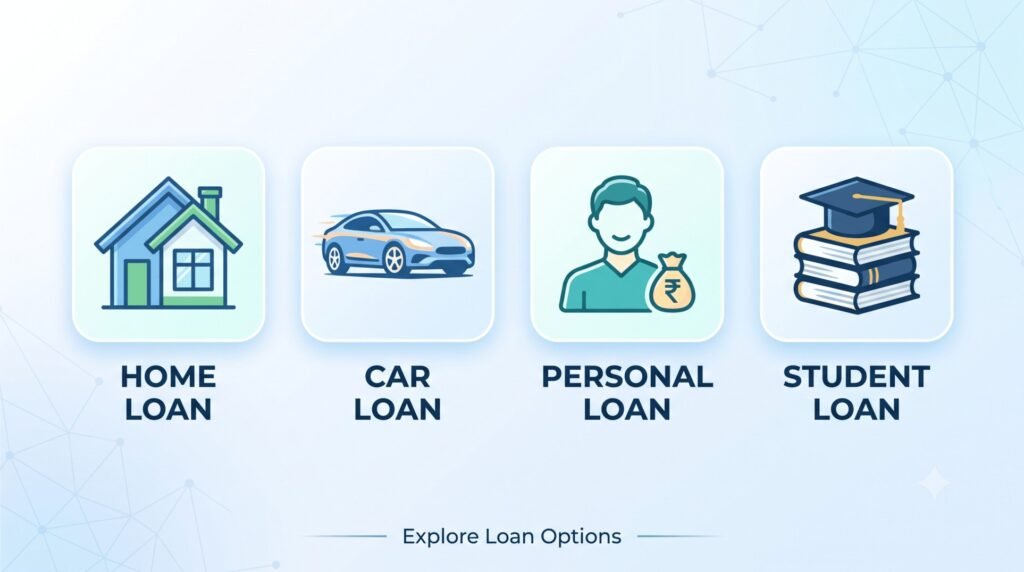
Home Loan
Home loans are typically the largest loans most people take. They come with long tenures (15–30 years) and relatively lower interest rates compared to personal loans. The long tenure keeps the monthly EMI manageable, but the total interest paid over 20–30 years can be enormous — often exceeding the original loan amount.
Personal Loan
Personal loans are unsecured loans (no collateral required) with shorter tenures (1–5 years) and higher interest rates. They are often used for emergencies, medical expenses, travel, or home renovations. Because of the higher interest rate and shorter tenure, EMIs for personal loans tend to be higher relative to the loan amount.
Car Loan
Car loans are secured against the vehicle being purchased. They typically have tenures of 3–7 years and interest rates that fall between home loan and personal loan rates. The EMI for a car loan is directly affected by the car’s price, down payment amount, and loan tenure.
Education Loan
Education loans help students fund higher education. They often come with a moratorium period (a grace period after course completion before repayment begins) and moderate interest rates. EMI calculation for education loans starts after the moratorium period ends.
Smart Tips Before Taking a Loan
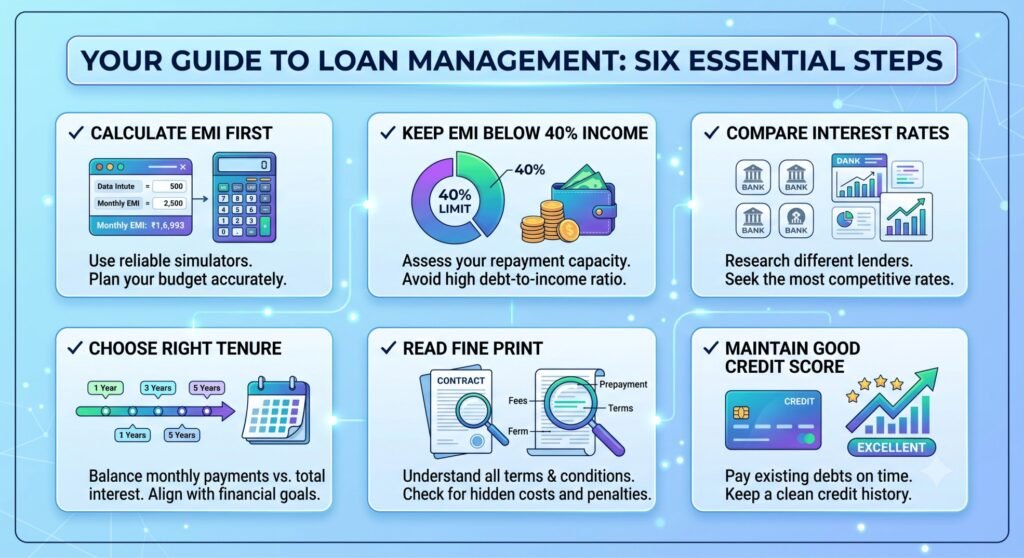
Now that you understand how EMI works, here are some practical tips to help you borrow smartly:
- Always Calculate EMI Before Applying: Never apply for a loan without knowing your exact monthly EMI. Use our free EMI Loan Calculator to run different scenarios before committing.
- Keep EMI Below 40% of Monthly Income: A common financial rule of thumb is that your total monthly EMI payments (across all loans) should not exceed 40% of your monthly take-home income. This ensures you have enough left for living expenses and savings.
- Compare Interest Rates: Even a 1–2% difference in interest rate can save you thousands over the loan period. Always compare rates from at least 3–4 lenders before deciding.
- Choose the Right Tenure: Do not automatically choose the longest tenure just because it gives a lower EMI. Calculate the total interest you will pay over the entire loan and weigh that against the monthly savings.
- Read the Fine Print: Watch out for processing fees, prepayment penalties, and other hidden charges that can add significantly to the total cost of your loan.
- Maintain a Good Credit Score: A higher credit score (typically 700+ in Pakistan and India) gives you access to lower interest rates, which directly reduces your EMI and total repayment amount.
- Consider Prepayment: If your financial situation improves, consider making lump-sum prepayments toward your loan principal. This reduces your outstanding balance, which in turn reduces either your EMI or your remaining tenure.
EMI vs Flat Rate Interest — What is the Difference?
This is something many borrowers do not realize until it is too late. There are two ways lenders can charge interest on a loan:
- Reducing Balance Method (used in EMI): Interest is calculated on the outstanding loan balance each month. As you repay the principal, the interest charged decreases. This is the standard method used by most banks and the method our EMI Calculator uses.
- Flat Rate Method: Interest is calculated on the original loan amount for the entire tenure, regardless of how much principal you have repaid. This results in a much higher effective interest rate than what is advertised.
Warning: Always confirm which method your lender uses before signing. If a lender offers a “flat rate” of 8%, the effective interest rate using the reducing balance method could actually be closer to 14–15%.
Frequently Asked Questions About EMI
What does EMI stand for?
EMI stands for Equated Monthly Installment. It is the fixed monthly payment made to a lender to repay a loan, which includes both the principal and interest components.
Is EMI fixed throughout the loan tenure?
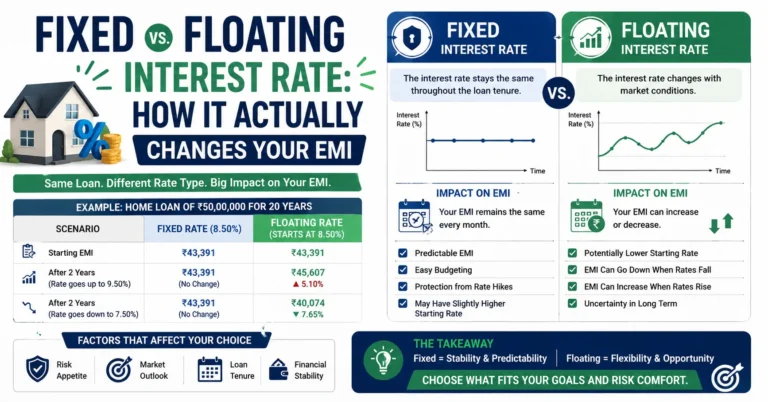
For fixed-rate loans, the EMI remains constant throughout the loan tenure. For floating-rate loans, the EMI may change if the interest rate changes during the loan period.
What happens if I miss an EMI payment?
Missing an EMI payment can result in late payment penalties, a negative impact on your credit score, and in severe cases, legal action by the lender. Always ensure you have sufficient funds in your account on the EMI due date.
Can I reduce my EMI after taking a loan?
Yes. You can reduce your EMI by making a partial prepayment of the principal, which reduces the outstanding loan balance. Alternatively, you can request your lender to extend the loan tenure, which also reduces the monthly EMI but increases total interest paid.
What is a moratorium period?
A moratorium period is a temporary pause in EMI payments, often offered at the beginning of education loans or during financial hardships. During this period, interest may still accrue on the outstanding loan balance.
How does a down payment affect EMI?
A larger down payment reduces the principal loan amount, which directly reduces your EMI and total interest paid. Whenever possible, make the largest down payment you can comfortably afford.
Is it better to choose a short or long loan tenure?
A shorter tenure means higher EMI but lower total interest paid. A longer tenure means lower EMI but much higher total interest. The right choice depends on your monthly cash flow — choose the shortest tenure your budget can comfortably handle.
What is an amortization schedule?
An amortization schedule is a complete table showing the breakdown of every EMI payment — how much goes toward principal and how much toward interest — for the entire loan tenure. It helps you understand how your loan balance reduces over time.
Can I calculate EMI for any type of loan?
Yes. The EMI formula works for all types of loans including home loans, personal loans, car loans, and education loans. Our free EMI Loan Calculator at InnovaiTools can handle all loan types.
Is the InnovaiTools EMI Calculator free?
Yes, our EMI Loan Calculator is 100% free to use. No account required, no data stored. Just enter your loan details and get instant results. Visit our EMI Loan Calculator page to try it now.
Final Thoughts
Taking a loan without calculating your EMI first is like driving without a map — you might reach your destination, but the journey will be far more stressful and expensive than it needed to be. Understanding your EMI gives you clarity, control, and confidence when making one of the most important financial decisions of your life.
Before you sign any loan agreement, take two minutes to run the numbers. Use our free EMI Loan Calculator at InnovaiTools to calculate your monthly installment, total interest, and total repayment amount for any loan scenario. Try different loan amounts, interest rates, and tenures to find the combination that works best for your financial situation.
A little planning today can save you a significant amount of money — and a lot of stress — over the years ahead. Borrow smart, plan ahead, and let InnovaiTools help you make better financial decisions.

Arid is a web developer and computer expert who specializes in building practical utility web applications. With a strong focus on technical problem-solving and user experience, he develops efficient online calculators and writing tools designed to help students, bloggers, and professionals streamline their daily tasks.