Body Fat Percentage vs. BMI: What’s the Real Difference?
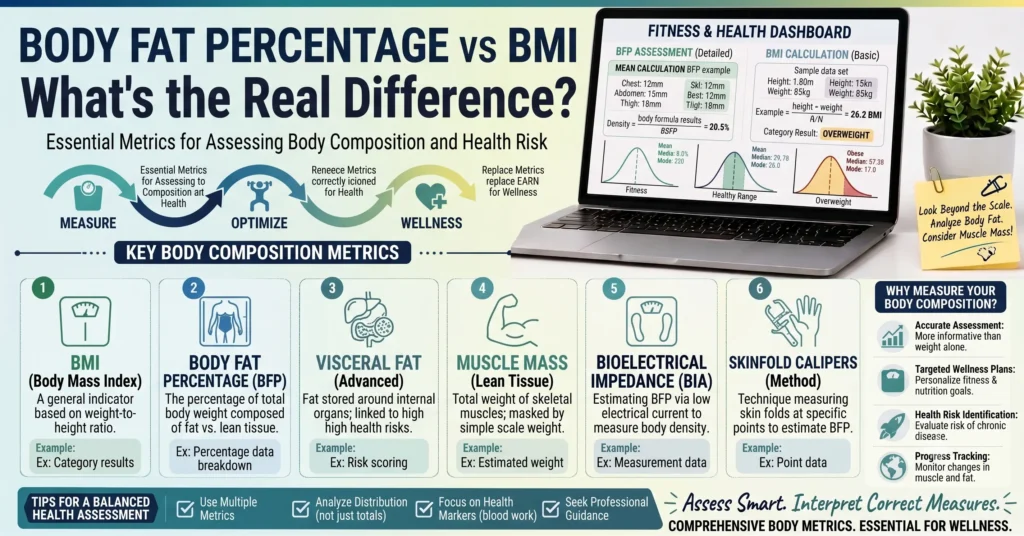
Picture this scenario: two different people step onto a scale at the doctor’s office. They are the exact same height, and they weigh the exact same amount. According to the medical chart on the wall, they get the exact same BMI result.
But if you look at them side-by-side in real life, they have completely different body shapes. One might be a dedicated gym-goer carrying a ton of dense, heavy muscle, while the other hasn’t worked out in months and carries more weight around their midsection.BMI simply doesn’t care. It literally cannot tell them apart.If you have ever felt incredibly frustrated stepping on a scale and seeing a number that doesn’t seem to match the mirror, or if you’ve been told your BMI is “too high” despite being in great shape, you are not alone. This is exactly the massive blind spot that body fat percentage fills.
Let’s break down the real difference between these two numbers, how they are actually measured, why BMI can be so misleading, and why understanding your body fat percentage gives you a much clearer, more honest picture of your overall health.
What Exactly Is Body Fat Percentage?
To put it simply, your body fat percentage is the portion of your total overall body weight that consists exclusively of fat.
Think about everything that makes up your body. You have your skeleton, your muscles, your organs, and a whole lot of water. All of those things grouped together are what fitness professionals call your “lean mass.” Whatever is left over after you account for all of that lean mass is your fat mass.
While BMI just looks at how heavy you are relative to how tall you are, body fat percentage looks inside that weight. It doesn’t just ask “how much do you weigh?” It asks, “what is that weight actually made of?”
Why BMI and Body Fat Percentage Tell Completely Different Stories
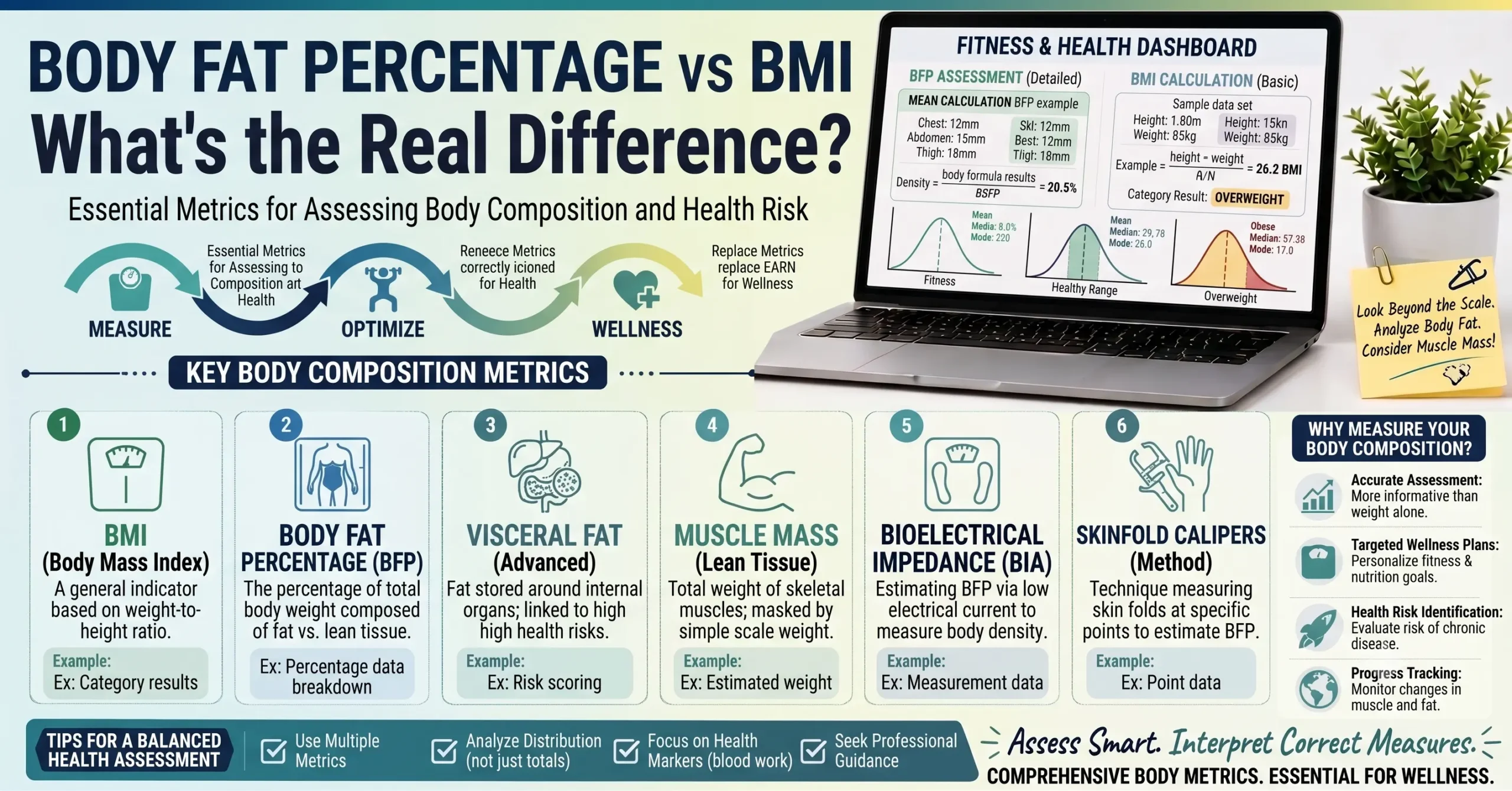
Let’s clear up a very common confusion right away: BMI (Body Mass Index) is not, and has never been, a measurement of your body composition. It is literally just a math equation.
To understand why BMI is flawed for individuals, it helps to know a little bit of history. BMI was invented all the way back in the 1830s by a Belgian mathematician named Adolphe Quetelet. He wasn’t a doctor, and he wasn’t trying to measure individual health. He was trying to figure out the characteristics of the “average man” to help the government allocate resources. He explicitly stated that his formula shouldn’t be used to judge a single person’s level of fatness.
Fast forward to today, and we still use his formula. Because muscle is significantly denser than fat, a compact, highly muscular athlete is very often categorized as “overweight” or even “obese” on a standard BMI chart.
We actually have a complete guide on how BMI works if you want to dive deeper into its specific limits. But the main takeaway for you right now is this: BMI is a quick, general screening tool for large populations. Body fat percentage is the real truth-teller when it comes to your actual personal fitness level.
How Do You Actually Measure Body Fat?
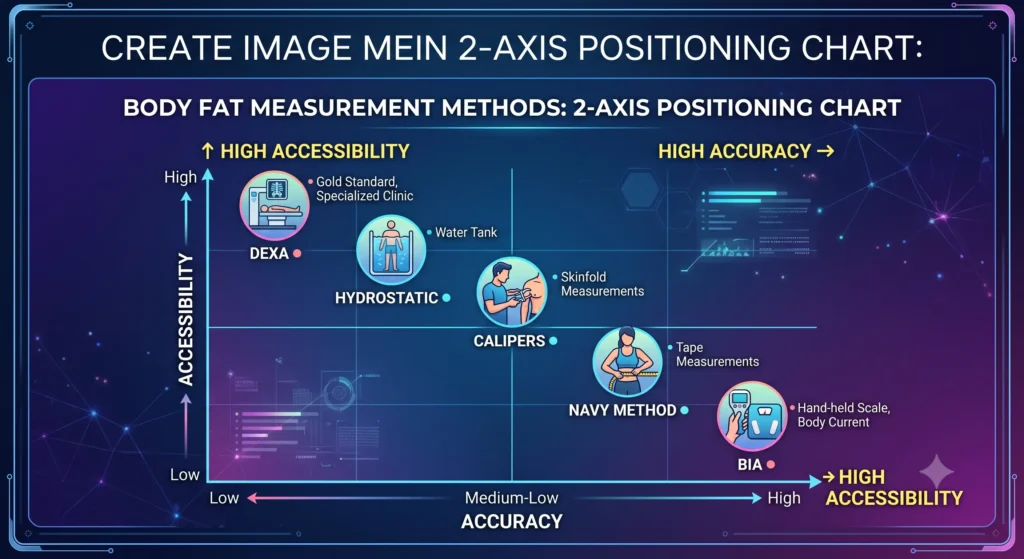
Unlike calculating BMI, which just requires knowing your height and weight, figuring out your body fat percentage requires a bit more effort. Here are the most common ways people measure it today, ranging from the easiest to the most complex:
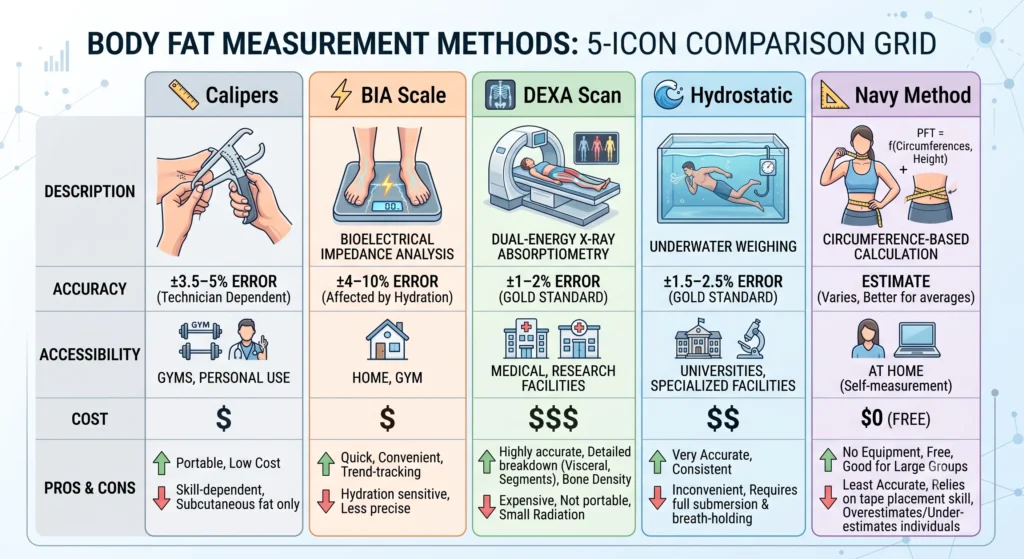
1. Smart Scales (Bioelectrical Impedance)
You have probably seen these sleek glass scales on Amazon or at the gym. They work by sending a tiny, completely painless electrical current up one leg and down the other. Because muscle contains a lot of water, it conducts electricity well. Fat does not. The scale measures the resistance and guesses your body fat. The catch: They are super convenient, but your hydration levels heavily influence them. If you drink a massive glass of water, your body fat percentage might look completely different an hour later.
2. Skinfold Calipers
This is the classic “pinch test” used by personal trainers. A professional will use a tool called a caliper to gently pinch folds of skin and fat at specific spots on your body (like your belly, thigh, and tricep). They measure the thickness of the pinch and plug those numbers into a formula. The catch: It’s affordable and surprisingly reliable, but it heavily depends on the skill of the person pinching you. If they pinch too much muscle, the reading is ruined.
3. Hydrostatic (Underwater) Weighing
This sounds like something out of a sci-fi movie, but it used to be the gold standard. You sit on a specialized scale and are completely submerged underwater. Because fat floats and muscle sinks, the difference between your normal weight and your underwater weight gives a highly accurate body fat reading. The catch: It is expensive, highly uncomfortable for people who don’t like holding their breath underwater, and very hard to find outside of sports science labs.
4. DEXA Scans
Today, this is considered the ultimate gold standard. A DEXA scan is a clinical X-ray that scans your entire body. It maps out your exact bone density, your muscle mass, and your fat tissue, even telling you where that fat is located on your body. The catch: It is incredibly accurate, but you usually have to visit a specialized clinic, book an appointment, and pay a decent amount of money for every single scan.
The Navy Method: How to Estimate Your Body Fat at Home for Free
If you want a solid estimate of your body fat without spending money on a scan or buying a smart scale, you are in luck. You can use the US Navy Method.
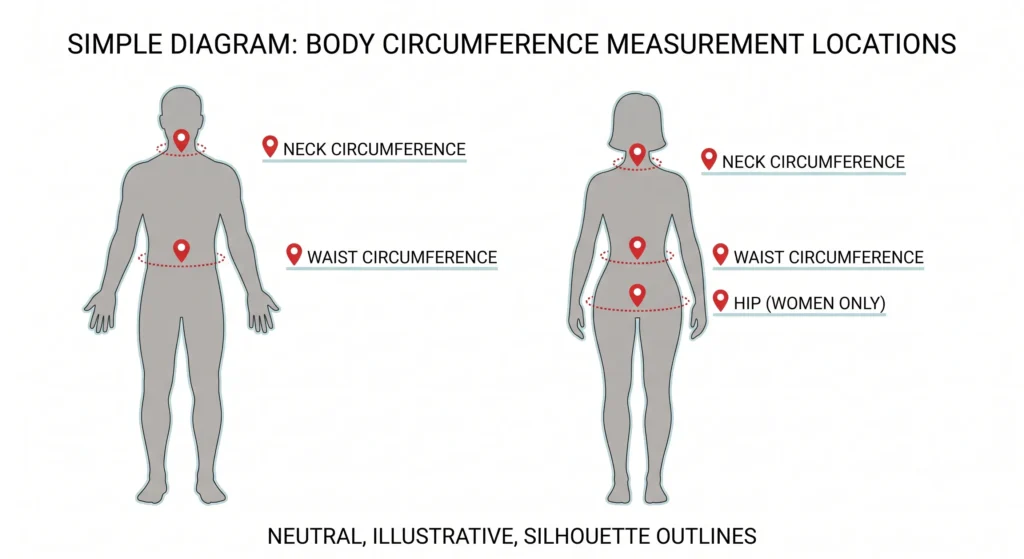
The military needed a way to test thousands of recruits quickly and cheaply, so they developed a formula that just uses a flexible tape measure. Here is how you can do it at home:
For Men: You will need to measure your height, the circumference of your neck (just below the Adam’s apple), and your waist (at your belly button).
For Women: You will need to measure your height, your neck, your natural waist (the narrowest part), and your hips (at the widest point).
Once you have those numbers, you can easily plug them into a free online Navy Method calculator. While it might not be as laser-accurate as a clinical DEXA scan, it is a fantastic, completely free way to track your real progress over time. If your bathroom scale isn’t moving, but your waist measurement is shrinking, the Navy Method will show you that you are successfully losing fat and building muscle.
What Does a “Healthy” Range Actually Look Like?
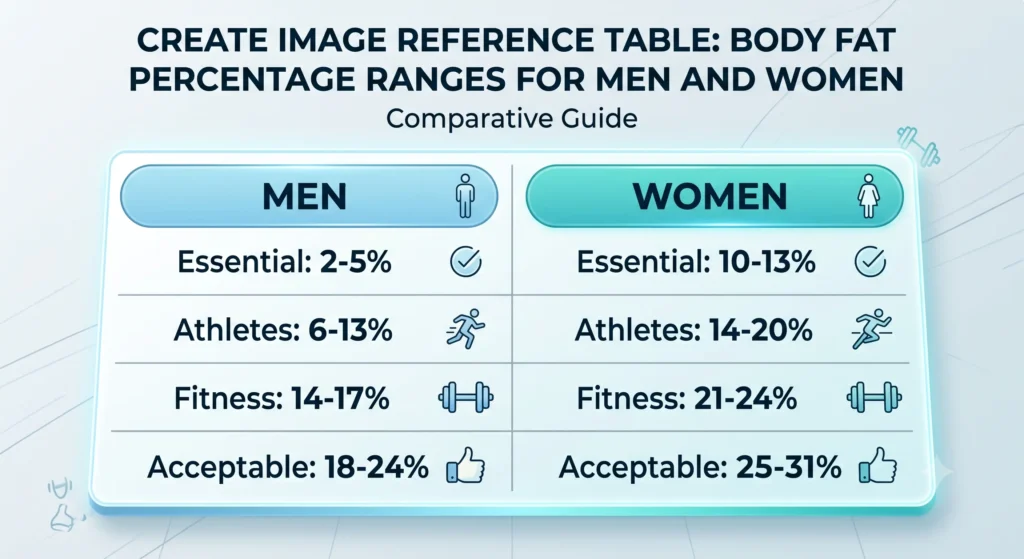
If you start searching for healthy body fat ranges online, you will quickly notice that the numbers for men and women are vastly different. This isn’t a double standard in the fitness industry; it’s basic human biology.
For Men:
- Essential Fat: 2–5%
- Athletic: 6–13%
- Fit/Average: 14–24%
- Obese: 25% and above
For Women:
- Essential Fat: 10–13%
- Athletic: 14–20%
- Fit/Average: 21–31%
- Obese: 32% and above
Notice how a woman at 20% body fat is considered highly athletic, whereas a man at 20% is considered perfectly average. Women’s bodies are biologically designed to hold more fat, which brings us to our next very important point.
The Myth of “Lower is Always Better” (Essential vs. Storage Fat)
A lot of people in the fitness world think they need to drop their body fat as close to zero as humanly possible. Please don’t do that. Your body actually needs fat to survive and function properly.
We categorize fat into two types: Essential fat and Storage fat.
Essential fat is exactly what it sounds like. It is the fat stored inside your organs, inside your bone marrow, and throughout your central nervous system. It regulates your hormones, absorbs vital nutrients (like Vitamins A, D, E, and K), and keeps your brain functioning. Women naturally need significantly more essential fat to support their reproductive health and menstrual cycles.
Storage fat is the extra energy reserve. This is the fat sitting just under your skin and around your waistline. When people talk about “losing weight” to look more toned or to get healthier, this storage fat is what they are talking about.
Dipping into your essential fat levels to look like a fitness model on a magazine cover is incredibly dangerous. It can wreck your immune system, cause chronic fatigue, and lead to severe hormonal imbalances.
Subcutaneous vs. Visceral Fat: Why Where You Store Fat Matters
While we are talking about storage fat, we have to talk about where it lives, because not all fat behaves the same way.
Subcutaneous fat is the soft, jiggly fat right under your skin. It’s the fat you can pinch on your arms, legs, or belly. While people often want to lose it for cosmetic reasons, it is actually relatively harmless from a medical standpoint.
Visceral fat, on the other hand, is the hard fat that lives deep inside your abdomen, wrapping around your liver, stomach, and intestines. You can’t pinch it. A high amount of visceral fat is directly linked to heart disease, type 2 diabetes, and high blood pressure. This is why knowing your body composition—and keeping an eye on your waistline measurements—is so much more valuable than just staring at the total weight on a scale.
If BMI Is So Flawed, Why Do Doctors Still Use It?
You might be wondering: if body fat percentage is so vastly superior, why does every single doctor’s office, insurance company, and health app still ask for your BMI?
Honestly, it all comes down to speed and convenience.
Measuring body fat accurately takes time, skill, or expensive medical equipment. Calculating BMI requires nothing more than a basic scale, a wall chart for height, and about three seconds of math. It costs nothing. For massive populations, public health officials can use BMI to spot widespread obesity trends across entire countries. It’s not a perfect tool for the individual, but it is the easiest, cheapest triage tool we have at a massive scale.
Using BMI and Body Fat Together
The good news is that you don’t have to throw your BMI completely out the window. The smartest, most balanced approach to health tracking is to use both metrics together.
You can use our free BMI Calculator at InnovaiTools to get your baseline number in seconds. If the result says you are in the “overweight” category, but you know you have an active lifestyle, eat well, and lift weights frequently, that is your cue to look at your body fat percentage for the real story. Think of BMI as the warning light on your car’s dashboard, and body fat percentage as the actual diagnostic check under the hood.
A Few Common Traps to Avoid
- Don’t obsess over daily fluctuations. If you are using a smart scale, your body fat percentage might look like it jumped 2% overnight. It absolutely didn’t. You probably just drank more water, ate a salty dinner, or haven’t gone to the bathroom yet. Look at the monthly trends, not the daily blips.
- Don’t compare different measurement methods. If you use skinfold calipers one month and a fancy DEXA scan the next, the numbers will not match perfectly. Pick one convenient method (like the Navy tape measure method) and stick to it so you can track your progress accurately over time.
- Don’t ignore how you actually feel. Numbers are great data points, but your daily energy levels, how comfortably your clothes fit, and your strength are just as important as the percentage on a screen.
Frequently Asked Questions
What is the absolute main difference between BMI and body fat percentage?
BMI is simply a ratio of your height to your overall weight. It has no idea if you are made of solid muscle or excess fat. Body fat percentage cuts through the noise and tells you exactly how much of your total weight is pure fat tissue.
Why is the healthy fat range so much higher for women?
Women biologically require a higher baseline of fat (known as essential fat) for hormone regulation, pregnancy, and overall reproductive health. Attempting to match a male’s body fat percentage is extremely dangerous for a woman.
Can two people have the exact same BMI but look completely different?
Yes, absolutely. A professional bodybuilder and someone who lives a completely sedentary lifestyle can have the exact same height, weight, and BMI. The visible difference between them will be entirely due to their body fat percentage.
Are those smart scales you buy online actually accurate?
They are decent for tracking your long-term trends, but they aren’t perfectly accurate on a day-to-day basis. Because they use electrical currents, your hydration levels can easily skew the results on any given day. Use them to watch the overall trend over a few months.
Is there a free way to check my BMI right now?
Yes! You can use our completely free BMI Calculator to get your baseline numbers instantly, without needing to sign up, download an app, or give away your email address.
Final Thoughts
At the end of the day, a single number on a scale shouldn’t dictate how you feel about your health or your body. BMI is a helpful, quick-glance tool that takes seconds to calculate, but body fat percentage gives you the actual context of what is happening under the surface.
The next time you are tracking your fitness journey, don’t let the standard bathroom scale frustrate you. Take some tape measurements, focus on building healthy lifestyle habits, and remember that building muscle might keep your total weight exactly the same while completely transforming your health for the better.
Need a quick starting point today? Jump over to our BMI Calculator to see where you stand, and use the knowledge from this post to decide your next best step!

Arid is a web developer and computer expert who specializes in building practical utility web applications. With a strong focus on technical problem-solving and user experience, he develops efficient online calculators and writing tools designed to help students, bloggers, and professionals streamline their daily tasks.