Fixed vs. Floating Interest Rate: How It Actually Changes Your EMI
Imagine two friends take out the exact same loan on the exact same day. They borrow the same principal amount, they agree to the same repayment timeline, and their very first EMI (Equated Monthly Installment) is identical down to the last rupee.
Fast forward three years. One friend is still paying that exact same EMI every month. The other friend’s EMI has quietly crept up, and they are now paying significantly more every month for the exact same loan.
How does this happen? It all comes down to a single choice they made on the day they signed the paperwork: whether they chose a fixed or a floating interest rate.
This decision directly changes how and how often your EMI gets calculated over the life of your loan. Understanding the mechanics behind these two rates matters well beyond the number you see on your very first payment. Let’s break down exactly how fixed and floating rates affect your EMI, what actually happens behind the scenes when a floating rate changes, and how to decide which option is genuinely better for you.
What a Fixed Interest Rate Actually Means for Your EMI
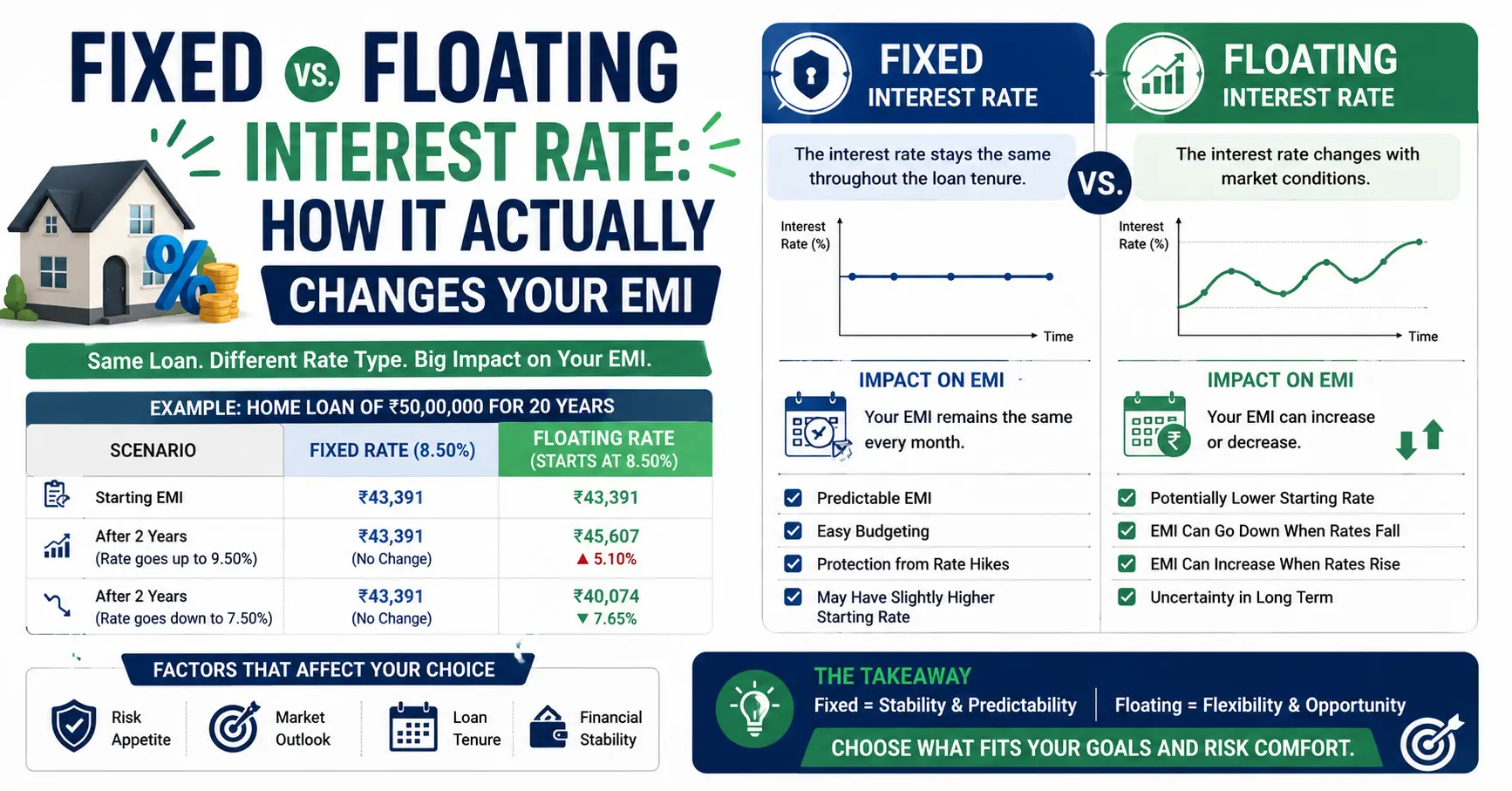
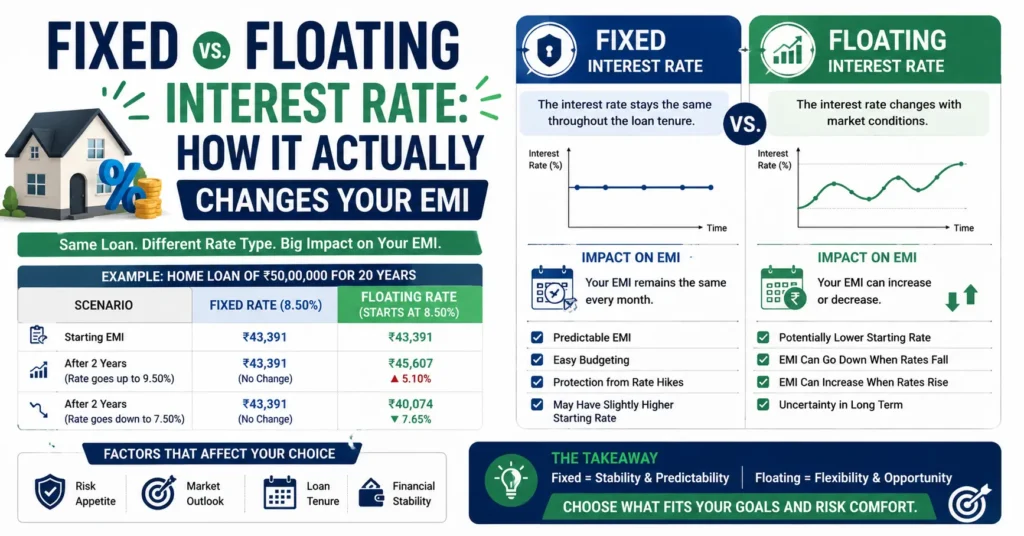
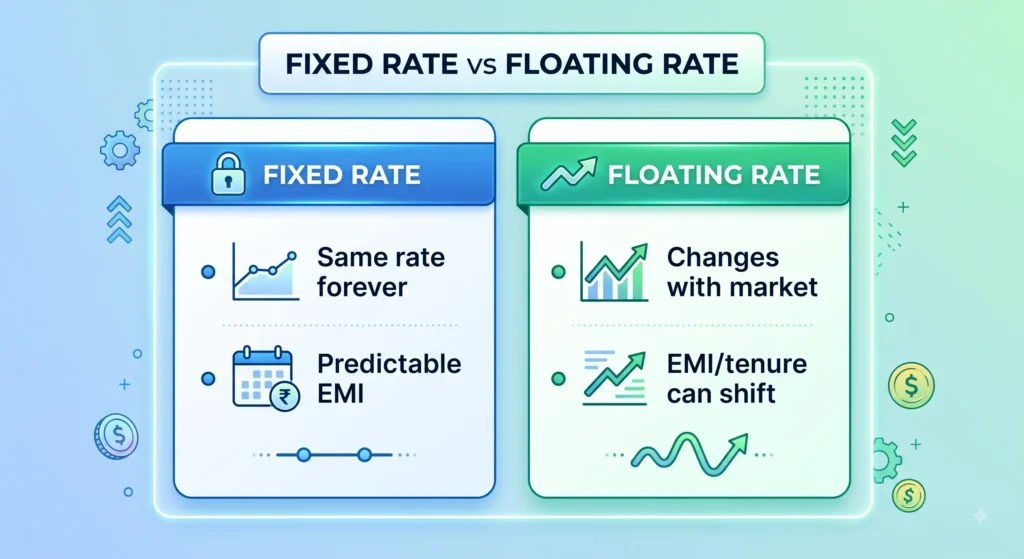
A fixed interest rate is exactly what it sounds like: it stays perfectly constant for the entire duration of the loan term.
When you sign the loan agreement, the bank locks in that percentage. That specific rate is plugged into the EMI formula (which we cover in detail in our EMI Loan Calculator guide), and it generates your monthly payment amount.
Because the interest rate never changes, your EMI never changes. Whether the global economy booms, crashes, or stays exactly the same, your monthly payment on month 1 will be identical to your payment on month 60. A fixed rate buys you absolute, iron-clad predictability. You know exactly what your budget needs to be for the entire life of the loan.
What a Floating Interest Rate Actually Means for Your EMI
A floating interest rate (sometimes called a variable or adjustable rate) works completely differently. Instead of locking in a number, your loan is tied to a broader economic benchmark rate.
This means the actual percentage used in your EMI calculation isn’t fixed on the day you sign. It gets periodically reviewed and adjusted by the lender sometimes every quarter, sometimes once a year. When the national benchmark rate moves up or down, your loan’s interest rate moves right along with it.
When that happens, the bank throws out your old EMI calculation and recalculates your loan using the brand-new interest rate.
Behind the Scenes: How Lenders Handle a Rate Change
When a floating rate adjusts, how does that actually affect your wallet? Lenders typically respond in one of two ways, and it is incredibly important to know which method your bank uses before you sign.
Approach 1: Changing Your Payment Amount
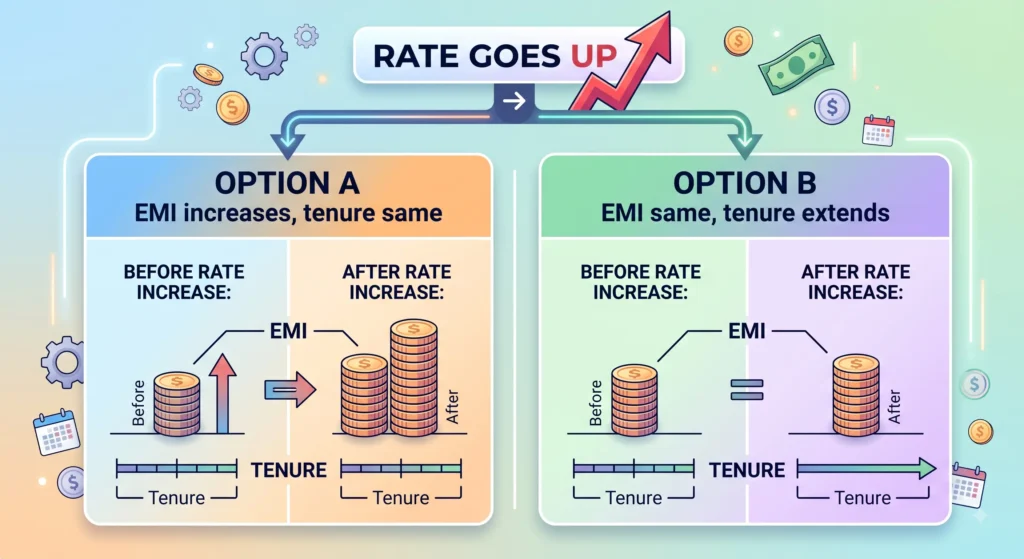
Some lenders keep your loan tenure exactly the same but adjust your monthly payment up or down to reflect the new rate. If rates go up, your next EMI bill will simply be for a higher amount. This keeps you on track to finish the loan on the exact date you originally planned, but it can wreak havoc on a tight monthly budget.
Approach 2: Changing Your Loan Tenure
Other lenders prefer to keep your monthly EMI amount unchanged because they know borrowers like predictable bills. Instead, they absorb the rate change by adjusting the remaining timeline of your loan. If interest rates go up, your monthly payment stays the same, but the bank quietly tacks an extra six months onto the end of your loan. You will be in debt for longer than you originally planned.
Which approach applies depends entirely on your specific lender’s policy. Never assume one over the other; always ask your loan officer.
Worked Example: Recalculating EMI After a Rate Change
Let’s look at the real math to see how a rate change shifts your payments.
Imagine you have an outstanding loan balance of PKR 1,000,000 with a 5-year (60 months) remaining tenure. You are currently on a floating rate of 12% annually.
- Using the standard formula, your original monthly EMI at 12% works out to approximately PKR 22,244.
Now, let’s say the central bank raises rates, and your floating rate adjusts from 12% up to 14%.
- If your lender recalculates your EMI to keep your 60-month timeline intact, your new EMI at 14% jumps to approximately PKR 23,268.
That is an increase of roughly PKR 1,024 every single month for the next five years. Over the remainder of the loan, that “small” rate bump costs you over PKR 60,000 in extra interest.
If your lender used the second approach keeping your payment locked at PKR 22,244—they would have to extend your loan by several extra months to make up for the higher interest accruing on the balance.
Why Are Floating Rates Usually Lower at First?
If floating rates carry the risk of going up, why does anyone choose them? Because when you look at a loan offer, the floating rate is almost always lower than the fixed rate on day one.
This isn’t an arbitrary discount. When a bank offers you a fixed rate, they are taking on all the risk. They are promising that even if inflation spikes and it costs them more to borrow money, they won’t pass that cost on to you. To compensate for taking on that massive risk, they charge a “premium” in the form of a higher starting interest rate.
With a floating rate, the bank is transferring the interest rate risk onto you, the borrower. Because you are agreeing to absorb the risk if rates rise, the bank rewards you with a lower starting rate. You are essentially making a bet: you are betting that rates will stay flat or drop, while acknowledging that they could rise.
When a Fixed Rate Makes More Sense
A fixed rate is generally the smarter choice when payment predictability matters more to you than optimizing for the absolute lowest possible cost.
If you are on a very tight, fixed monthly budget where a sudden PKR 5,000 increase in your EMI would cause genuine financial distress, a fixed rate is the way to go. It is also highly recommended for long-term loans (like a 20-year mortgage). Over a two-decade span, economic rates will fluctuate wildly. Locking in a solid fixed rate protects you from long-term economic volatility.
When a Floating Rate Makes More Sense
A floating rate tends to make more sense for shorter-term loans (like a 3-year car loan). Over a short period, there is simply less time for rate movements to compound and hurt you meaningfully.
It is also a great choice if you have a comfortable financial cushion and can easily absorb an EMI increase if rates go up. If you secure a floating rate that is significantly lower than the fixed option, you can save a considerable amount of money over the life of the loan as long as rates remain stable or trend downward.
How to Test Your Own Loan Scenarios
You don’t have to guess how a rate change will affect you. Our free EMI Loan Calculator lets you model either scenario instantly.
Run the calculation once at your loan’s current rate to see your baseline EMI. Then, run it again at a hypothetical higher rate (add 2% or 3%) to see exactly how much your monthly payment would jump if the market shifted. Seeing the actual, concrete numbers side-by-side gives you a clear sense of your true financial exposure before you sign a loan agreement.
Common Mistakes When Choosing Between Rates
- Mistake 1: Choosing a floating rate purely because the initial EMI looks cheaper, without considering if you can actually afford the payment if the rate rises by 3% next year.
- Mistake 2: Not reading the fine print to see if your bank adjusts your EMI amount or your loan tenure when a floating rate changes. These two approaches have drastically different impacts on your financial planning.
- Mistake 3: Choosing a floating rate on a 25-year loan because the current economy looks stable. Two decades is a long time, and rate volatility will happen eventually.
- Mistake 4: Forgetting to actively adjust your monthly household budget after a floating rate adjustment goes into effect.
Key Terms You Should Know
- Fixed Interest Rate: An interest rate that remains locked and constant for the entire duration of the loan, guaranteeing your EMI will never change.
- Floating Interest Rate: An interest rate tied to an economic benchmark that fluctuates over time, causing your EMI or your loan tenure to adjust periodically.
- Benchmark Rate: The foundational economic rate (often set by a country’s central bank) that a floating loan is tied to.
- Rate Reset Period: The scheduled dates (often quarterly or annually) when a bank reviews the current benchmark and adjusts your floating rate up or down accordingly.
Frequently Asked Questions
Q1: What is the core difference between fixed and floating interest rates? A fixed rate stays identical for your entire loan term, keeping your EMI locked. A floating rate is tied to an economic benchmark and changes over time, which causes your monthly payment or your loan timeline to adjust.
Q2: Does my EMI automatically increase if I choose a floating rate? Not necessarily. Floating rates can move down as well as up. If the central bank lowers interest rates, your EMI could actually decrease.
Q3: Why do banks offer lower starting rates for floating loans? Because you are taking on the risk. A fixed rate offers absolute safety, so banks charge a premium for it. With a floating rate, you absorb the risk of market changes, so the bank gives you a lower starting point.
Q4: What happens to my loan if my floating rate goes up? It depends on your bank. They will either increase your monthly EMI payment, or they will keep your payment the same but add extra months to the total length of your loan.
Q5: Can I switch from a floating rate to a fixed rate in the middle of my loan? Yes, many banks allow you to convert your rate type mid-loan. However, they almost always charge a hefty conversion fee to do so, and you will be subject to the current market fixed rates.
Q6: Is a fixed rate mathematically more expensive? Usually, it is more expensive on day one. But if floating rates skyrocket over the next five years, the fixed rate will end up being the much cheaper option overall.
Q7: How often do floating rates change? This is determined by your specific loan agreement. Some adjust every three months, some adjust every six months, and some adjust annually.
Q8: Is a floating rate too risky for a mortgage? It carries more risk because a mortgage is a long-term loan (15 to 30 years). The longer the loan, the more time there is for interest rates to shift against you.
Q9: Can I calculate what my EMI would be if rates go up? Absolutely. You can use our freeEMI Loan Calculatorto plug in any hypothetical interest rate and instantly see exactly what your new monthly payment would be.
Q10: Which is objectively better, fixed or floating? Neither is universally better. It depends on whether you value absolute budget predictability (choose fixed) or are willing to take on some risk for a potentially cheaper loan (choose floating).
Final Thoughts
The choice between a fixed and floating interest rate isn’t really a question of which one is “better.” It is a question of which tradeoff fits your specific financial personality.
Are you someone who needs iron-clad predictability so you can sleep soundly at night? Or are you comfortable accepting a little bit of uncertainty in exchange for the chance to save money on a lower initial rate? Understanding exactly how each option feeds into your EMI calculation rather than just blindly picking the lower starting number allows you to make that choice with absolute clarity.
Before you sign any paperwork, run your numbers through our free EMI Loan Calculator at InnovaiTools. Model your loan with a fixed rate, and then model it with a floating rate that jumps by 2% to see how it affects your wallet. Knowledge is your best defense against unexpected debt!

Arid is a web developer and computer expert who specializes in building practical utility web applications. With a strong focus on technical problem-solving and user experience, he develops efficient online calculators and writing tools designed to help students, bloggers, and professionals streamline their daily tasks.