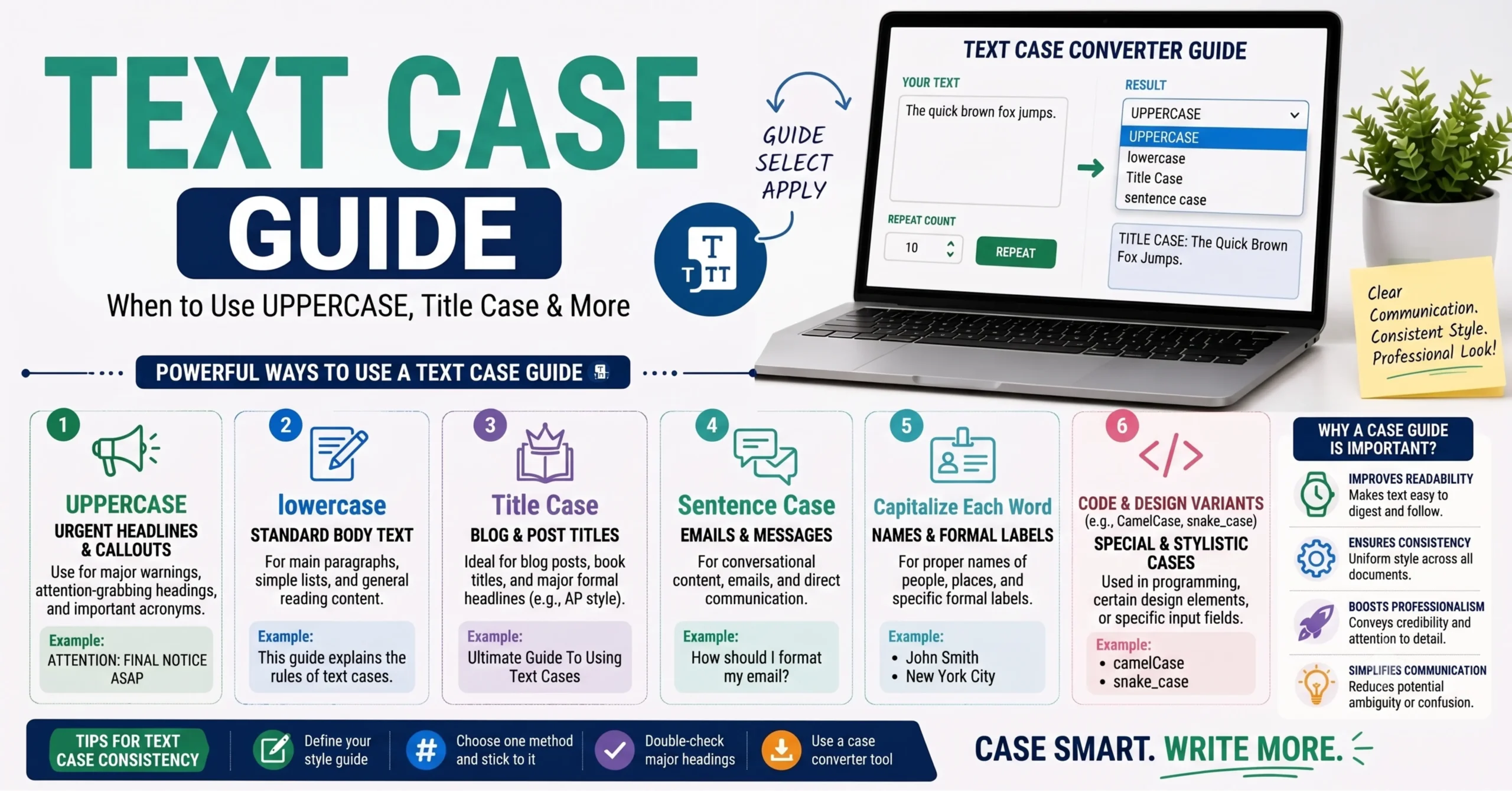
Text Case Guide: When to Use UPPERCASE, Title Case & More
Capitalization feels like one of those things everyone already understands until you actually sit down to title an article, name a variable in code, or write a heading for a website, and suddenly you’re second-guessing whether “of” should be capitalized in a title, or whether ALL CAPS is going to come across as shouting. Text case is one of the most quietly important, most commonly misunderstood aspects of writing, precisely because it looks simple on the surface.
This guide breaks down the main text case types, the surprisingly specific rules behind proper Title Case, why writing in all caps can actually work against you, and how programmers use case conventions for reasons that go well beyond style. By the end, choosing the right case for any situation should feel a lot less like guesswork.
What Are Text Cases and Why Do They Matter?
Text case, sometimes called letter case, refers to how capitalization is applied across a piece of text whether letters are fully capitalized, left lowercase, or capitalized according to a specific pattern like the start of each sentence or each major word. It’s easy to treat this as a purely cosmetic choice, but case conventions carry real meaning: they affect how fast a reader processes text, how a message’s tone is perceived, and in programming, they can even determine whether code runs correctly at all, since many languages treat differently-cased identifiers as entirely distinct.
The Main Text Case Types Explained
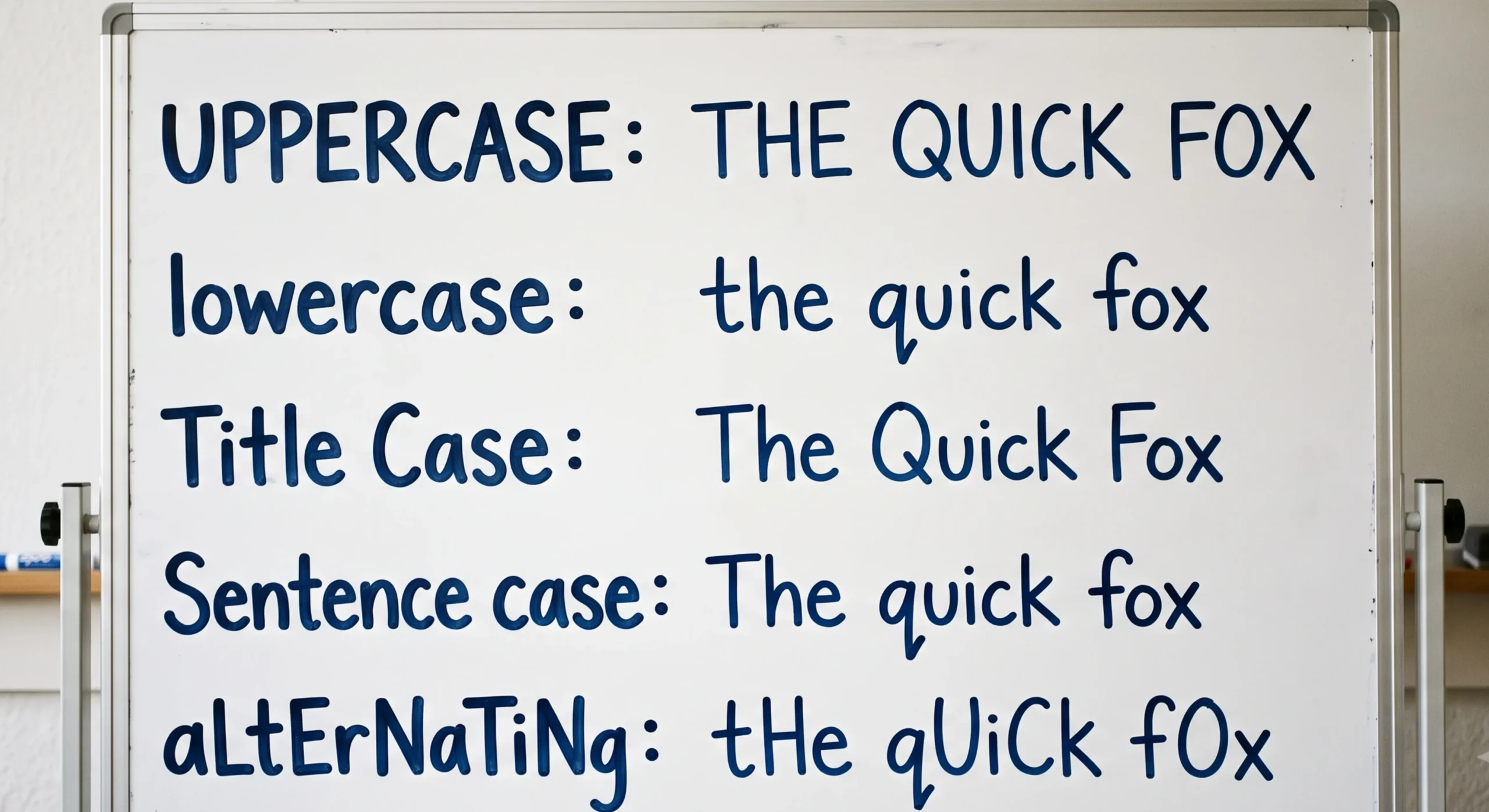
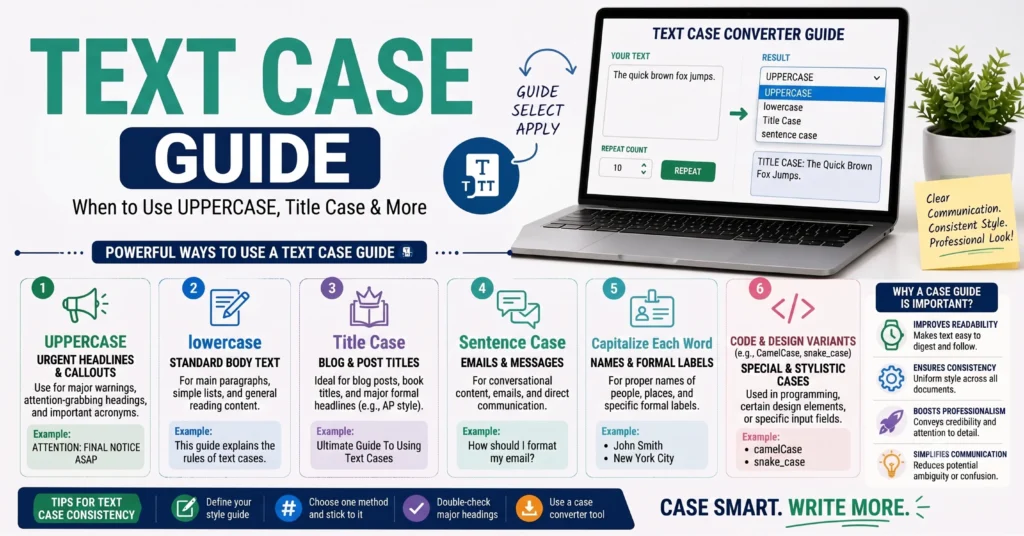
UPPERCASE
Every letter capitalized. UPPERCASE is best reserved for short bursts acronyms, warning labels, brief emphasis, or specific legal and formal headers like “TERMS AND CONDITIONS.” Used across full sentences or paragraphs, it works against you rather than for you, a point covered in more depth further below.
lowercase
No letters capitalized at all. Beyond its obvious use in casual writing, lowercase has become a deliberate stylistic choice for many modern brands and designers, who use it in logos and headings to convey a more casual, approachable, understated tone than traditional capitalization allows.
Title Case
Most, though not all, major words capitalized used for headlines, book and movie titles, and formal headings. This sounds straightforward until you look closely at the actual rules, which are considerably more specific than “capitalize every word,” and are covered in detail in the next section.
Sentence case
Only the first word of a sentence, along with proper nouns, is capitalized the same convention used in normal prose. Sentence case has increasingly become the default for headings and interface text across modern websites and apps, largely because it reads faster and feels less formal or dated than full Title Case.
aLtErNaTiNg cAsE
Letters alternate between uppercase and lowercase. This one is purely stylistic and shows up almost exclusively in casual internet writing, often used for visual novelty or to convey a sarcastic, mocking tone in social media posts and comments.
Title Case Rules Are Trickier Than You Think
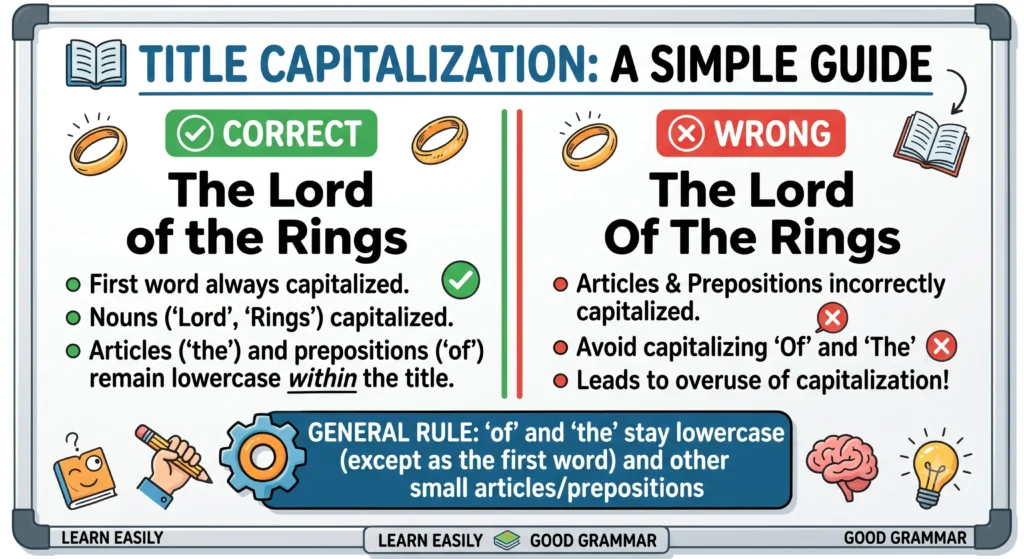
Here’s a genuinely common misconception worth correcting: Title Case does not mean capitalizing every single word. Standard style guides including AP Style and the Chicago Manual of Style generally keep short articles, conjunctions, and prepositions in lowercase, such as “a,” “an,” “the,” “and,” “but,” “or,” “in,” “on,” and “of,” unless one of those words happens to be the very first or very last word of the title.
Take a well-known example: “The Lord of the Rings.” Under proper Title Case rules, “of” and the second “the” stay lowercase, while “Lord,” “Rings,” and the first “The” since it opens the title are capitalized. A naive tool or habit that simply capitalizes every word would incorrectly produce “The Lord Of The Rings,” which looks subtly off to anyone familiar with proper editorial conventions.
To add another layer of nuance, different style guides don’t fully agree with each other. AP Style generally capitalizes prepositions of four or more letters, while Chicago Style leans toward keeping most prepositions lowercase regardless of length. Neither approach is universally “correct” the right choice depends on which style guide your publication, employer, or academic institution follows. What matters most is picking one convention and applying it consistently, rather than mixing rules from different guides within the same document.
Why All Caps Can Hurt Your Writing (Readability and Etiquette)
Writing in all caps might feel like an easy way to grab attention, but it tends to work against the writer on three separate fronts.
The first is pure readability. Research on reading behavior suggests that mixed-case text is read faster than all-caps text, largely because words written in lowercase and mixed case have a distinctive visual shape created by ascenders and descenders on letters like “b,” “g,” and “l” that helps skilled readers recognize whole words at a glance. All-caps text flattens that visual variation into a uniform rectangular block, forcing more letter-by-letter processing and slowing readers down, especially across longer passages.
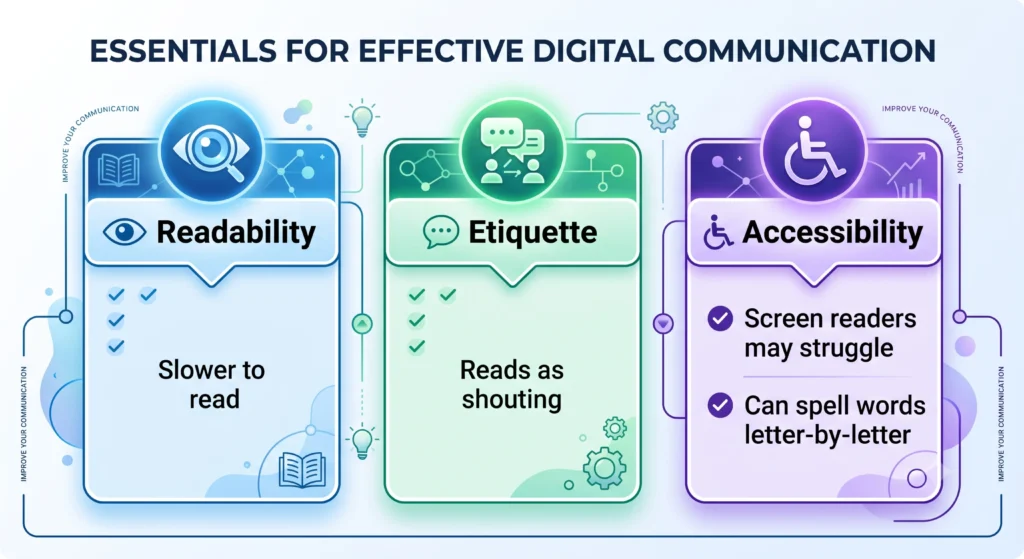
The second is tone and etiquette. In email, chat, comments, and virtually every digital communication context, writing in all caps is widely interpreted as shouting or aggression, regardless of the writer’s actual intent. A message meant to convey urgency can easily come across as hostile or unprofessional once it’s rendered entirely in capital letters.
The third, and perhaps least obvious, is accessibility. Some screen readers used by visually impaired users interpret certain all-caps words as acronyms and read them out letter by letter rather than pronouncing them as whole words meaning a word like “IMPORTANT” written in caps might be read aloud as “I. M. P. O. R. T. A. N. T.” rather than as the intended word, creating genuine confusion for screen reader users. The practical takeaway across all three points is the same: reserve all caps for short labels, acronyms, and deliberate emphasis, not for full sentences or paragraphs of running text.
Programming Case Conventions: camelCase, PascalCase, snake_case, and kebab-case
Beyond writing and design, case conventions play a genuinely functional role in software development, where consistent casing is often expected and sometimes strictly required by a language’s own style conventions.
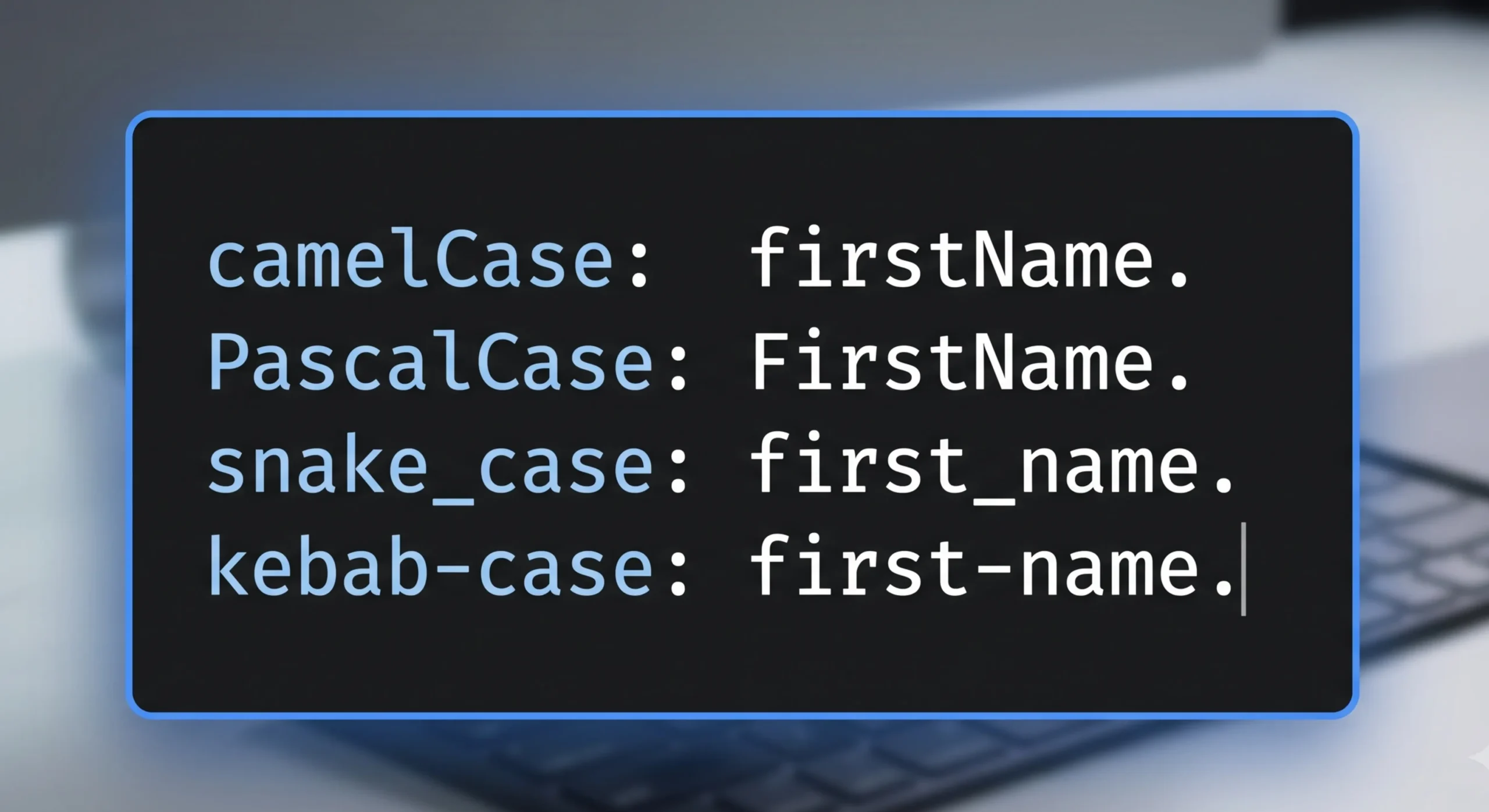
- camelCase capitalizes every word except the first, with no spaces or separators between them, as in
firstName. It’s the standard convention for variable and function naming in JavaScript and several other languages. - PascalCase capitalizes every word including the first, also with no separators, as in
FirstName, and is commonly used for naming classes across many programming languages. - snake_case keeps everything lowercase and separates words with underscores, as in
first_name, and is the dominant convention in Python. - kebab-case, similarly all lowercase but separated by hyphens as in
first-name, shows up most often in URLs and CSS class names, largely because search engines and browsers handle hyphens more gracefully than underscores in web addresses.
These aren’t arbitrary preferences mixing conventions inconsistently within a single codebase, or ignoring a language’s established convention entirely, makes code noticeably harder for other developers to read and maintain, even though the code itself may still run correctly.
How to Choose the Right Case for Your Context
For formal publications and traditional headlines, proper Title Case following a specific, consistently applied style guide remains the standard choice. For headings and interface text on modern websites and apps, Sentence case has become increasingly common, since it reads faster and feels more conversational than traditional Title Case. Body text and paragraphs should always follow normal sentence case, never full capitalization, regardless of the platform. Short emphasis, warnings, and acronyms are the appropriate, limited use case for UPPERCASE. In code, the right case depends entirely on the language and context camelCase or PascalCase for many object-oriented languages, snake_case for Python, and kebab-case specifically for URLs and file names, where hyphens tend to be both more readable and more search-engine-friendly than underscores.
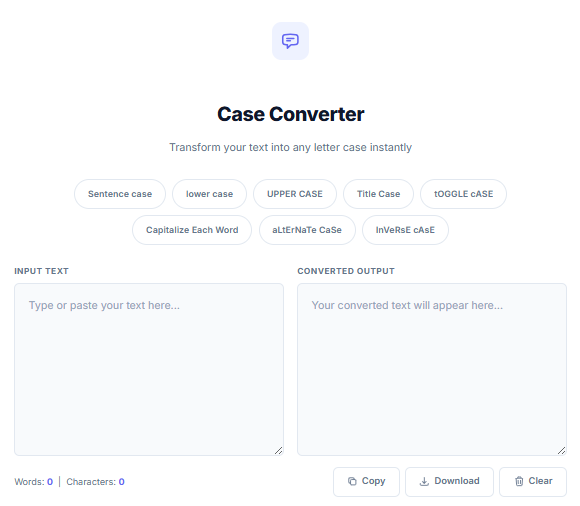
How to Use the InnovaiTools Case Converter
- Step 1: Open the Case Converter on InnovaiTools.
- Step 2: Paste or type the text you want to convert into the input box.
- Step 3: Choose your target case UPPERCASE, lowercase, Title Case, Sentence case, or aLtErNaTiNg case with a single click.
- Step 4: Copy the converted result instantly. If you’re drafting the original text first, our Online Notepad is a convenient place to write before converting the case, and our Word & Character Counter can confirm the exact length of your final text.
Common Mistakes with Text Case
- Mistake 1: Writing entire emails, comments, or captions in all caps to grab attention, which more often reads as aggressive or unprofessional rather than emphatic.
- Mistake 2: Applying a simple “capitalize every word” rule to titles without accounting for the lowercase exceptions that proper Title Case actually requires for short articles, conjunctions, and prepositions.
- Mistake 3: Mixing case conventions inconsistently within the same codebase, such as naming some variables in camelCase and others in snake_case, which makes code harder to read even when it still functions correctly.
- Mistake 4: Using decorative alternating case in professional or formal contexts, where it reads as unpolished rather than stylistically intentional.
Key Terms Related to Text Case
- Title Case: A capitalization style used for headings and titles that capitalizes major words while keeping short articles, conjunctions, and prepositions lowercase, based on the rules of a specific style guide.
- Sentence Case: A capitalization style that capitalizes only the first word of a sentence or heading along with proper nouns, matching normal prose conventions.
- camelCase: A programming naming convention that capitalizes every word except the first, with no spaces, commonly used for variables in JavaScript.
- Kebab-case: A naming convention using all-lowercase words separated by hyphens, most commonly used in URLs and CSS class names.
Frequently Asked Questions About Text Case
Q1: What is the correct way to write Title Case? Capitalize major words while keeping short articles, conjunctions, and prepositions lowercase, unless they’re the first or last word of the title the exact list of lowercase exceptions varies slightly by style guide.
Q2: Is writing in all caps considered rude? In most digital communication contexts, yes all caps is widely interpreted as shouting or aggression, even when that isn’t the writer’s intent.
Q3: What is the difference between Title Case and Sentence case? Title Case capitalizes most major words in a heading, following specific style rules. Sentence case capitalizes only the first word and proper nouns, matching how a normal sentence is written.
Q4: What is camelCase used for? It’s a programming naming convention, most commonly used for variables and functions in JavaScript, where every word after the first is capitalized with no spaces or separators.
Q5: Should headings on a website use Title Case or Sentence case? Many modern websites and apps favor Sentence case for headings and interface text since it reads faster and feels more conversational, though Title Case remains standard for formal publications and traditional headlines.
Q6: Does all-caps text cause accessibility problems? It can some screen readers interpret certain all-caps words as acronyms and spell them out letter by letter instead of reading them as whole words, which can confuse users relying on screen readers.
Q7: What is kebab-case and where is it used? It’s an all-lowercase naming convention with words separated by hyphens, most commonly used in URLs and CSS class names, partly because hyphens are more search-engine-friendly than underscores in web addresses.
Q8: Are Title Case rules the same across all style guides? No AP Style and Chicago Manual of Style, among others, differ slightly on which prepositions stay lowercase and under what length threshold, so the “correct” rule depends on which style guide you’re following.
Q9: Can I convert text case instantly online? Yes, our freeCase Converterinstantly converts any text into UPPERCASE, lowercase, Title Case, Sentence case, or alternating case with a single click.
Q10: Is the InnovaiTools Case Converter free? Yes, completely free with no sign-up required, and it works on any length of text directly in your browser.
Final Thoughts
Text case looks like a small detail, but it quietly shapes how readable, professional, and appropriate your writing feels in any given context from a properly cased article headline to a sensibly named variable in code. Understanding the real rules behind Title Case, the genuine downsides of writing in all caps, and the practical conventions developers rely on turns capitalization from a source of second-guessing into a quick, confident decision.
For instant, accurate case conversion whenever you need it, use our free Case Converter at InnovaiTools no sign-up required, and it works instantly on text of any length.

Arid is a web developer and computer expert who specializes in building practical utility web applications. With a strong focus on technical problem-solving and user experience, he develops efficient online calculators and writing tools designed to help students, bloggers, and professionals streamline their daily tasks.