Grade Calculator: How Letter Grades Work and What You Need on Your Final

Somewhere between “I got 78 out of 100” and seeing a “C+” on a report card, a fair amount of interpretation happens and most students never actually learn the rules behind that conversion, or realize how differently those rules can work depending on where you’re studying. A letter grade feels simple on the surface, but it’s really a compressed summary of a specific scale, a specific set of boundaries, and sometimes a specific weighting formula that most people never see spelled out.
This guide covers exactly what goes into a letter grade, how grading systems actually differ around the world, the real difference between grading on a fixed scale versus a curve, and probably the most practically useful part how to calculate exactly what score you need on an upcoming final exam to land the grade you’re aiming for.
What Is a Letter Grade, and How Is It Determined?
A letter grade is a standardized symbol typically A, B, C, D, or F used to represent a range of numerical academic performance, making it far easier to communicate and compare results at a glance than raw percentages alone. Instead of a transcript full of numbers like 87%, 91%, and 74%, a letter grade compresses each score into a recognizable category that instructors, institutions, and employers can interpret consistently, at least within the same grading system.
The percentage-to-letter conversion is governed by a grading scale, which defines exactly where each letter grade begins and ends. This scale isn’t universal it’s set by the individual institution, and sometimes even by the individual instructor within a single course, which is exactly why the same raw score can translate into different letter grades depending on where you’re studying.
The Standard Grading Scale Explained
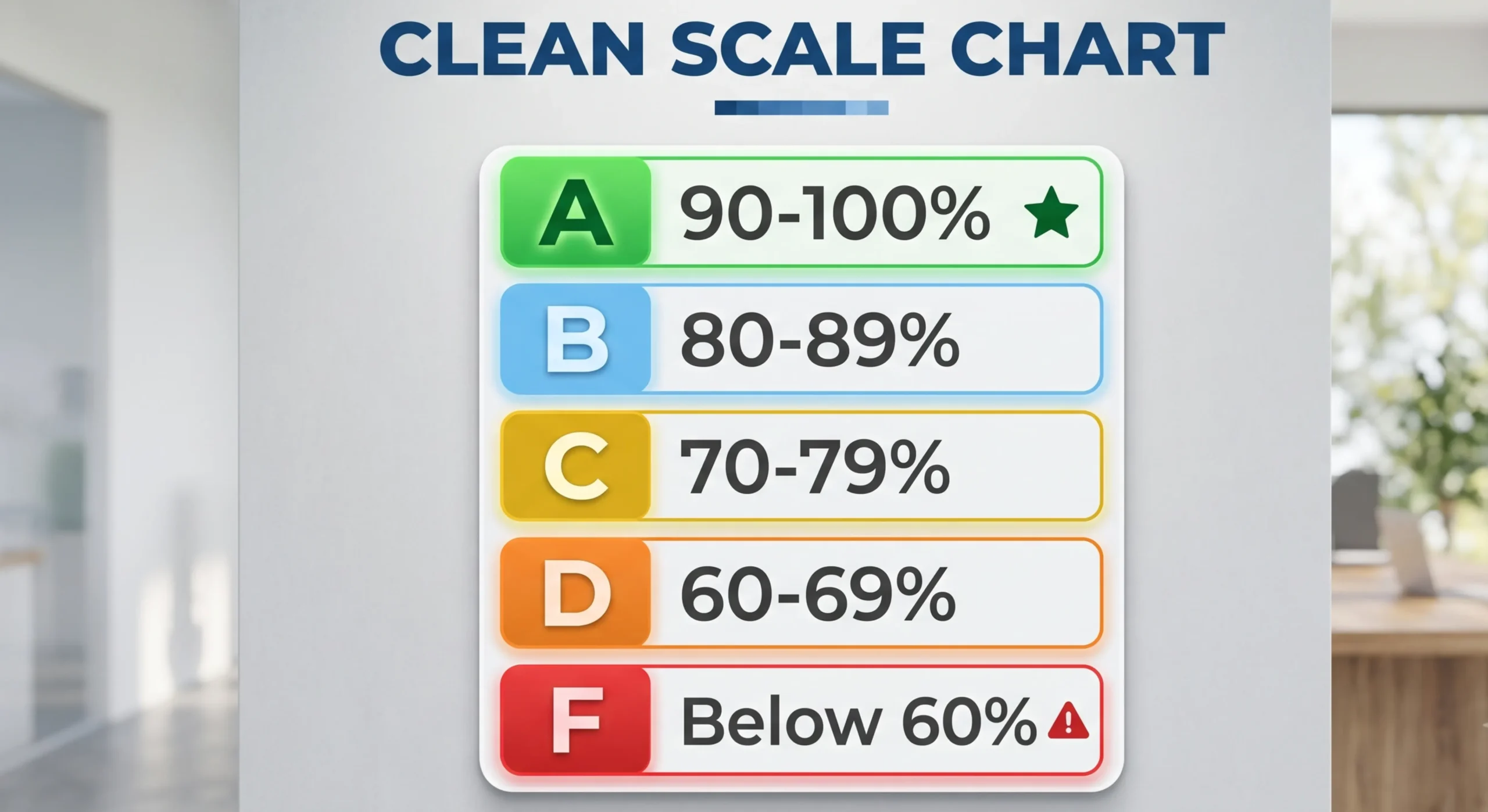
While exact boundaries vary by institution, a commonly used baseline scale looks like this:
- A: 90–100%
- B: 80–89%
- C: 70–79%
- D: 60–69%
- F: Below 60%
This baseline is widely used across much of the United States, but it’s genuinely just a starting reference point many schools and universities shift these boundaries up or down, and some compress or expand certain ranges depending on the difficulty or grading philosophy of a particular course. Always check your specific syllabus or institution’s official scale rather than assuming this exact breakdown applies universally.
Grading Systems Around the World Aren’t All the Same
This is where things get genuinely interesting, and where a lot of confusion tends to creep in for students moving between educational systems or comparing results internationally.
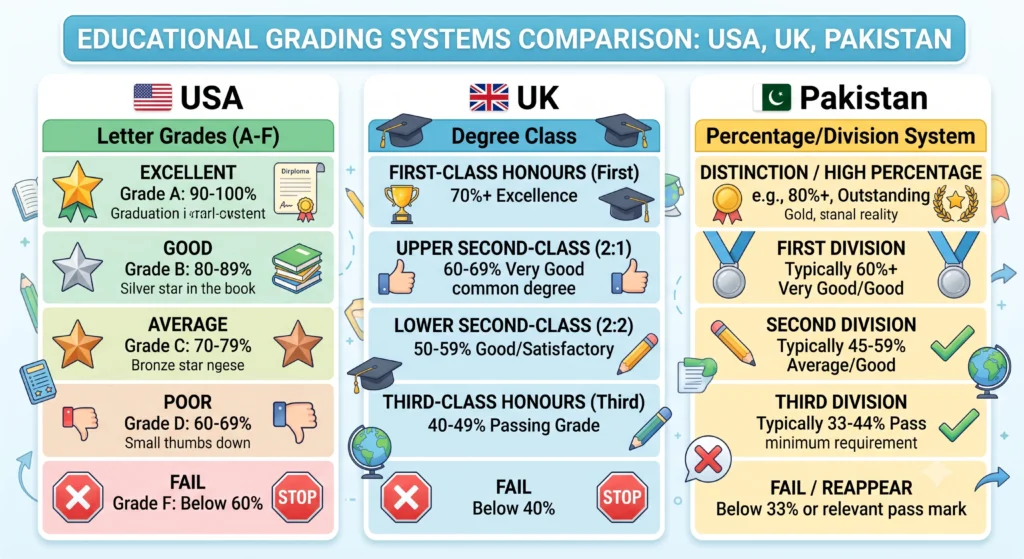
The United States generally uses the letter grade system described above, often layered with plus and minus subdivisions covered in the next section. The United Kingdom takes a notably different approach at the university level, using degree classifications rather than letter grades entirely a First typically requires roughly 70% or above, an Upper Second (commonly called a 2:1) usually falls around 60–69%, a Lower Second (2:2) around 50–59%, and a Third around 40–49%, though exact boundaries vary by institution.
In Pakistan and much of South Asia, grading conventions have historically leaned toward direct percentage reporting or division-based classification First Division, Second Division, and Third Division at the school and college level, with specific percentage thresholds varying by education board. At the university level, many institutions across the region have since adopted GPA-based systems similar to the American model, particularly for programs following a semester credit-hour structure, while school-level results often remain percentage or division-based. Because conventions can genuinely differ between boards and institutions even within the same country, it’s always worth confirming the specific scale your own school or university actually follows rather than assuming any single standard applies.
Plus and Minus Grades | Why They Exist and How They Work
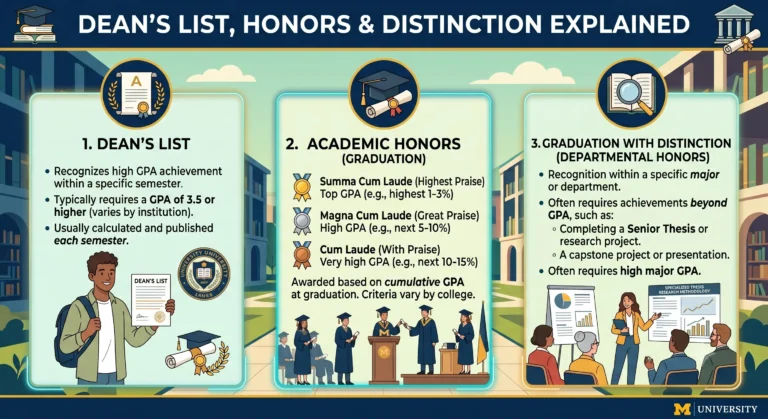
Many grading scales subdivide each letter into plus and minus variants A+, A, A- to capture finer distinctions within what would otherwise be one broad category. A student scoring 91% and a student scoring 99% might both fall under a plain “A” on a scale without subdivisions, even though their performance clearly differs meaningfully.
A typical subdivided scale might set A- at roughly 90–92%, a plain A at 93–96%, and A+ reserved for 97% and above though, as with the base scale itself, exact cutoffs vary by institution. The purpose is straightforward: reward students near the top of a grade band without requiring an entire jump to the next letter, giving a more granular and arguably fairer reflection of performance differences within the same general range.
Absolute Grading vs Grading on a Curve
This distinction trips up a lot of students, particularly the first time they encounter a curved course.
- Absolute grading, sometimes called grading on a fixed scale, means your letter grade depends only on your own score measured against a predetermined scale how your classmates performed has no bearing on your result whatsoever.
- Curved grading works differently: grades are adjusted based on how the entire class performed, often to account for an exam that turned out considerably harder or easier than the instructor intended. In one common approach, the highest score in the class gets recalibrated to represent 100%, with every other score adjusted proportionally upward to match. In another approach, grades are assigned based on where each student falls relative to the class average and the overall spread of scores, rather than against a fixed external benchmark.
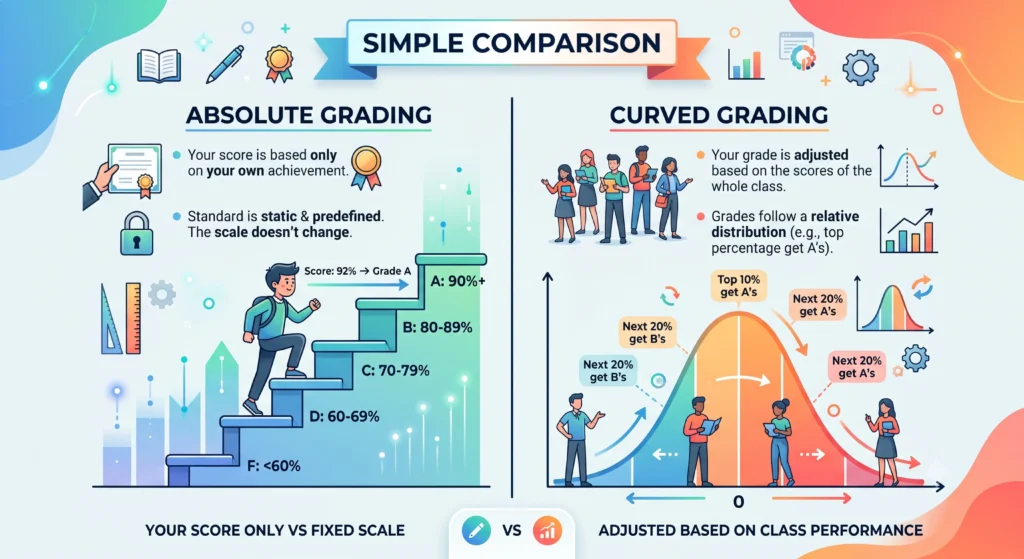
Curves exist primarily as a fairness mechanism if an exam was unexpectedly difficult and the top score in the entire class was only 78%, a fixed absolute scale would fail nearly everyone, which usually says more about the exam’s difficulty than about the students’ actual understanding of the material.
Weighted Grades | When Not All Assignments Count the Same
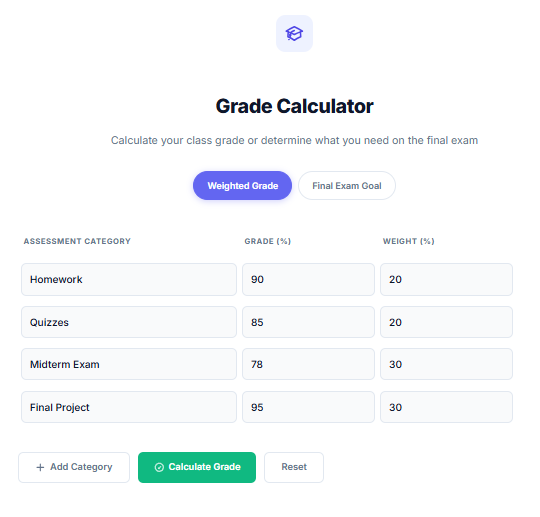
In most real courses, not every assignment contributes equally to your final grade. A final exam might account for 40% of your total grade, while weekly quizzes collectively contribute only 10%, with midterms and homework filling in the remainder. This means a simple average of all your individual scores almost never matches your actual final grade the weighting has to be factored in explicitly.
The general formula looks like this:
Final Grade = Sum of (Component Score × Component Weight)across every graded component in the course.
Understanding this weighting is exactly what makes it possible to calculate something students search for constantly: exactly what score they need on a remaining assignment to hit a target final grade, which is covered directly in the next section.
How to Use the InnovaiTools Grade Calculator
- Step 1: Open the Grade Calculator on InnovaiTools.
- Step 2: Enter the marks obtained and total possible marks for your assessment.
- Step 3: Instantly view your percentage score and corresponding letter grade based on the standard scale.
- Step 4: If you’re tracking a full semester’s grade point average rather than a single assignment, our GPA Calculator and CGPA Calculator handle that broader calculation, while this tool focuses specifically on converting a single score into its letter grade.
How to Calculate What You Need on a Final Exam
This is genuinely one of the most useful calculations a student can run before a final exam, and the math behind it is more approachable than it looks once the weighting concept from the previous section is in place.
Required Final Score = (Target Grade − Current Grade × Non-Final Weight) ÷ Final Weight
Here’s a worked example: suppose your current grade going into the final — based on everything except the final exam sits at 78%, your non-final coursework is worth 70% of your overall grade, your final exam is worth the remaining 30%, and you’re aiming for an 80% overall average.
Required Final Score = (80 − 78 × 0.70) ÷ 0.30= (80 − 54.6) ÷ 0.30= 25.4 ÷ 0.30= approximately 84.67%
In this example, you’d need roughly 84.67% on your final exam to bring your overall average up to 80%. Running this calculation before a final gives you a concrete, realistic target instead of walking in with only a vague sense of how much the exam matters.

Common Mistakes When Interpreting Grades
- Mistake 1: Assuming every institution uses the same grade boundaries treating 90% as an automatic A everywhere, without checking your specific syllabus or institution’s actual scale.
- Mistake 2: Forgetting that weighted grading exists, and calculating a simple average of all scores instead of the properly weighted final grade.
- Mistake 3: Confusing a curve with a flat percentage bonus applied to everyone, when it’s actually a proportional recalibration based on overall class performance.
- Mistake 4: Not accounting for an institution’s specific rounding policy some round 89.5% up to 90% and an A, while others truncate or round differently, which can matter right at a grade boundary.
Key Terms Related to Grade Calculation
- Grading Scale: The specific percentage ranges an institution or instructor uses to determine which letter grade corresponds to a given numerical score.
- Weighted Grade: A final grade calculated by multiplying each graded component by its assigned percentage weight and summing the results, rather than simply averaging every score equally.
- Curved Grading: A grading approach where scores are adjusted relative to overall class performance, rather than measured against a fixed, predetermined scale.
- Grade Boundary: The specific percentage cutoff separating one letter grade from the next, such as the line between a B and an A.
Frequently Asked Questions About Grade Calculation
Q1: What percentage is an A grade? On a commonly used baseline scale, 90% and above is typically an A, though exact boundaries vary meaningfully by institution and course, so always confirm the specific scale being used.
Q2: Are grading scales the same at every school or university? No grading scales, and sometimes even entire grading systems, vary significantly by institution, and in some cases by individual instructor within the same institution.
Q3: What is the difference between absolute grading and grading on a curve? Absolute grading measures your score against a fixed scale regardless of classmates’ performance. Curved grading adjusts scores relative to the overall class performance, often to account for an exam that was unexpectedly hard or easy.
Q4: How do weighted grades work? Each graded component exams, quizzes, homework, participation is multiplied by its assigned percentage weight, and the results are summed to produce the final grade, rather than simply averaging every score equally.
Q5: What is the UK equivalent of a US letter grade? UK universities generally use degree classifications instead First, Upper Second (2:1), Lower Second (2:2), and Third with different percentage thresholds than the US letter system, and boundaries that vary somewhat by institution.
Q6: How do I calculate what I need on my final exam? Use the formula:
Required Final Score = (Target Grade − Current Grade × Non-Final Weight) ÷ Final Weight, based on your current grade and the weight assigned to the final exam in your course.Q7: What does a grade of D mean? On many standard scales, D represents the lowest passing grade, typically just above the failing threshold, though the exact range and whether it counts as passing varies by institution.
Q8: Why do some institutions use plus/minus grades? Plus and minus subdivisions capture finer distinctions within a broad letter grade band, rewarding students near the top of a range without requiring a full jump to the next letter grade.
Q9: How is grading different in Pakistan compared to the US? Pakistani and South Asian institutions have historically leaned toward percentage-based or division-based grading at the school level, while many universities have since adopted GPA-based systems similar to the US, particularly for semester credit-hour programs though conventions vary by board and institution.
Q10: Is the InnovaiTools Grade Calculator free? Yes, completely free with no sign-up required, instantly converting any marks and total into a percentage and corresponding letter grade.
Final Thoughts
A letter grade might look like a simple symbol, but behind it sits a specific scale, sometimes a weighting formula, and occasionally an entirely different grading philosophy depending on where you’re studying. Understanding how that conversion actually works and knowing how to calculate exactly what you need on an upcoming final turns grades from something that just happens to you into something you can plan around with real precision.
For an instant grade conversion any time you need one, use our free Grade Calculator at InnovaiTools and when you’re ready to look at the bigger picture across a full semester, our GPA Calculator and CGPA Calculator pick up right where this one leaves off.

Arid is a web developer and computer expert who specializes in building practical utility web applications. With a strong focus on technical problem-solving and user experience, he develops efficient online calculators and writing tools designed to help students, bloggers, and professionals streamline their daily tasks.