Dean’s List, Honors & Distinction Explained
Have you ever looked at a university graduation program and wondered what all those fancy Latin words actually mean? Or maybe you had a fantastic semester and received an email welcoming you to the “Dean’s List,” but you aren’t entirely sure if that means you are graduating with honors.
A genuinely strong semester earns you a spot on the Dean’s List. A consistently strong performance across your entire degree earns you graduation honors like cum laude. They sound incredibly similar, and many students naturally assume that achieving one automatically guarantees the other. However, they are actually calculated using two fundamentally different numbers: one relies on a single semester’s GPA, while the other looks at your cumulative CGPA across your entire academic career.
This guide is going to break down exactly how the Dean’s List, graduation honors, and their global equivalents actually work. We will look at what specific grade thresholds each one typically requires, how international systems differ from the US, and—just as usefully—what “academic probation” actually means when things don’t go exactly as planned.
What Does “Academic Standing” Actually Mean?
Before we dive into the specific honors, we need to talk about “academic standing.” When you hear a university use this phrase, they are referring to the formal recognition whether positive or negative that an institution assigns to you based on your GPA or CGPA performance.
This scale ranges from the honor rolls and the Dean’s List at the very high end, down to academic warning and probation at the low end.
It is important to understand that these aren’t just informal, feel-good labels. Academic standing often carries very real, practical consequences. Being in good standing or achieving honors can dictate your eligibility for highly competitive scholarships, determine whether you get accepted into a graduate program, and result in permanent, prestigious notations on your official transcript. On the flip side, falling into a negative academic standing can temporarily restrict your ability to register for classes or participate in college athletics until your grades improve.
The Dean’s List: Celebrating a Single Great Semester
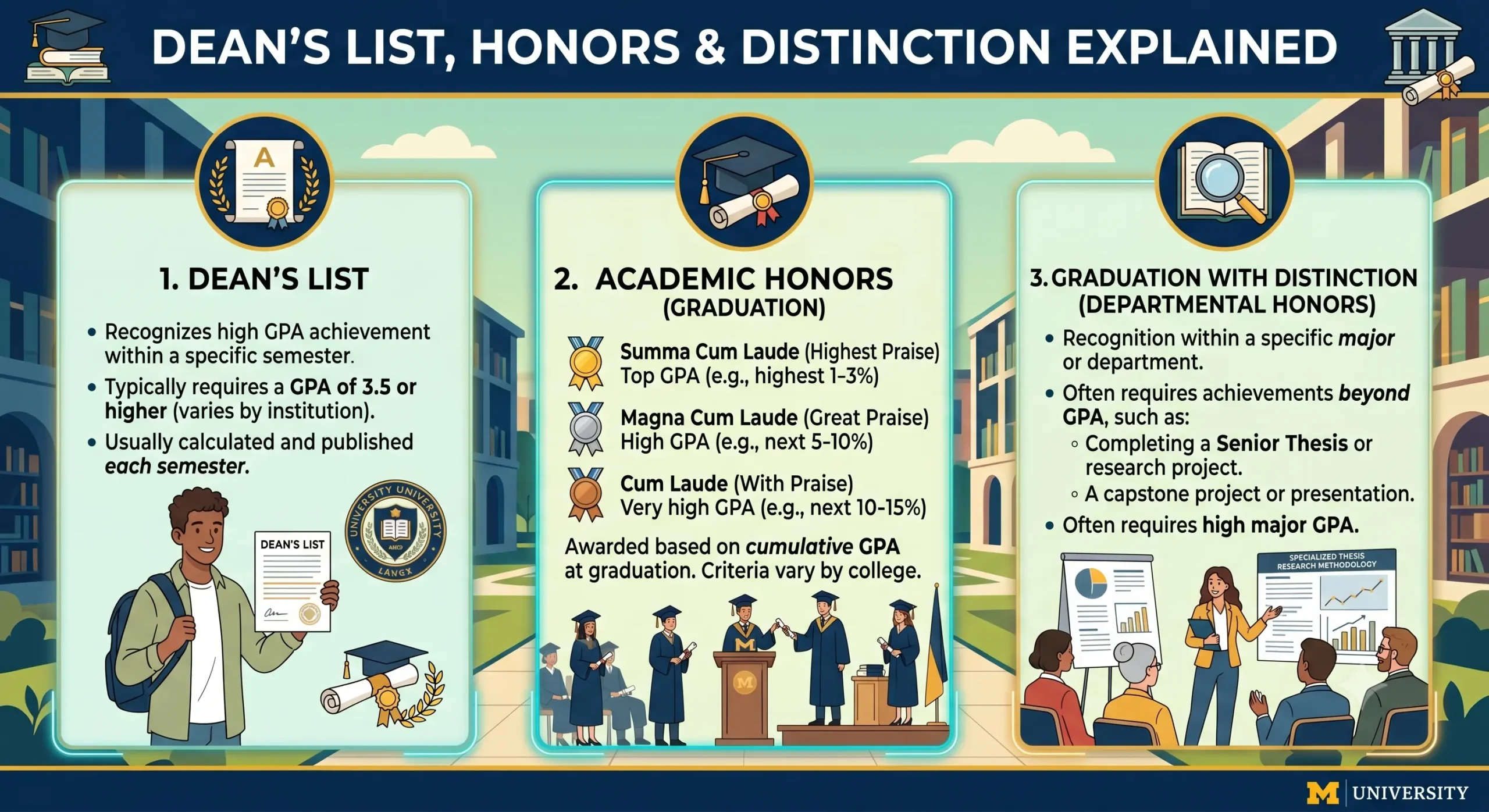
The Dean’s List is typically a semester-specific honor. It is awarded to students who achieve a Grade Point Average (GPA) above a strictly defined threshold during one particular academic term.
Commonly, this cutoff sits around a 3.5 or higher on a standard 4.0 scale, though the exact number varies meaningfully from one institution to another. Because the Dean’s List is evaluated one semester at a time, it is based entirely on your semester GPA rather than your long-term CGPA. (If you are curious about the exact math behind a single semester, our GPA Calculator guide covers those mechanics in detail).
There is a catch, though. You can’t just take one easy class, get an A, and expect to make the Dean’s List. Many institutions require a minimum course load typically full-time enrollment (usually 12 or more credit hours) to qualify. The recognition is designed to reward students who maintain high academic excellence while balancing a full, demanding schedule.
The President’s List: When Dean’s List Isn’t the Top Tier
What happens if you have an absolutely flawless semester? While the Dean’s List is widely known, some institutions maintain an even higher, more exclusive recognition tier above it, frequently called the President’s List (or sometimes the Chancellor’s List).
This tier is typically reserved for students who pull off a perfect or near-perfect semester GPA. We are usually talking about a flawless 4.0, or sometimes a 3.9 and above, depending on how strict the university is. It is a slightly less commonly known distinction, but it is genuinely worth aiming for if your institution offers it, as it represents a meaningfully higher and rarer bar than standard Dean’s List recognition.
Graduation Honors: Cum Laude, Magna Cum Laude, and Summa Cum Laude
Now we get to the Latin words. These honors are awarded at the very end of your journey, during graduation, and they are based on your cumulative performance across your entire degree. That means they are calculated using your CGPA (Cumulative Grade Point Average), not just a single semester’s GPA.
While the exact cutoffs vary fiercely depending on how rigorous your specific university is, the commonly cited threshold ranges generally look like this:
- Cum Laude (With Honor): This is the entry-level tier for graduation honors. It typically requires a CGPA starting somewhere around 3.5 to 3.7.
- Magna Cum Laude (With Great Honor): The middle tier, representing outstanding academic achievement, usually requires a CGPA around 3.7 to 3.9.
- Summa Cum Laude (With Highest Honor): The absolute peak of academic recognition. This is reserved for the top fraction of a graduating class, requiring a CGPA of roughly 3.9 or a perfect 4.0.

Because these thresholds are cumulative, they connect directly to the weighted, multi-semester calculations covered in our CGPA Calculator guide. A single outstanding semester alone typically isn’t enough to secure Latin honors if your earlier semesters pulled your cumulative average down significantly. Conversely, one mediocre semester won’t necessarily ruin your chances at cum laude if the rest of your academic career was spectacular.
First Class, Distinction, and Division-Based Honors
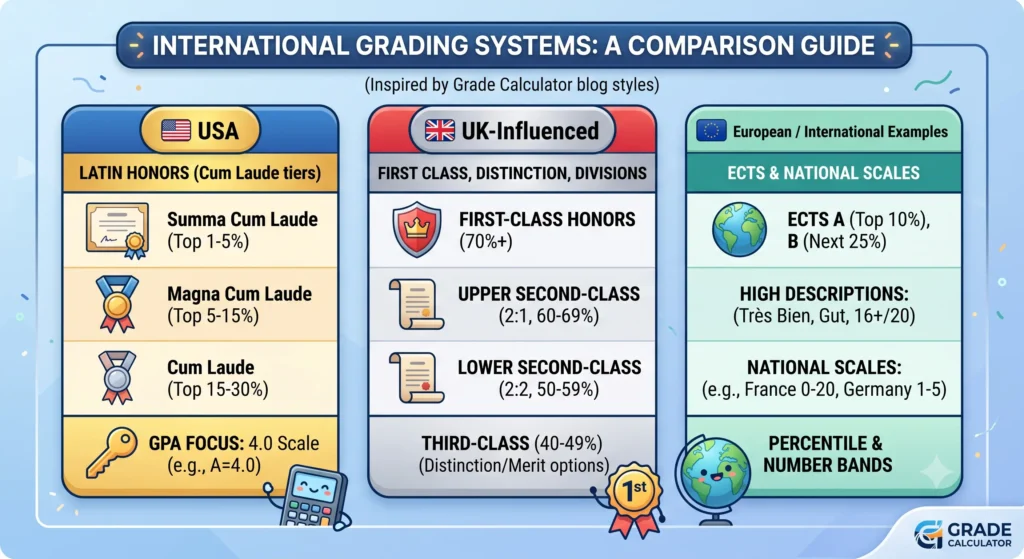
If you are reading this from outside the United States, you might be wondering why none of these Latin terms sound familiar. Institutions following UK-influenced academic traditions which includes much of Europe, Australia, and South Asia (due to historical educational ties) take a completely different approach. They often use degree classifications instead of GPA-based Latin honors.
If you score a 70% in the US, you are getting a ‘C’, which is painfully average. But in the UK system, a 70% is a massive achievement.
- First-Class Honours (A “First”): This is roughly equivalent to graduating summa cum laude in the US. It typically requires an overall percentage score of 70% or above.
- Upper Second-Class Honours (A “2:1”): Sitting right below a First, this usually requires scoring in the 60–69% range and is highly respected by employers.
- Distinction: In many master’s programs or specific South Asian institutions, a “Distinction” represents the absolute highest tier, sometimes requiring scores in the 75–80% range or higher.
- Division Systems: In Pakistan and India, especially at the pre-university and bachelor’s levels, you will frequently see older Division-based classifications. Earning a “First Division” is a mark of honor, while “Second Division” and “Third Division” follow below.
This fascinating global discrepancy perfectly mirrors the grading comparisons we cover in our Grade Calculator guide, extended specifically to the prestige and recognition layer rather than just basic percentage-to-letter conversions.
How These Thresholds Actually Get Calculated
The practical distinction between all these different honors comes down entirely to which underlying mathematical calculation the university uses.
The Dean’s List and the President’s List are evaluated using your semester GPA the weighted average of a single term’s courses. Graduation honors like cum laude, by contrast, are evaluated using your cumulative CGPA the massive, weighted average across every single completed semester from your freshman to senior year.
This is precisely why a student can have a rough freshman year, finally figure out their study habits, and earn Dean’s List recognition in their junior year, even if their overall CGPA hasn’t quite recovered enough to reach graduation-honors level. The two calculations are answering genuinely different questions about your performance over different timeframes.
Academic Probation: The Other End of the Spectrum
It is incredibly important to talk about the opposite end of academic standing. College is hard, life happens, and sometimes grades slip.
When your CGPA and sometimes your specific semester GPA falls below an institution-defined threshold (often somewhere around a 2.0 on a 4.0 scale), you may be placed on academic probation. This is a formal status signaling a risk of academic dismissal if your performance doesn’t improve within a defined period.
However, students often view probation as a punishment. It isn’t. At the vast majority of institutions, academic probation is a safety net. It is not purely punitive; it almost always comes attached with specific, helpful support resources. Universities want you to graduate. Probation usually triggers mandatory academic advising, access to free tutoring, and check-ins with counselors. It is a system designed precisely to help a student recover rather than simply flagging them for failure and leaving them to figure it out alone.
How to Actively Track Your Progress Toward Academic Honors
Finding out you missed cum laude by a fraction of a decimal point on graduation day is a heartbreaking experience. Checking your standing throughout your degree, rather than only discovering it at the very end, is entirely practical with the right tools.
You can use our GPA Calculator at the end of each semester to check your current term against your institution’s Dean’s List threshold in real-time. Simultaneously, use our CGPA Calculator to meticulously track your cumulative progress against graduation honors thresholds as every new semester factors into your overall, long-term average.

Common Mistakes When Thinking About Academic Honors
- Mistake 1: Confusing the Dean’s List (a semester-based honor) with graduation honors like cum laude (which are cumulative). Students often wrongly assume that making the Dean’s List once automatically implies they will graduate with honors.
- Mistake 2: Assuming honor thresholds are identical universally across institutions. The exact GPA and CGPA cutoffs genuinely vary fiercely from one school to another.
- Mistake 3: Not checking the minimum credit-hour course load requirements for Dean’s List eligibility. Taking one class and getting an ‘A’ will not put you on the Dean’s list if your university requires full-time enrollment to qualify.
- Mistake 4: Treating academic probation as a definitive punishment rather than recognizing the massive support resources most institutions attach to it specifically to help students recover their grades.
Key Terms Related to Academic Standing
- Dean’s List: A prestigious, semester-specific honor awarded to students who achieve a GPA above a strictly defined threshold during one particular academic term.
- Cum Laude: A tier of Latin graduation honors based on your cumulative CGPA. It translates to “with honor” and is generally the entry-level tier below magna cum laude and summa cum laude.
- Academic Probation: A formal academic status indicating a student’s CGPA has fallen below a university’s minimum threshold, generally accompanied by an intervention of specific support and advising requirements.
- First-Class Honours: A prestigious degree classification common in UK-influenced academic systems, typically requiring an overall percentage score of roughly 70% or above.
Frequently Asked Questions About Academic Honors
Q1: What exact GPA do I need to make the Dean’s List? It is commonly around a 3.5 or higher on a standard 4.0 scale. However, the exact threshold and any minimum course load requirements vary by institution.
Q2: Is the Dean’s List based on my GPA or my CGPA? It is based on your GPA. The Dean’s List is evaluated one single semester at a time, using that specific term’s grade point average rather than your cumulative historical record.
Q3: What is the difference between cum laude and magna cum laude? Both are Latin graduation honors based on your cumulative CGPA. Magna cum laude (with great honor) requires a significantly higher threshold than cum laude (with honor). Summa cum laude requires the absolute highest of the three tiers.
Q4: What CGPA is needed to get graduation honors? Commonly cited ranges place cum laude around 3.5–3.7, magna cum laude around 3.7–3.9, and summa cum laude at roughly 3.9 and above. Always check your specific university’s handbook.
Q5: What is First-Class Honours? It is the highest degree classification used in UK-influenced academic systems (like England, Australia, and parts of Asia), typically requiring an overall percentage score of around 70% or above.
Q6: What happens if I am placed on academic probation? Do not panic. Most institutions attach specific support resources to probation status, such as mandatory academic advising and tutoring, intended specifically to help a student recover their standing within a defined period.
Q7: Is the President’s List higher than the Dean’s List? Yes. Where it exists, the President’s List typically requires a perfect or near-perfect semester GPA (like a straight 4.0), representing a much higher bar than standard Dean’s List recognition.
Q8: Do all universities globally use the exact same honors thresholds? Not at all. GPA and CGPA thresholds for the Dean’s List, graduation honors, and academic probation vary meaningfully by institution. What gets you honors at one school might just miss the mark at another.
Q9: Can I be on the Dean’s List one semester and not the next? Yes. Since the Dean’s List is evaluated fresh each semester based on that specific term’s GPA alone, qualifying in the fall term doesn’t guarantee you will qualify in the spring term.
Q10: How can I accurately track my progress toward academic honors? Use a GPA calculator at the end of each semester to check your Dean’s List eligibility, and rely on a CGPA calculator to track your long-term cumulative progress toward graduation honors over time.
Final Thoughts
The Dean’s List and graduation honors might sound like slightly different variations of the exact same recognition, but they are built on genuinely different mathematical calculations answering different questions: one term’s excellent performance versus an entire academic career’s cumulative dedication.
Understanding which threshold applies to which honor and tracking both of those numbers actively throughout your degree rather than just crossing your fingers at the end turns your academic standing from a surprise you just “find out about” into a clear goal you can genuinely plan around.
Our free GPA Calculator and CGPA Calculator at InnovaiTools make tracking both of those vital numbers instant, completely private, and available any time you want to see exactly where you stand.

Arid is a web developer and computer expert who specializes in building practical utility web applications. With a strong focus on technical problem-solving and user experience, he develops efficient online calculators and writing tools designed to help students, bloggers, and professionals streamline their daily tasks.